
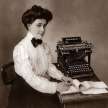
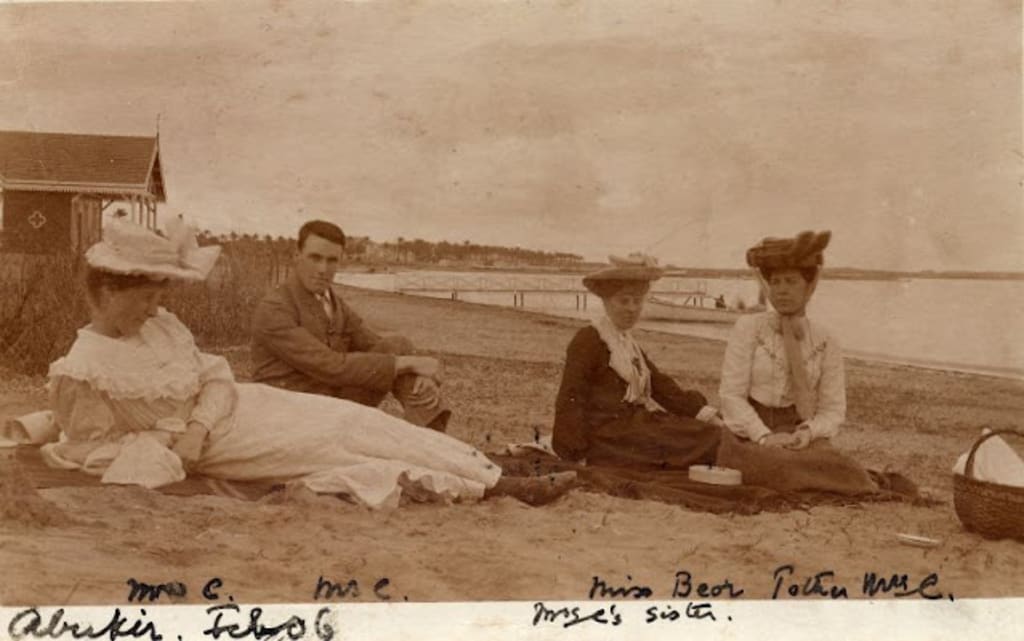
Daily Life is the fourth chapter in the book Lost Voices of the Edwardians by Max Arthur.
Daily life in the Edwardian Era, in one way, wasn’t that much different to our lives today. They would go to work or school, cook, eat, drink, and have a roof over their heads. The main difference was how they did this and at what ages, and they wore very different clothes.
For example, the chimney sweep was a busy man because there were only open fires but he used very young children, some as young as five, to go up and clean the chimneys. There were some terrible accidents. The hay-man always made sure that there was enough hay for the horses. The horse and cart was the only transport but when the car took over, this job was no longer needed. There were also the domestic servants. Many young girls left school and became a maid, some as young as ten, because that was what girls did. All of the upper-classes had a team of staff, maids, cooks, butlers, etc, etc. Today, very few use domestic staff. Today we have a whole ‘world’ of technology and the appropriate jobs to go with it, but back then, the typewriter was being invented along with the telephone, there was hardly any ‘tech’.
So we see the difference in jobs and what a person does affects their home, both financially and physically. There was the “Class System” in the Edwardian Era. If you were ‘rich’, you lived a comfortable life, with a nice big home, nice food, nice clothes and plenty of servants to ‘look after you’. If you were middle-class, you had to work hard but you still had a ‘comfortable’ life. If you were lower-class or poor, you lived day by day and ‘just did your best’, and life was not comfortable.
Today, we do not have this “Class-System”, and most people live on a certain level of ‘comfort’. The poor and homeless are still with us but there is a lot more help today than there ever has been.
Again, let’s read these very real-life experiences of daily life by some of the Edwardians themselves:
Lady Charlotte Bonham Carter: “During the London season, there were many people around. It was very jolly indeed. The Times had a list of the balls, starting with the last week of April right to the end of the third week in July, and there were a minimum of four balls every night — six balls possibly. My mother took a house in Eton Square and held a ball for me in 1912. We got a good list of the young men who were available and a list of young ladies who we asked to be accompanied by their mother. The invitation read ‘Mrs and Miss So-and-So’ and sometimes the father could be dragged along as well. Fathers were often awkward about this but they could be very useful because they could take a lady into supper. Supper had to be taken downstairs unless it was a very grand house like Surrey House. Supper generally began at twelve and might consist of a clear soup, quails with white grapes and potatoes. It was a light but really delicious meal and you could take it whenever you liked. While the ball was in progress, the mothers sat round. There were lovely chairs all round the walls of the dance room. Of course, the really lovely place to have a ball was the Ritz. The really well-to-do people gave a ball at the Ritz — it was perfectly beautiful. I think there was a ball at the Ritz every evening from Monday to Friday during the Summer season.”
Clearly, the upper-classes enjoyed their ‘parties’ — a little different to today (2025) but the sight must have been beautiful, especially with the ball-gowns that were worn but I’m not sure they were very comfortable.
Mary Keen: “There were large Victorian houses near where I lived and they used to have grand parties and balls there. We used to go round and watch people going in and coming out. The women were beautifully gowned in evening dress. The ground floor was one large room and they had red carpet laid down and when the carriages arrived, footmen would jump down, open the door, help the ladies out and hold their trains as they walked up the stairs. You would hear a little band playing and they had the windows wide open. We used to cross over to where we could see them dancing all around. It made me want to dance, seeing them like that.”
This young woman was clearly not from the upper-class but would watch ‘her superior sisters’ as they had their balls. We cannot imagine doing this these days, but on a lighter note, it was possibly their ‘tv’ and a way of spending the evening.
Mr F Davies: “We used to go up to Mayfair. That, of course, was where the money was. Sometimes you’d see the street completely covered with straw about a foot deep. That meant that somebody in the house was extremely ill. Once it was someone on the west side of Grosvenor Square, in the house where the American Embassy is now. We’d gone there because we wanted to look at the kilted footmen who worked for the Sunderland families on the corner of Grosvenor Street and South Audley Square. We loved how the wealthy dressed. You could see your face in the men’s shoes. The ladies with their long skirts scraping the ground and their dresses shaped to the waist with the sleeves puffed up. Huge hats with feathers and flowers. Any dress cut lower than the throat line was considered very daring. In the evenings, ladies sometimes wore a plunging neckline but this was to show off their jewels. In the evening, the gentleman wore his evening suit, tails, waistcoat, stiff shirt and gold watch chain right across his tummy.”
The clothes sound fantastic but expensive and clearly only for the wealthy. Again, how comfortable were they though?
Albert ‘Smiler’ Marshall: “I grew up in Elmstead Market in Essex and I remember village life very clearly. There was Mrs Page, who sold sweets, biscuits and cigarettes. A strip of liquorice cost a farthing, a bottle of ginger beer a penny. There was a glass marble at the top of the bottle which was much prized as marbles were at a premium. The Watkins sold bacon, dripping and cheese — large round cheeses. Six carriers took the produce to Colchester — a distance of four miles. Mrs Pentney sold haberdashery, women’s overalls, children’s dresses, stockings — and also tins of bully beef and condensed milk and cake by the half pound. It was here that my future wife was to work. The bakery was run by two spinsters who baked every day, starting at four a.m. Three pony carts delivered bread to outlying farms. Milk from the farms was collected in milk cans — a penny for a pint of skimmed, or for a ha’penny, a pint of new milk. Water was obtained from the village pump, which really belonged to the village pub — The Bowling Green — where you could get beer directly from the barrel for tuppence a pint. The blacksmith played an important part in the village, making metal hoops for the wagon-wheels, shoeing all the horses and repairing anything. Most of the villagers worked on the land — the village policeman went on rabbiting and pigeon-shooting — the pigeons were shared in the village.”
This sounds very much like something out of a story book but in fact, it was a very real experience — life was really like that back then!
Margaret Jones: “Monday was wash-day when everything got washed, including our white cat, Peter. We had a wash-house with a sink and a cold water tap where you were supposed to do the washing. Mother had a table in the kitchen and on Mondays she scrubbed it until it was white.The broom handles were also scrubbed and stood out in the yard to dry. Finally, Peter got a bath in the last of the water, and then he was tied to the kitchen table leg so that he didn’t go out in the garden and mess about. We had a safe in the garden in which we kept the meat.”
We’ve got to remember that the washing was done ‘manually’ or ‘by-hand’. There were no washing machines like we have today, so it did take a full day to do all the washing, plus a few days for it to dry. I must admit, I felt a bit sorry for the cat (poor thing).
George Hewins: “The missus would send one of the older kiddies to the Co-Op with a pillowcase. She’d say to our Edie — she were no bigger’n than a bee’s knee: ‘Ere’s thruppence. Go to the Co-Op and say, “Could I have this filled, mister? And could I ‘ave some change?” She came back with an old brown loaf, a current loaf, lots o’ tops and bottoms of broken cottage loaves, stale cakes and a bag o’ broken biscuits.”
Little different from the M+S shops we have today.
Bessy Ruben: “We used to live in Rothschild Buildings in the East End of London. I remember a Mrs Morris living there. I was friendly with her children. She had seven of them. This Mrs Morris got on a chair to put a penny in the slot for her gas to go on, and she fell and broke her leg. She was taken to the London Hospital — but what should she do with her seven children? Well, it was no problem. All the neighbours collected around, and said they’d take it in turns each day — one would go in the mornings to give them their breakfast and see that they got off to school, and in the evening when the husband comes home, he’ll take a pot of whatever it was and they’ll all feed together. This went on until Mrs Morris came home. Now, on the day that she came home from hospital, the neighbours all around collected together and washed the children, made them all clean, and sat them up in a row. There was a baby there, tied to a chair with a towel so he couldn’t wriggle out. When her husband brought Mrs Morris home from the hospital, she was so overwhelmed by the party — they’d collected some cakes and things, and made it all look very nice — that she burst out crying. It was really wonderful to know that her family were being taken care of by her neighbours.”
How many of us know our neighbours or even know their names?
I wanted to finish on this experience because it was one in which ‘it was better back then’ because people were more aware of their neighbours and everyone was so much closer. Today, we are too busy in our own little worlds to even notice those who live around us, which is sad but understandable.
There are a lot more experiences to read but this article is long enough!
I do recommend reading them because it gives us a real insight into a very different world but quite an interesting one, especially if you are obsessed with the Edwardian Era (like myself!).
About the Creator
Ruth Elizabeth Stiff
History and knowledge, especially about the Earth, are my passions. I enjoy putting my thoughts to paper and I always try to encourage self-motivation and love for life. LIVE AND LOVE LIFE!
Keep reading
More stories from Ruth Elizabeth Stiff and writers in BookClub and other communities.
Rachel Reviews: Lakefront Wolves by Joseph Deegan
Meet Finn. He's an 18 year old kid who has potential. He's bright with great school scores and he's also an athlete, a footballer of some prowess. He has it all going for him, it would seem, and yet, he's determined to send what could be a well-planned, stable existence firmly off the rails. He drinks, he smokes, he takes drugs, he has violent tendencies and he's in danger of losing not only his mind but all that he holds dear.
By Rachel Deeming13 days ago in BookClub
Why Didn't Anyone Tell Us
Men, move along. This is not for you. This is for the women. I was forty-five when I began menopause. It is pretty young for that to be going on in a woman’s life, but I had undiagnosed PCOS, my entire life. Thank you to all the gynecologists I had seen my entire life. That in itself should encourage women to keep seeking second opinions, especially when you are not getting correct answers or any at all.
By Alexandra Grant4 days ago in Humans



Comments
There are no comments for this story
Be the first to respond and start the conversation.