
"Come Sweet Death..."
"The Men Who Loved the Dead" and Why My Personal Literature Remains Unread.

"Come sweet death, one last caress..." The Misfits
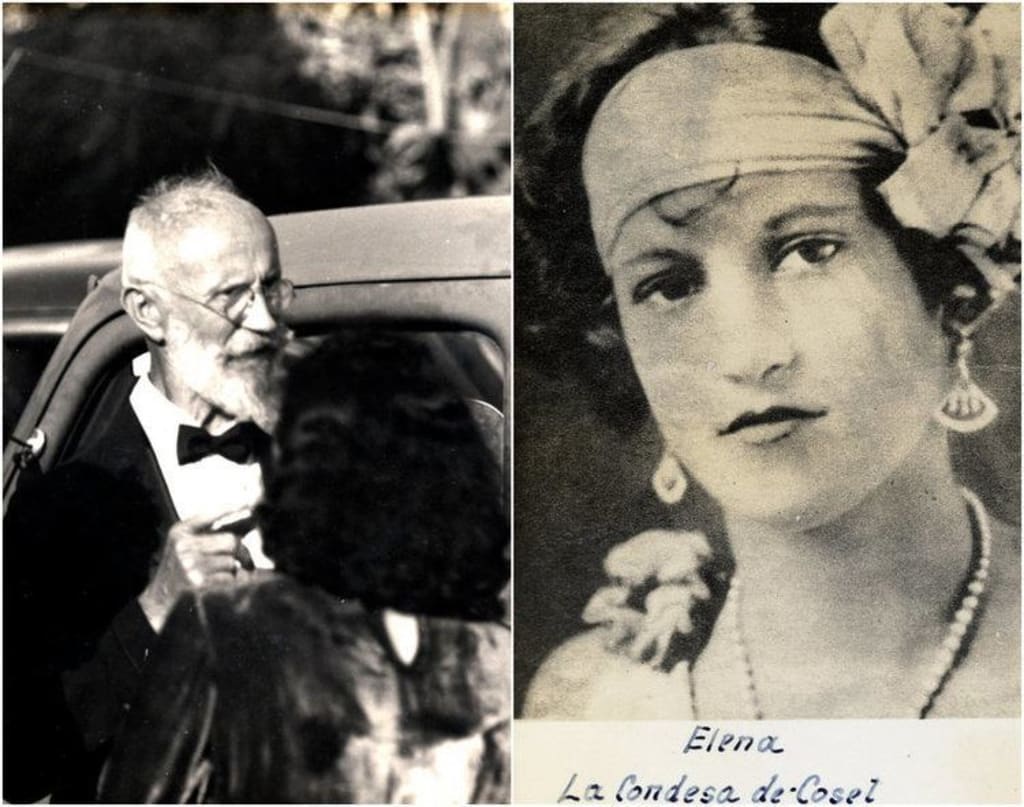
I've written two books on the subject of graverobbers and necrophiles. One from a fictional standpoint, but based on the very real case of Otto Carl Tanzler, a.k.a. "Count von Cosel," a man from the 1930s who robbed the tomb he constructed for the adored object of his infatuation, Cuban immigrant and tuberculoid Elena Milagro De Hoyos, who died in 1928 and who was a beautiful, tricky little thing that enraptured the weird old "Doctor" Count, who wrote in a later, largely fictionalized memoir about the various quack nostrums he used to try and preserve her fast-fading life. He didn't succeed, of course, but, in my novel, he manages, like Herbert West in then-contemporary author H.P. Lovecraft's famous story of the "Reanimator," to bring "His Darling Rose" back to life.
In reality, Otto Carl Tanzler, "The Count," stole the body of Elena Milagro de Hoyos and carefully, painstakingly preserved it with strips of cloth covered in paraffin wax, glass eyes, a wig, and plenty of perfume. He ravished the corpse, creating a false vagina out of a cardboard tube (oh my, I am allowed to talk about such things, am I not?), and when he was finally sussed out (living in a shack as a surfside vagrant) the "living doll" was in such a state that it looked like a giant porcelain horror. There are plenty of photos of it still in existence, for those who do a simple Google search.
Buried
My novel Buried, which I finished in 2007, very closely followed the life path of Dr. Count von Cosel Tanzler (or whatever the hell you want to call him), but simply fictionalized Elena ("Rose") in the novel, as a vampiric, reanimated corpse that had to suck the brutal, bloody sustenance of living victims. Love, devotion, and death; the ultimate triumvirate of existence; the trifecta of the "Hellbound Heart," as Clive Barker termed it.
We are all Hellbound hearts; all of us give our love and devotion to dead and dying things, mere illusions that torment us. What we think we feel and crave is our True Desire. But some of us are madmen, and we want what has already been taken from us.
It was a few years ago when The Count began to obsess me, after the suicide of a young friend, that I began what I consider to be my one supreme victory to wrestle from my mind an actual, honest-to-God piece of literature, in the form of a small monograph called The Men Who Loved the Dead, which was begun in 2015, and not completed until 2019 or thereabouts.
I have always loved strange, bold, mysterious tomes, books that seemed like they flew here on worm-eaten wings from some other, alternate dimension. Might is Right by Ragnar Redbeard (Arthur Desmond) is one such book; so is Apocalypse Culture by Adam Parfrey (editor). Death Scenes by Sean Tejaratchi, The Circus of Dr. Lao, The Torture Garden, Can Such Things Be?, and the very bizarre book of "Angel Poems" I once found in the children's reading room at Fort Clayton in Panama, Central America back in the 1980s. Many of the eerily disguised poems from this book were subtly blasphemous, and I remember the line, following a sort of textual handwringing over atomic bombs, war, poverty, and the like, that declared, "Lord we thank you on our knees, that we were born in times like these..."
All of these books leave the reader with a haunted feeling. He or She may feel shocked, disgusted, titillated, annoyed...but the Reader will not remain unaffected. (Still, another such book is Words for Elephant Man, a cycle of poetry for Joseph Carey Merrick by Kenneth Sherman. Also, Very Special People by Frederick Drimmer. Lastly, who could forget The King in Yellow by Robert W. Chambers? I love troubling, mysterious literature.)
The Sandman by Neil Gaiman, a comic series I'm a huge fan of, has a vast "library of dreams" within its pages, one that collects the billions and billions of "dream books" never actually written. My dream books I've fought to bring to life. However, once brought into the world they remain unloved, orphaned children; lost, lonely, forgotten things, collecting dust and dreams; little cul-de-sacs some may discover accidentally.
The Men Who Loved the Dead is about graverobbers, necrophiles, Sergeant Bertrand, Henri Blot, Karen Greenlee, Joan of Castile, and Herod Out-Heroding Herod, har-har. It is of course about my beloved Count, and "Victor of the Heavenly Eyes," a.k.a, Victor Ardisson, the "Vampire of Muy," a small plump French wastrel and psychopath with the most beatific gaze. It is about all of them, and none of them, and myself, and the Angel of Death, and the Angel of Deceit that the Good Doctor Anton LaVey was said to be camped in the "souls of the Righteous." "The eternal flame of Strength Through Joy dwelleth within the flesh of the Satanist!" Cue rainstorms, thunderclaps, menacing laughter, and "Yankee Rose."
I tried to examine death through the lens of erotic obsession, pointedly gazing at Marilyn, James Dean, Eva Peron, and the anonymous little necrophile (was he real or was he my literary invention? I can't quite remember) who spoke of his desire to fall through the carcass of an elephant into some eternal space, some crepitant alien womb or maw of death, wherein he might gestate and become a New Creature. Bully for him. He tried to commit incest with his sister but was afraid her vagina would grow teeth.
I feel Victor Ardisson down inside my bones. The ugly boy who licked piss from the lavatory seats at school seemed like the harmless butt of jokes. Inside, his Heavenly Eyes betrayed a psychopath's menace, a man sending and receiving messages from the dead, a man that expected the severed heads of the corpses he collected to speak to him; to reciprocate his tormented love for them, as he lined them up in a row, called them "sweetie." Victor was a Man Outside, a mystic or medium of tombs, a necromancer; not a killer. Not a Ted Bundy, who was also a necrophile, but not, perhaps in the same way or with the same motivation as the others here; these others who seemed to be determined to open the gateway, to use the body as a means of summoning forth the spirit of Azrael (as the late necromancer Leilah Wendell would call it), as a portal to another realm, to Fantasy and Dream of a very dark, dark place.
In my literature, I have explored death and the nature of reality frequently. For me, it is the "Little Men," the lost, lonely, forgotten, and broken souls who do dream, and who die, each day, as the sunlight of the infernal world peeps below the curtain. We resonate together, the Lost Souls and Broken Dreamers, the 'Men Who Loved the Dead."
Would you, could you read it? It would be my only way of reaching out to you, with a cold kiss, a loveless embrace, and the stiff, unyielding fingers of a cadaver.
Here in my place, I am in a womb, waiting. Whitley Strieber thought his putative "alien visitors" were, at first, "our dead, come back to us." (Not an exact quote.)
Since beginning the book, I have been in the presence of a dying man, and been with him when he has breathed his last. I have felt the bony rattle of the Reaper's knuckles on my door; yet, that doorway has never been opened, in spite of what an EMT once told me as I was riding the back of an ambulance to a hospital, wondering if it was going to be my last night on earth. Taping electrodes for a defibrillator to my chest as we drove with the sirens on, she looked into my face and said:
"I'm getting ready for you."
She might have been the Angel at the Gate. She might have been the last human face I ever saw that night if things had gone a bit differently. But each and everyone shuffles off this mortal coil, and none of it matters in the end.
My own author's statement would include something along the lines of: I tried to point a lens at what we hope to preserve in our illusion of life, in the panacea of our ritualization of the death process. Why the cerements of a cold, loveless tomb is the womb for our eternal longings, our fixation on the cult of celebrity and sexuality interspersed with our morbid fear of the existential despair one inevitably feels when confronted with the Void; with the unthinkable yet undeniable fact of the dissolution of ALL WE ARE. Forever. And so we invent religion, the Cult of the Dead; the putative eternal seat of consciousness, a Supreme Being to validate our insufferable egos. The book is an essay. But it is poetry, too.
I'll leave you with this.
The body is a sacred vessel, the putrefying gateway to the kingdom of death. In its dissolution and decay can be seen a microcosm of all the mysteries of creation, of the beginning and end of TIME, of the unwinding of the Eternal Clock, of the otherwise inscrutable Will and logic of God. Jonah festered in the belly of a whale; a madman once expressed the desire to fall through space and time by entering the mutilated carcass of an elephant. It’s all the same; the flesh is a portal to a forbidden world, a starting point, divided from spirit but inextricably bound over to it, as a prison, a cocoon of the conscious self-awareness of man.
C. Augustine, The Men Who Loved the Dead
And a bit of this:
“I kissed her once, then again, then again.”
Anatoly Moskovin, as a young boy, was forced to marry a corpse. Or so he claims.
A grieving Russian funeral procession passed the boy on the road. The men quickly dragged the frightened boy over to the opened coffin, in which lay the beautiful but deceased body of Natasha Petrova.
"Kiss her!" the men commanded.
Reluctantly, his fear mixing with fascination, he bent to do so. "Oh, my poor dear! You shall be wed to her in death, though she could not be your wife while alive!"
This was said by a grieving old woman Anatoly took to be his mother. Coming forward, she thrust a ring upon Anatoly's finger. And then, she placed the other ring, a cheap, brass thing to be sure, on the dead finger of Natasha Petrova.
Hence, he was married now to the dead girl.
On his lips, he could taste the ashen hue of her slowly rotting flesh, and feel the icy rubber of her lips. He could taste death on his tongue, feel himself grow hot and excited--but, it was a perplexing feeling.
Death fucked you and robbed you in equal measure. It held out the electrifying promise of a New Reality, and slammed you, then, against the wall of a dark tomorrow. And how to defeat Him, finally?
Anatoly grew to believe in magick, madness, and the mystery of le morte.
Dear Reader, we have not penned this tome to, exhaustively, track down every psychopath with a "taste for corpses." Nor is it simply an exercise in morbid titillation or ghoulish horror; no.
We have penned it to understand. To know. To rehearse our mortality through the prismatic lens of sepulchral minds, those who swam in the churning, brackish waters of dripping decay--for those who held on, when they should have let go. For the outsiders, the Little Men, who could only form attachments to an inert mass of tissue they could imbue with a new, hideous half-life.
To those who heard the siren wail, and closed their eyes to "lie down with death," their bride.
To the misfits and the lurking shadows, the human ghosts; the maniacs, seers, flotsam and jetsam, fleshly mediums; and, well, to...the "Men Who Loved the Dead."
This book is for all of us, on our way.
In Pace Requiscat.
Note.
The book is only available as an ebook. I have left it lie fallow since losing my first POD publishing platform, and have been loath to reupload it out of fear it is too controversial due to the subject matter. It can be downloaded below for those who care to read it. It's a pity it has not had more readers. it is an intensely personal book, and perhaps that is why so few find so much of what I write accessible. Very well. A few will, and that is sufficient. But, even if no one did, I would still produce what I know, inside myself, I was meant to produce.
Best regards.
Tom B.
"The Men Who Loved the Dead" Internet Archive.
About the Creator
Tom Baker
Author of Haunted Indianapolis, Indiana Ghost Folklore, Midwest Maniacs, Midwest UFOs and Beyond, Scary Urban Legends, 50 Famous Fables and Folk Tales, and Notorious Crimes of the Upper Midwest.: http://tombakerbooks.weebly.com
Reader insights
Nice work
Very well written. Keep up the good work!
Top insight
Expert insights and opinions
Arguments were carefully researched and presented
Rachel Reviews: Lakefront Wolves by Joseph Deegan
Meet Finn. He's an 18 year old kid who has potential. He's bright with great school scores and he's also an athlete, a footballer of some prowess. He has it all going for him, it would seem, and yet, he's determined to send what could be a well-planned, stable existence firmly off the rails. He drinks, he smokes, he takes drugs, he has violent tendencies and he's in danger of losing not only his mind but all that he holds dear.
By Rachel Deeming9 days ago in BookClub
7 Amazing Books to Read When You're Feeling Lazy
We all have those moments when life feels slow, energy is low, and the idea of tackling dense, heavy books feels impossible. Yet, even on our laziest days, reading can still be one of the most rewarding ways to spend time. The trick lies in choosing the right books—stories that are engaging without being exhausting, inspiring without being overwhelming, and comforting without feeling trivial.
By Diana Merescabout 5 hours ago in BookClub
The Politics of Playing Dress-Up
Well, to start off I'd like to say a happy world book day to all who celebrate. I know I haven't really posted anything on my socials about it but I'm not a jubilant kind of person. I lay low most of the time. Let's start off with a popular anecdote from the vaults...
By Annie Kapur5 days ago in Geeks


Comments (4)
Thank you for sharing this journey with us, more for my reading list
As you might have expected, I have read this & am now downloading the PDF of "The Men Who Loved the Dead". I don't know when I'll get around to reading it, but I do intend to do so. Be well, my friend, as well as can be.
I've heard about Carl but am not very familiar with him. Pretty gruesome what he did. I cannot imagine what goes wrong in someone's head that actions like this become okay.
Oh my, that is one weird yet fascinating read.