
Book: Thinking, Fast and Slow
Discusses decision-making under risk and uncertainty

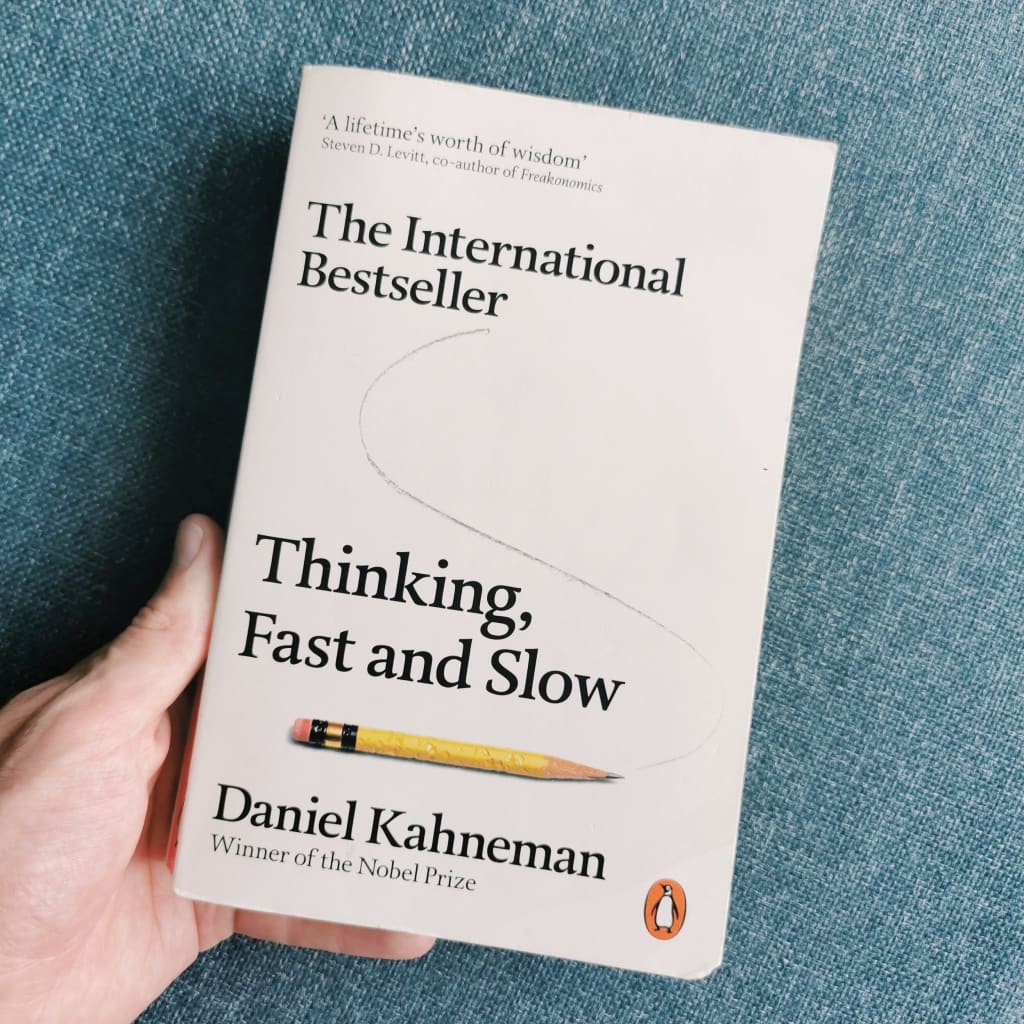
Thinking, Fast and Slow by Daniel Kahneman is a groundbreaking exploration of how the human mind processes decisions and judgments. Published in 2011, the book delves into the dual-process theory of cognition, introducing two modes of thinking: System 1 (fast, intuitive, and automatic) and System 2 (slow, deliberate, and analytical). Kahneman, a Nobel Prize-winning psychologist, draws on decades of research to reveal how these systems shape our perceptions, choices, and biases, often leading to errors in reasoning. The book combines insights from psychology, behavioral economics, and cognitive science to explain why humans make irrational decisions and how we can improve our thinking.
The book is structured into five parts, each addressing different aspects of human cognition:
Two Systems: Introduces System 1 and System 2 and their interplay.
Heuristics and Biases: Explores cognitive shortcuts and their pitfalls.
Overconfidence: Examines how overconfidence distorts judgments.
Choices: Analyzes decision-making under risk and uncertainty.
Two Selves: Discusses the conflict between our experiencing and remembering selves.
Kahneman’s work challenges the traditional economic assumption that humans are rational actors, showing instead that our decisions are often influenced by unconscious biases, emotions, and flawed heuristics.
Summary
In Thinking, Fast and Slow, Kahneman explains that System 1 operates quickly, relying on intuition, emotions, and learned associations. It allows us to make snap judgments, like recognizing a friend’s face or swerving to avoid an obstacle. However, System 1 is prone to errors, such as stereotyping or overreacting to recent events. System 2, in contrast, is effortful and logical, used for complex tasks like solving math problems or planning a trip. Because System 2 requires energy and attention, we often default to System 1, leading to systematic biases.
The book highlights several cognitive biases and heuristics:
Availability Heuristic: People judge the likelihood of events based on how easily examples come to mind (e.g., overestimating plane crash risks after news coverage).
Anchoring Effect: Initial information influences subsequent judgments (e.g., a high price tag makes a lower price seem reasonable).
Framing Effect: The way information is presented affects decisions (e.g., 90% success vs. 10% failure rate of a surgery).
Prospect Theory: Kahneman’s Nobel Prize-winning contribution, showing that people value losses more than equivalent gains (loss aversion) and take risks to avoid losses but are risk-averse for gains.
Kahneman also explores overconfidence, where people overestimate their knowledge or control over outcomes, and the illusion of validity, where we trust flawed judgments. In the section on choices, he discusses how people struggle with statistical reasoning and misjudge probabilities, often leading to poor financial or life decisions. The final part introduces the concept of two selves: the experiencing self (focused on moment-to-moment feelings) and the remembering self (focused on memories). This distinction explains why we might choose experiences that feel good in retrospect, even if they were painful at the time.
The book concludes with practical implications, urging readers to recognize their cognitive limitations, question intuitive judgments, and engage System 2 for important decisions. It’s a call to think more critically in a world where biases are inevitable.
Key Points
Dual Systems: System 1 is fast, intuitive, and prone to biases; System 2 is slow, logical, and effortful.
ognitive Biases: Heuristics like availability, anchoring, and framing lead to systematic errors in judgmen
Prospect Theory: People are loss-averse, valuing losses more than equivalent gains, impacting risk-taking behavior.
Overconfidence: We overestimate our knowledge and abilities, leading to flawed decisions.
Two Selves: The experiencing self and remembering self create discrepancies in how we evaluate happiness and life choices.
Practical Applications: Awareness of biases can improve decision-making in personal, professional, and policy contexts.
About the Author
Daniel Kahneman is an Israeli-American psychologist and economist, born in 1934 in Tel Aviv. He is renowned for his pioneering work in behavioral economics, particularly his development of prospect theory with Amos Tversky. Kahneman won the Nobel Memorial Prize in Economic Sciences in 2002 for integrating psychological insights into economic theory. He is a professor emeritus at Princeton University and has authored numerous influential papers. Thinking, Fast and Slow is his first book aimed at a general audience, distilling his decades of research into an accessible format. Kahneman’s work has profoundly influenced psychology, economics, and public policy.
Conclusion
Thinking, Fast and Slow is a seminal work that unveils the complexities of human thought. By dissecting the interplay between System 1 and System 2, Kahneman provides a framework to understand why we make decisions that often defy logic. The book’s insights are invaluable for anyone seeking to navigate life’s choices more wisely, from personal decisions to professional strategies. Its engaging style, backed by rigorous research, makes it a must-read for those interested in psychology, decision-making, or human behavior.
About the Creator
Am@n Khan
I'm educational storyteller passionate about turning knowledge into engaging narratives.
I write about topics like science, history and life skills.
Contact
WhatsApp : +923336369634
Rachel Reviews: Lakefront Wolves by Joseph Deegan
Meet Finn. He's an 18 year old kid who has potential. He's bright with great school scores and he's also an athlete, a footballer of some prowess. He has it all going for him, it would seem, and yet, he's determined to send what could be a well-planned, stable existence firmly off the rails. He drinks, he smokes, he takes drugs, he has violent tendencies and he's in danger of losing not only his mind but all that he holds dear.
By Rachel Deeming6 days ago in BookClub
Review of 'Man on the Run'
My wife and I saw Man on the Run, a nearly 2-hour documentary on Amazon Prime, about Wings, Paul McCartney's group that flew around the world from shortly after The Beatles broke up in early 1970 to shortly after John Lennon was murdered at the end of 1980, making a Beatles reunion forever impossible.
By Paul Levinson6 days ago in Beat


Comments (1)
This is the Best book Thinking Fast and Slow learn this Book