
Book review: Ulysses by James Joyce
Ulysses is a modernist novel by the Irish writer James Joyce. Partially serialised in the American journal The Little Review from March 1918 to December 1920, the entire work was published in Paris by Sylvia Beach on 2 February 1922, Joyce's fortieth birthday.

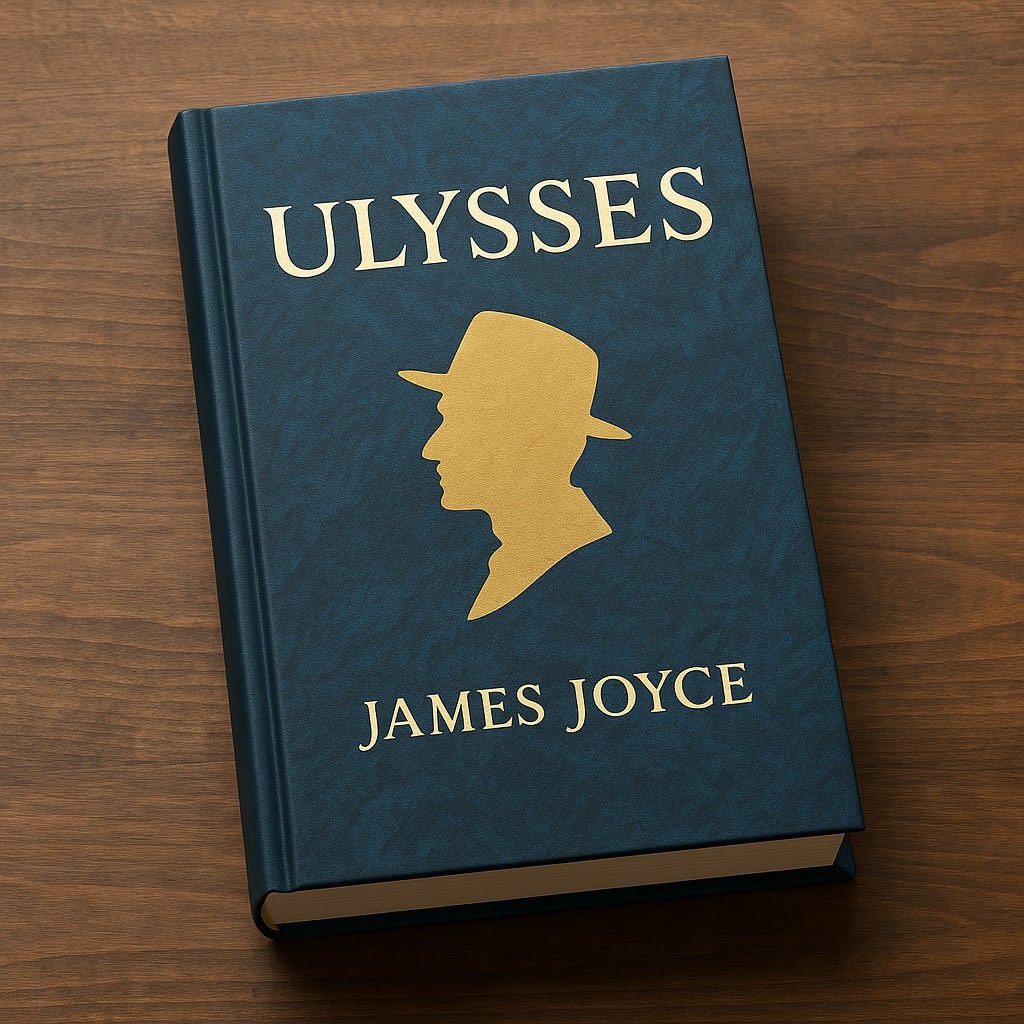
Reading Ulysses by James Joyce is not so much engaging with a novel as it is stepping into a vast, breathing organism of language and consciousness. It is one of those books that demands complete surrender—not only of your attention but of your expectations of what a novel should be. When I first approached it, I knew I was about to embark on something monumental, but nothing quite prepared me for the intellectual rigor, emotional complexity, and linguistic beauty it contained. It is not a casual read, nor is it conventionally entertaining, but it is a deeply transformative literary experience.
Ulysses, written by Irish author James Joyce and first published in its entirety in 1922, is widely regarded as one of the most important and challenging works of modernist literature. The novel belongs to a unique genre that combines stream-of-consciousness writing, mythological parallel, and experimental form. It is, at its core, an exploration of human consciousness and language, a book best suited for readers who not only enjoy a challenge but seek to be changed by literature. It draws upon Homer’s Odyssey as its structural and symbolic foundation, but transposes that epic narrative onto the events of a single day—June 16, 1904—in the city of Dublin.
The plot, to the extent that one can summarize it, follows three main characters over the course of this day: Stephen Dedalus, a young, intellectually ambitious teacher; Leopold Bloom, a middle-aged Jewish advertising agent; and Molly Bloom, Leopold’s wife. Stephen, a carryover from Joyce’s earlier novel A Portrait of the Artist as a Young Man, is wrestling with questions of identity, faith, and art. Bloom, by contrast, is an everyman whose concerns are more domestic, but no less profound. He navigates the streets of Dublin, haunted by the death of his son, estranged from his wife, and acutely aware of his outsider status. The novel moves through their separate trajectories, eventually bringing them together, and ends with Molly’s famous soliloquy. The narrative’s structure echoes the episodes of Homer’s Odyssey, though Joyce’s use of this framework is more thematic than literal.
What stands out immediately in Ulysses is the language—its fluidity, density, and experimentation. Joyce uses stream-of-consciousness technique not as a stylistic gimmick, but as a way to collapse the boundaries between thought and language, between perception and narration. Each chapter adopts a distinct style and tone, ranging from newspaper headlines to catechism-like Q&A, from interior monologue to theatrical script. The effect is disorienting, exhilarating, and at times deeply frustrating. There is no hand-holding here; the reader must piece together meaning from fragments, echoes, and allusions. But the reward is immense. Once you adjust to the rhythm and give in to its logic, the book becomes a symphony of voices, a celebration of the mundane rendered mythic.
Structurally, Ulysses is audacious. It is divided into eighteen episodes, each of which not only corresponds to a part of the Odyssey but also experiments with a different literary form or technique. The novel plays with time and space, often collapsing both as it delves into the minds of its characters. The narrative is not driven by plot but by consciousness itself—memories, sensations, digressions, repetitions, and contradictions. This structure allows Joyce to explore not just the external world of Dublin but the internal labyrinths of thought and feeling that define human experience. The book is as much about how we think as it is about what we think.
Thematically, Ulysses is inexhaustible. It tackles identity, nationality, religion, sexuality, mortality, and the search for meaning in an indifferent world. It is intensely local—its references to Dublin are encyclopedic—but also universal. Bloom’s wandering through the city becomes an epic journey of selfhood, compassion, and understanding. His kindness, curiosity, and melancholy make him one of the most human characters I’ve ever encountered in fiction. Stephen’s brooding intellectualism and Molly’s sensual directness offer contrasting, equally compelling perspectives. Together, they form a kind of trinity that mirrors the mind, body, and soul.
What impressed me most was Joyce’s ability to find the sublime in the ordinary. A man buying soap, a funeral procession, a conversation in a pub—all become occasions for existential reflection, poetic reverie, or stylistic fireworks. There is humor here too—often bawdy, sometimes absurd—but it coexists with deep sorrow and yearning. The novel’s emotional range is staggering. It moves from philosophical abstraction to raw physicality, from lyricism to vulgarity, without ever losing its internal coherence.
That said, Ulysses is not without its challenges. Its density, its opacity, and its lack of a conventional narrative arc make it inaccessible to many. There are moments of genuine tedium, where the experimentation becomes exhausting rather than enlightening. The novel also demands a familiarity with classical literature, Irish history, Catholic theology, and dozens of other disciplines that not every reader will possess. But to approach Ulysses as something to be decoded is to miss the point. It is a book to be lived in, puzzled over, reread, and re-experienced. The confusion is part of the journey, the meaning often emergent rather than imposed.
Personally, I found the novel to be deeply moving. Bloom’s gentleness, his quiet resilience in the face of loss and alienation, stayed with me long after I closed the book. Stephen’s inner turmoil, his yearning to create something lasting, mirrored so many of my own intellectual struggles. And Molly’s final soliloquy—earthy, sensuous, defiant—was one of the most intimate and powerful pieces of writing I’ve ever read. Ulysses is not about heroes in the traditional sense. It is about flawed, ordinary people trying to make sense of a world that resists understanding. In that, it is as modern and relevant as any book written today.
Ulysses is a towering achievement in literature, one that defies easy categorization or summary. It is a novel that challenges, provokes, delights, and transforms. I would not recommend it to everyone—it requires patience, openness, and a willingness to be confused. But for those who are willing to take the plunge, it offers an unparalleled literary experience. My final verdict: a work of genius that expands the boundaries of what fiction can do, and a book that, for all its difficulty, is ultimately about the beauty and complexity of being alive.
This book review was written using the following references 👇
About the Creator
Caleb Foster
Hi! My name is Caleb Foster, I’m 29, and I live in Ashland, Oregon. I studied English at Southern Oregon University and now work as a freelance editor, reviewing books and editing texts for publishers.
Keep reading
More stories from Caleb Foster and writers in BookClub and other communities.
Book review: Treasure Island by Robert Louis Stevenson
There are books we read in childhood that never quite leave us, whose echoes remain long after the final chapter is closed. Treasure Island by Robert Louis Stevenson is one such book for me, a novel that first captured my imagination years ago and has since only deepened in richness with each revisit. Originally published in 1883, this adventure novel has long been considered a cornerstone of children's literature, but its lasting appeal extends far beyond youthful audiences. It is a tale of high seas, buried treasure, and dangerous alliances, and at its heart lies a profound meditation on morality, courage, and the ambiguity of human nature.
By Caleb Foster7 months ago in BookClub
My New Book is Finally Here
My poetry collection Beautiful and Brutal Things is done. It's actually done and finally published over 270 pages. Over a year of my life went into this book. More than a year, really. Long days at my computer, sometimes seven days a week because I couldn't stop even when I probably should have. Then two months of editing that felt harder than the writing itself. But it's finished, and I'm still standing, and the book is real.
By Tim Carmichael5 days ago in BookClub
Verses & Villainy: Where Crime Meets Rhyme
Welcome to The Chapter Cafe, where stories steep like strong coffee and conversation flows like ink on a page. In today’s episode, “Verses & Villainy: Where Crime Meets Rhyme,” we’re diving into the shadowy alleys of crime fiction and the lyrical landscapes of poetry.
By Kristen Barenthaler7 days ago in BookClub




Comments
There are no comments for this story
Be the first to respond and start the conversation.