
Book Review: The Algebra of Wealth
A quick review of the The Algebra of Wealth giving you a sample of what the book covers!
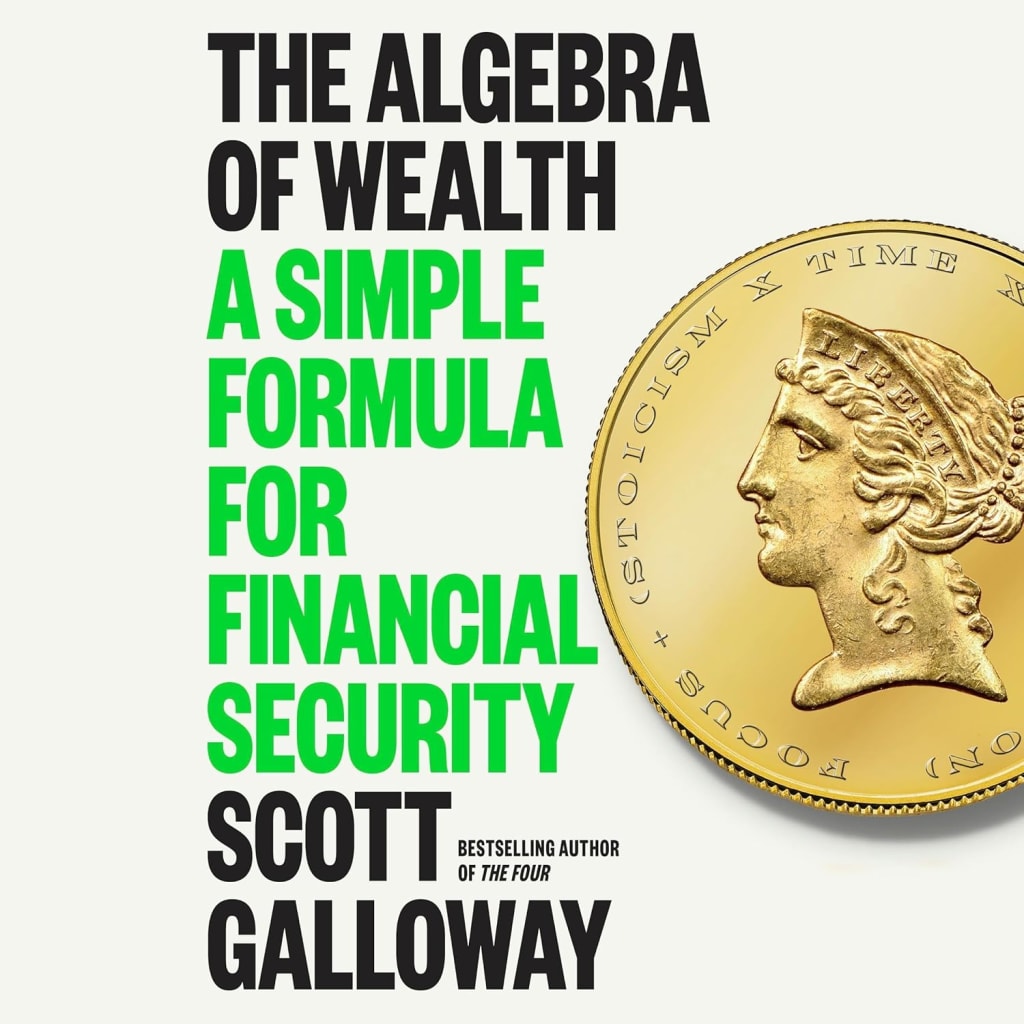
The Algebra of Wealth: by Scott Galloway is a pragmatic and insightful guide that seeks to help readers achieve financial security by understanding the core principles that drive wealth creation. As a professor at NYU and co-host of the popular Pivot podcast, Galloway leverages his academic background and entrepreneurial experience to break down the complexities of financial success into a digestible formula. His book is structured around key factors that influence financial outcomes, including risk-taking, entrepreneurship, and personal mindset. He provides clear strategies, illustrating how the right moves can lead to financial security, wealth growth, and ultimately, fulfillment.
This review provides an overview of the book, chapter by chapter, along with the key takeaways from each section.
Chapter 1: The Equation of Wealth
Galloway opens the book by introducing the central metaphor: wealth is akin to an algebraic equation that can be solved with the right variables. He explains that wealth is not merely the product of inheritance or luck but is built through a combination of skills, risk management, and calculated decisions. Galloway introduces his "algebra of wealth," a formula that emphasizes that wealth creation is achievable through consistent effort, smart investment, and understanding your relationship with risk.

Key concepts include:
Human Capital: Your skills, education, and experiences are a primary driver of your financial potential.
Risk: Effective wealth-building requires taking calculated risks.
Time: Wealth is often built over time through consistent effort and compounding growth.
Chapter 2: The Value of Education and Skills
In this chapter, Galloway highlights the importance of education, but he challenges the traditional view that a degree guarantees financial success. He points out that certain fields and industries offer greater returns on investment in terms of education, such as technology and business. Galloway emphasizes the need for individuals to develop skills that align with market demands, suggesting that continuous learning and adaptability are critical for long-term wealth.
Key takeaways:
Not all education is equal—some fields provide better financial returns.
Continuous skill development is essential in a rapidly changing world.
Seek opportunities that increase your value in the marketplace, both in terms of technical and soft skills.
Chapter 3: The Role of Risk in Wealth Creation
Galloway asserts that risk is an essential element of the wealth equation. However, he distinguishes between reckless risk and calculated risk. He advises readers to take risks that have the potential for high rewards, such as starting a business or investing in the stock market, but only after careful planning. He discusses the importance of understanding your risk tolerance and making sure that your actions align with your long-term financial goals.

Key points:
Understand and measure your risk tolerance.
Diversify your investments to spread risk.
Take calculated risks in entrepreneurship, investment, and career moves.
Chapter 4: Investing: The Power of Compounding
One of the most powerful tools for wealth creation, according to Galloway, is compounding. In this chapter, he delves into the mechanics of investing and the impact of compounding returns over time. He encourages readers to start investing early, pointing out that even small, consistent investments can grow significantly over decades. Galloway also explains the importance of understanding market cycles and not being swayed by short-term fluctuations.
Main ideas:
Start early: The earlier you begin investing, the more time compounding has to work in your favor.
Stay invested through market fluctuations.
Use tax-advantaged accounts like 401(k)s and IRAs to maximize returns.
Chapter 5: Entrepreneurship and Wealth
Entrepreneurship plays a significant role in Galloway's wealth equation. He argues that owning and growing a business can offer far greater financial rewards than working a conventional job. However, he is also realistic about the challenges and risks that come with entrepreneurship. Galloway outlines the traits of successful entrepreneurs, such as resilience, vision, and the ability to execute. He also emphasizes the importance of scalability in any business venture, as scalability increases the potential for higher returns.
Key lessons:
Entrepreneurship offers significant potential for wealth creation but comes with high risk.
Focus on scalable businesses to maximize profits.
Persistence and adaptability are key traits of successful entrepreneurs.
Chapter 6: The Wealthy Mindset
In this chapter, Galloway explores the psychology of wealth. He argues that mindset plays a crucial role in financial success. Wealthy individuals tend to have an abundance mindset—they believe that opportunities are abundant and that hard work and smart decisions will pay off. On the other hand, those with a scarcity mindset often view wealth as finite and see financial success as out of reach. Galloway encourages readers to adopt a mindset of abundance, focusing on the opportunities that lie ahead and the actions they can take to seize them.

Core principles:
Develop an abundance mindset, seeing opportunities rather than limitations.
Wealth is as much about attitude and approach as it is about money.
Avoid the trap of viewing wealth as a zero-sum game.
Chapter 7: The Role of Luck
While Galloway emphasizes the importance of skill, hard work, and calculated risk in wealth creation, he also acknowledges the role of luck. In this chapter, he discusses how timing, environment, and even randomness can impact financial outcomes. However, Galloway also points out that successful people often create their own luck by positioning themselves to take advantage of opportunities when they arise. This includes building networks, staying informed, and being ready to act when the right moment comes.
Key insights:
Luck plays a role in financial success, but you can increase your chances by being prepared.
Build relationships and networks that can open doors.
Stay informed and alert to new opportunities.
Chapter 8: Financial Security vs. Wealth
Here, Galloway draws a distinction between financial security and wealth. Financial security means having enough money to meet your needs without stress, while wealth goes beyond that to include the ability to live life on your own terms. Galloway encourages readers to prioritize financial security first by building an emergency fund, paying down debt, and making smart financial decisions. Only after securing your financial base should you focus on building wealth through riskier ventures.
Key takeaways:
Focus on financial security first before pursuing wealth.
Build an emergency fund and pay off high-interest debt.
Wealth allows you to have more freedom, but security should be your first goal.

Chapter 9: The Role of Generosity
In the final chapter, Galloway emphasizes the importance of giving back. He argues that wealth should not be an end in itself, but a means to create a positive impact on the world. Whether through charitable donations, mentoring others, or contributing to your community, Galloway encourages readers to use their wealth for good. He believes that generosity can enhance personal fulfillment and lead to a more meaningful life.
Main points:
Use your wealth to make a positive impact on others.
Giving back can lead to greater personal satisfaction and a sense of purpose.
True wealth includes not only financial success but also the ability to contribute to the greater good.
Conclusion:
The Algebra of Wealth offers a comprehensive yet accessible guide to achieving financial success. Scott Galloway's approach blends practical advice with deep insights into the psychology and mechanics of wealth-building. By breaking down the complex elements of financial security and wealth into manageable components, Galloway provides a clear path for readers to follow, regardless of their starting point. His book is a valuable resource for anyone looking to understand the key drivers of financial success and take control of their financial future.
**Affiliate Disclosure** Some of the links in this article are affiliate links, which means I may earn a commission if you click on the link or make a purchase using the link. This comes at no additional cost to you, and it helps support the content I create. I only recommend products or services I believe will add value to my audience.
About the Creator
Keep reading
More stories from William D Smith and writers in BookClub and other communities.
Book Review: The Total Money Makeover Updated and Expanded
Introduction: The Total Money Makeover: Updated and Expanded by Dave Ramsey is a straightforward and practical guide for individuals looking to take control of their financial lives. Ramsey, a well-known financial expert and radio host, presents a plan that emphasizes debt elimination, disciplined saving, and long-term wealth building. Unlike many financial books that delve into complex strategies, Ramsey’s approach is simple, actionable, and grounded in common sense. His method, known as the "Baby Steps," helps people transition from financial distress to financial peace by focusing on eliminating debt and building a strong financial foundation.
By William D Smithabout a year ago in BookClub
My New Book is Finally Here
My poetry collection Beautiful and Brutal Things is done. It's actually done and finally published over 270 pages. Over a year of my life went into this book. More than a year, really. Long days at my computer, sometimes seven days a week because I couldn't stop even when I probably should have. Then two months of editing that felt harder than the writing itself. But it's finished, and I'm still standing, and the book is real.
By Tim Carmichael6 days ago in BookClub




Comments
There are no comments for this story
Be the first to respond and start the conversation.