
Book Review on "The Limits to Growth"
They Knew in '72

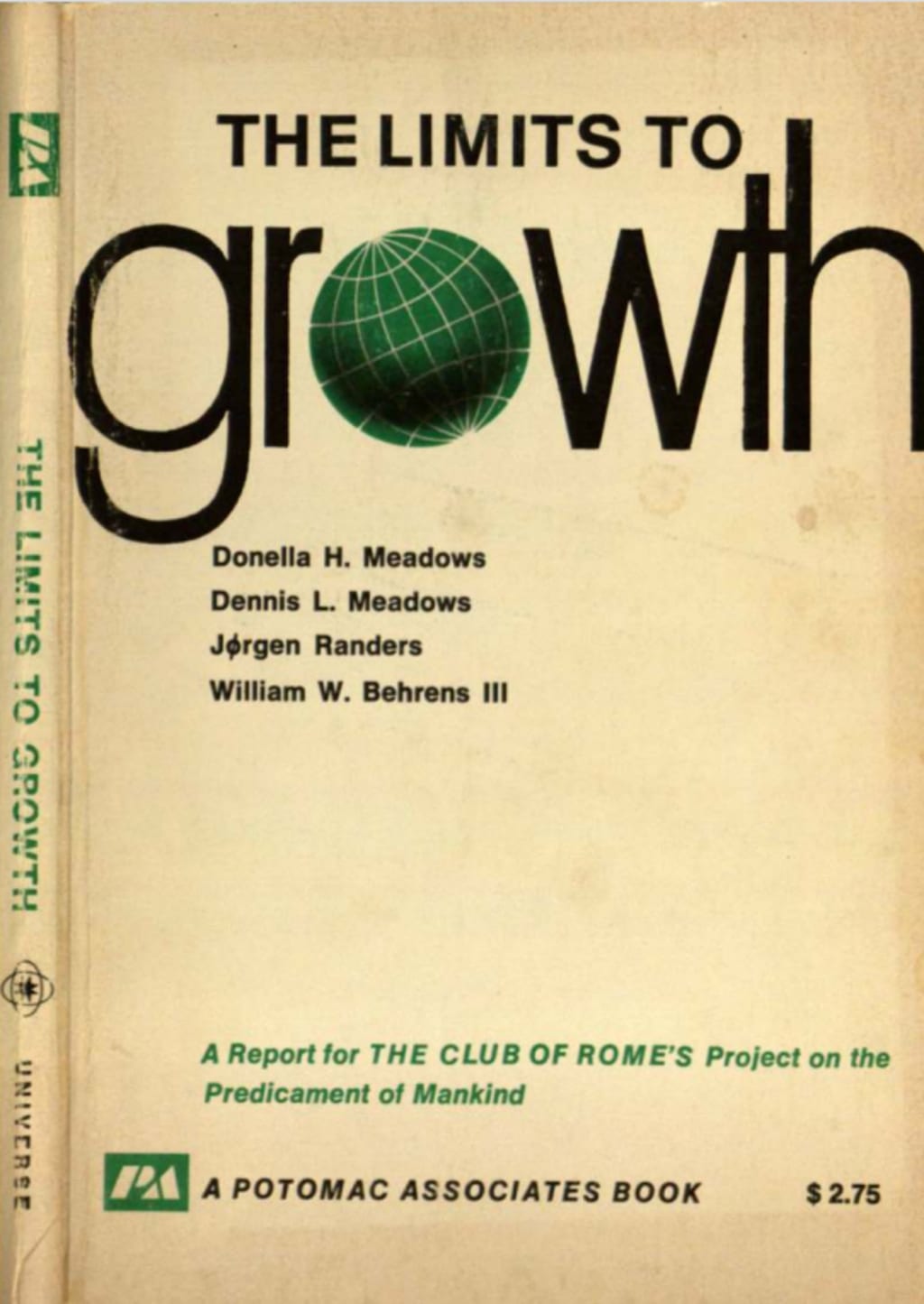
"The Limits to Growth" is a landmark publication released in 1972 by the Club of Rome, a global think tank of scientists, economists, and industrialists. Co authored by Donnella Meadows, Dennis Meadows, Jorgen Randers and William Bahrens III. This book is about 200 pages long.
Hailed as the “most successful econometric projection ever made”.

The Limits to Growth, a report commissioned by the Club of Rome, is one of the most influential books on environmental and sustainability issues. Based on a computer model called World3, it predicts the potential consequences of global economic growth given finite resources. The book's central message is that continuous economic and population growth cannot be sustained indefinitely due to limitations in the Earth's resources. Through its powerful analysis and warnings, The Limits to Growth provides a sobering examination of humanity’s growth trajectory.
This book was ground-breaking for its time and remains a key text in the field of environmental studies. It lays out the risks of over-exploitation of the planet's resources, providing a detailed yet accessible overview of how unchecked growth could lead to ecological and economic collapse. The work is not just a prediction of doom but a call for careful planning and sustainable practices.
The book is divided into several key sections, each focusing on a different aspect of global growth. The first chapters introduce the World3 model, explaining how factors such as population, industrial output, pollution, and resource depletion interact to shape global outcomes. It uses the model to explore a variety of potential scenarios for the future.

The authors argue that human civilization is on a path toward unsustainable growth unless we change our ways. They provide data-driven insights into trends in population, resource consumption, and environmental impact, all of which are interconnected in complex feedback loops. The book then transitions into discussing the long-term consequences of unchecked growth—ranging from environmental degradation to social and economic instability.
In my opionion one of the greatest strengths of The Limits to Growth is its ambitious, interdisciplinary approach. By combining economics, environmental science, and systems theory, it provides a holistic perspective on global issues. Every talking point and terminology in the book is thoroughly explained in good enough depth that even a layman can grasp the more complicated ideas that the authours present.

Overall, The Limits to Growth remains a landmark work in environmental thought, offering an insightful warning about the consequences of unchecked economic and population growth. Its strengths lie in its scope and the clarity with which it communicates complex issues.
This book is highly recommended for environmental scholars, policymakers, and anyone interested in understanding the foundational ideas behind sustainable development. It would also appeal to readers concerned about the long-term trajectory of human civilization and the global environment. its central message about the limits of unchecked global exponential growth and the need for a more sustainable future is as relevant today as it was in 1972.
About the Creator
Warriors vs Celtics (After 2022)
The Boston Celtics and Golden State Warriors met in the 2022 NBA finals culminating in 6 game victory in the Warriors’ favor. This wasn’t the first time these two teams played each other on the biggest stage but it was the most recent finals matchup between the two franchises.
By Y@#@Nabout a year ago in Unbalanced
My New Book is Finally Here
My poetry collection Beautiful and Brutal Things is done. It's actually done and finally published over 270 pages. Over a year of my life went into this book. More than a year, really. Long days at my computer, sometimes seven days a week because I couldn't stop even when I probably should have. Then two months of editing that felt harder than the writing itself. But it's finished, and I'm still standing, and the book is real.
By Tim Carmichael6 days ago in BookClub
7 Books That Mean Something Different Every Time You Read Them
In a world overflowing with information and fleeting stories, some books hold a rare power: they evolve with us. Books that mean something different every time you read them are not just stories—they are mirrors reflecting our changing perspectives, life experiences, and emotional states. Each reading can feel like discovering a new layer, a hidden message, or a fresh insight that resonated in a completely unexpected way.
By Diana Meresca day ago in BookClub




Comments
There are no comments for this story
Be the first to respond and start the conversation.