
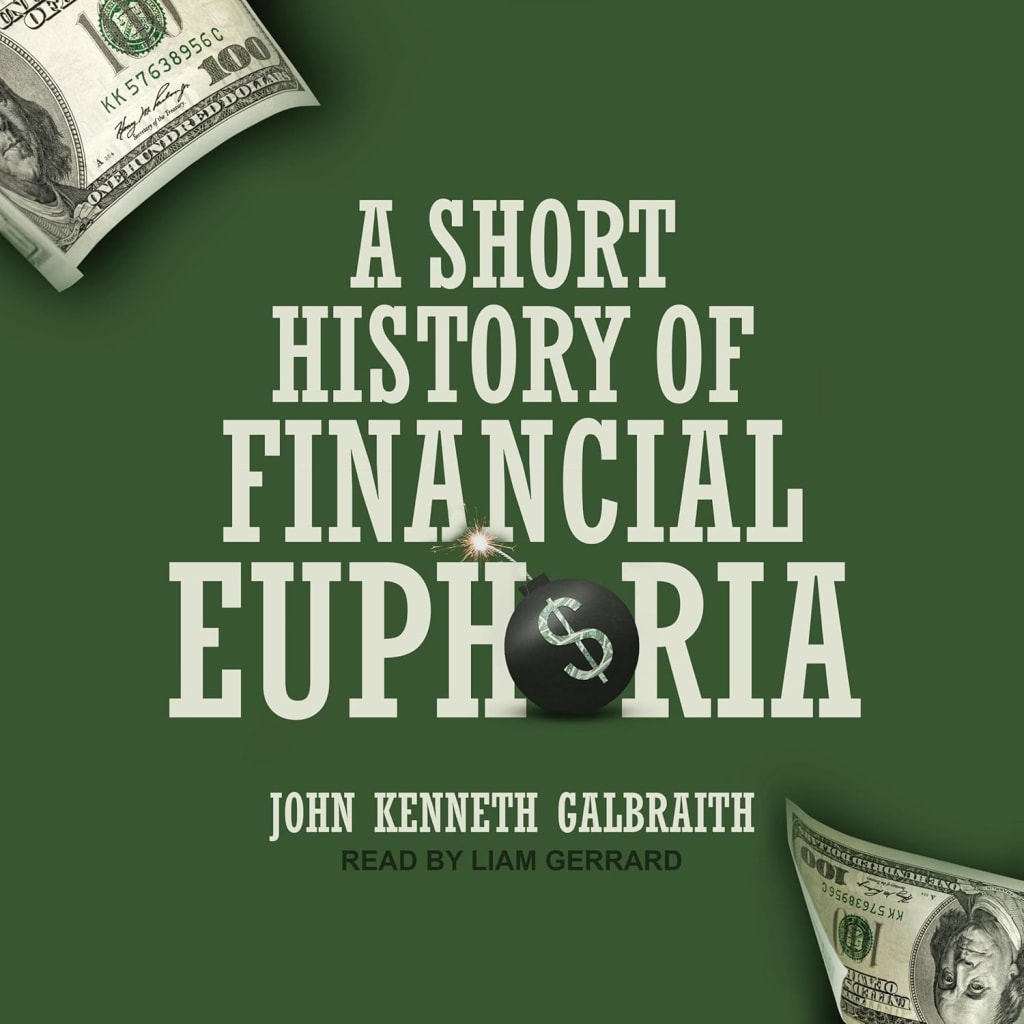
Book Review: A Short History of Financial Euphoria by John Kenneth Galbraith — Understanding the Psychology Behind Market Bubbles
The world-renowned economist reviews the great speculative episodes of the last three centuries, including the calamitous junk-bond follies of the 1980s, and shows how the lessons of history can help people avoid financial calamity.

Introduction
John Kenneth Galbraith’s A Short History of Financial Euphoria is a masterful exploration of one of the most captivating and perilous aspects of financial markets: speculative bubbles. First published in 1990, the book remains highly relevant today as it delves into the recurring patterns of euphoria, irrational exuberance, and eventual collapse that have characterized markets throughout history.
Galbraith, an esteemed economist and historian, uses vivid storytelling and incisive analysis to unravel the human emotions and social dynamics that drive investors into frenzy and, ultimately, ruin. This book is essential reading for investors, economists, students, and anyone intrigued by the behavioral forces behind financial booms and busts.
This comprehensive review will cover the core themes, historical case studies, and key lessons from A Short History of Financial Euphoria, showing why it stands as a timeless guide to understanding market psychology.
Overview of the Book
A Short History of Financial Euphoria is structured around detailed case studies of major speculative bubbles in history. Galbraith identifies common patterns of human behavior and market dynamics that lead to excessive optimism, reckless speculation, and market crashes.
The book’s accessible style combines economic theory with storytelling, making complex financial phenomena understandable and engaging for readers at all levels.
Key Themes and Insights
1. The Nature of Financial Euphoria
Galbraith defines financial euphoria as a collective mania in which investors, driven by greed and herd behavior, lose sight of fundamental values and engage in speculative excess. This irrational exuberance inflates asset prices far beyond intrinsic worth.
He emphasizes that such episodes are less about rational calculations and more about human psychology—hope, fear, greed, and social contagion.
2. The Pattern of Market Bubbles
Through historical analysis, Galbraith outlines a typical bubble lifecycle:
Displacement: An innovation or economic condition captures investors’ attention.
Boom: Rising prices attract more participants, creating a self-reinforcing upward spiral.
Euphoria: Overconfidence peaks, with speculative frenzy and disregard for risk.
Profit-taking: Some investors begin to sell, sensing unsustainable prices.
Panic: Prices plummet rapidly as fear replaces greed, leading to crashes.
Recognizing these phases helps investors understand when markets are vulnerable.
3. Historical Case Studies
Galbraith provides detailed examinations of famous bubbles, including:
Tulip Mania (1630s): Often cited as the first recorded speculative bubble, where tulip bulb prices soared and then collapsed dramatically.
South Sea Bubble (1720): A British stock bubble driven by exaggerated expectations of colonial profits, ending in ruin.
Railroad Mania (19th Century): Speculation on railroad stocks led to overinvestment and subsequent collapse.
1929 Stock Market Crash: The buildup of optimism and margin buying that preceded the Great Depression.
Japanese Asset Bubble (1980s): Real estate and stock market bubbles fueled by easy credit, followed by a prolonged economic stagnation.
Each case illustrates recurring human behaviors and market dynamics.
4. The Role of Credit and Leverage
Galbraith highlights how easy credit and borrowing amplify bubbles. Leverage allows investors to magnify gains but also deepens losses during downturns, intensifying crashes.
Understanding credit cycles is critical to grasping bubble mechanics.
5. The Failure of Rational Markets
Contrary to the Efficient Market Hypothesis, Galbraith argues that markets are often driven by irrational behavior. He stresses the limits of relying solely on mathematical models and fundamentals to predict market movements.
Human emotions and social forces frequently override logic.
6. The Importance of Skepticism and Prudence
- Galbraith advises investors and policymakers to cultivate skepticism during booms. Awareness of bubble dynamics can encourage caution and reduce vulnerability to losses.
- He also underscores the role of regulators and institutions in mitigating systemic risks.
- Why A Short History of Financial Euphoria is Still Relevant Today
- Despite being written over three decades ago, the book’s insights remain highly pertinent:
- The rise and fall of cryptocurrencies, meme stocks, and housing markets echo past bubbles.
- Behavioral economics and finance have validated many of Galbraith’s observations about investor psychology.
- Policymakers face ongoing challenges in balancing market growth with stability.
- This book equips readers with timeless lessons to navigate modern markets wisely.
Who Should Read A Short History of Financial Euphoria?
Investors: To understand market cycles and avoid the pitfalls of speculation.
Students of Finance and Economics: As a foundational text on behavioral finance and market history.
Financial Professionals: For deeper insights into market dynamics and risk management.
General Readers: Anyone curious about why markets boom and bust.
Key Takeaways
Financial markets are deeply influenced by human emotions, not just fundamentals.
- Speculative bubbles follow recognizable patterns that repeat throughout history.
- Credit and leverage play pivotal roles in inflating and bursting bubbles.
- Skepticism and discipline are essential tools for investors to survive euphoria.
- History offers valuable lessons to anticipate and mitigate financial crises.
Conclusion: A Timeless Guide to Market Psychology
John Kenneth Galbraith’s A Short History of Financial Euphoria remains a vital resource for anyone seeking to understand the forces behind financial bubbles. Its blend of historical narrative, economic insight, and psychological analysis provides a comprehensive perspective on market exuberance.
By studying this book, readers gain the wisdom to recognize euphoric phases, protect their investments, and contribute to healthier financial markets.
Get Your Copy Today
Ready to deepen your understanding of market bubbles and investor psychology? A Short History of Financial Euphoria is available on Amazon. Click the link below to purchase your copy and equip yourself with timeless financial wisdom.
About the Creator
TAPHA
Hi! Whether you're looking for insightful answers or a fresh perspective on a topic,I'm here to provide engaging, accurate,and thought-provoking content tailored just for you. Stick around, and let's explore the world of knowledge together!
My New Book is Finally Here
My poetry collection Beautiful and Brutal Things is done. It's actually done and finally published over 270 pages. Over a year of my life went into this book. More than a year, really. Long days at my computer, sometimes seven days a week because I couldn't stop even when I probably should have. Then two months of editing that felt harder than the writing itself. But it's finished, and I'm still standing, and the book is real.
By Tim Carmichael3 days ago in BookClub
The 2025 Bibliophile Advent Calendar Special
There’s a moment every December when the world finally exhales. For me, it usually happens right after I pull out my favorite winter mug and I take that first deep breath of the season. The lights glow a little softer. The books on my shelves seem to lean toward me, waiting. And I remember why winter reading feels like a ritual.
By Kristen Barenthaler5 days ago in BookClub




Comments
There are no comments for this story
Be the first to respond and start the conversation.