
Beyond Juneteenth
The Untold Timeline of Freedom Across America
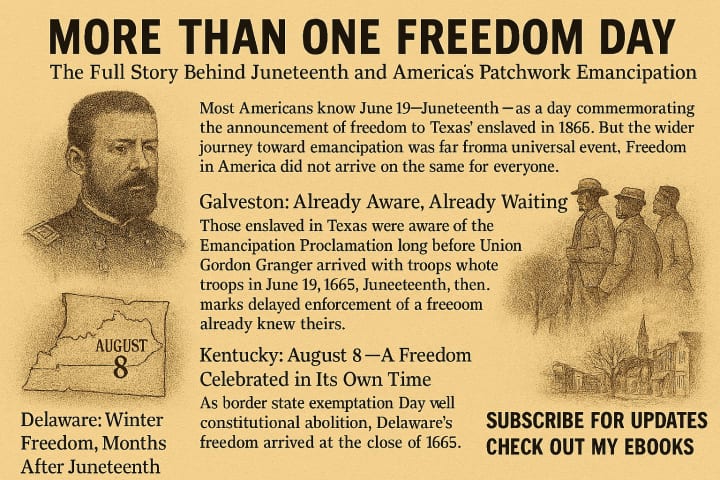
June 19th as Juneteenth, a day commemorated for the announcement of freedom to the enslaved in Galveston, Texas, in 1865. But the deeper story behind that date — and the wider national timeline of emancipation — reveals a far more complex, state‑by‑state journey toward freedom. It is a story shaped by delayed enforcement, resistance by local authorities, and communities who already understood their liberation long before anyone arrived to make it “official.”
Galveston: What People Already Knew
When Union Major General Gordon Granger arrived in Galveston on June 19, 1865, he was not informing Black people of something they had never heard. Those enslaved there had already been aware of the Emancipation Proclamation issued in 1863. News had traveled through soldiers, sailors, migrating families, and even sympathetic individuals who quietly passed messages along.
What Granger did announce, however, was directed squarely at white Texans — a formal order to stop resisting what had already been U.S. law for more than two years. His arrival, accompanied by roughly 3,000 United States Colored Troops, served to impose social order and finally enforce a federal proclamation that local slaveholders had violently ignored.

General Order No. 3 was not a revelation to the enslaved. It was an enforcement action.
A Texas Holiday, Not a Universal One
Despite its national recognition today, Juneteenth originated as a Texas‑specific emancipation observance. Across the country, the date of freedom varied widely, depending on local resistance, the pace of Union military presence, and the strength of local slave‑holding interests.
Even in 1865, the experience of emancipation bore little resemblance to a single celebratory moment. Instead, it unfolded unevenly, sometimes painfully, and often months apart.

Kentucky: August 8 — A Freedom All Its Own
Kentucky, a border state that did not join the Confederacy, was exempt from the Emancipation Proclamation. Many enslaved individuals there were not freed until August 8, 1865, a date still observed in several Kentucky communities as their own Emancipation Day.
August 8 became a day of parades, reunions, and declarations of long‑awaited autonomy — a reminder that freedom in America did not land on every doorstep on the same day.
Delaware: Freedom Delayed Until the Winter
Delaware, another Union state still legally permitting slavery during the Civil War, did not see emancipation enforced until late 1865, months after Juneteenth. Only with the ratification of the 13th Amendment in December did Delaware’s enslaved population gain legal recognition of freedom.
For them, the season of liberation arrived not in June’s heat but in winter’s cold.

Why the Timeline Was So Uneven
The idea that all enslaved people were freed on the same day is a common misconception. In reality:
* Texas ignored the 1863 proclamation until Union troops enforced it.
* Border states were legally exempt from the Proclamation and waited for constitutional abolition.
* Communication, resistance, and political interests created intentional delays.
* Freedom often depended on the physical arrival of Union soldiers — not the stroke of a pen.
Juneteenth, then, is not the universal date of emancipation — it is one chapter in a national mosaic.

A Celebration With Layers
Today, Juneteenth stands as a symbol of freedom, perseverance, and the long struggle toward equality. But the broader truth stands beside it: the end of slavery in the United States did not arrive on a single day, nor through a single announcement. It came through a patchwork of dates, each shaped by geography, politics, resistance, and the courage of those who already knew they were free.
The people of Galveston knew.
Kentucky’s communities celebrated on August 8.
Delaware’s waited until December.
And across the country, families marked emancipation on the day freedom finally reached their doorstep.

A Story Still Being Told
As the nation continues to reflect on its past, these varied dates matter. They honor not just the end of slavery, but the lived experiences of those who endured its final days. In understanding the fuller timeline, we gain a deeper appreciation for the resilience, unity, and determination of the people who made freedom real long before it was officially acknowledged.
Juneteenth is a powerful symbol — but the story of emancipation is far larger than any single date.
About the Creator
TREYTON SCOTT
Top 101 Black Inventors & African American’s Best Invention Ideas that Changed The World. This post lists the top 101 black inventors and African Americans’ best invention ideas that changed the world. Despite racial prejudice.
Keep reading
More stories from TREYTON SCOTT and writers in BookClub and other communities.
Rachel Reviews: Lakefront Wolves by Joseph Deegan
Meet Finn. He's an 18 year old kid who has potential. He's bright with great school scores and he's also an athlete, a footballer of some prowess. He has it all going for him, it would seem, and yet, he's determined to send what could be a well-planned, stable existence firmly off the rails. He drinks, he smokes, he takes drugs, he has violent tendencies and he's in danger of losing not only his mind but all that he holds dear.
By Rachel Deeming6 days ago in BookClub
Frankenstein: The “Monster” Story That Completely Changed How I See Humanity — And Why It’s More Terrifying Than You Think
When I first picked up Frankenstein, I thought I knew exactly what I was getting into. A scientist creates a monster. The monster becomes dangerous. Chaos follows. It sounded like a straightforward horror story—something dramatic, maybe even exaggerated.
By Lukáš Hrdlička6 days ago in BookClub
The Piggy Project
I’ve had so many names in this life I lose track of which ones were ever really mine and which ones I wore because someone needed me to. Some were handed to me before I had words to refuse them, before I knew what they meant, before I knew I could say no. Most weren’t meant to hurt. That doesn’t mean they didn’t leave marks. Marks that told me who I belong to, who I am by way of who claims me, recognizes me in the good and bad, who walks beside me.
By Fatal Serendipity3 days ago in Confessions


Comments
There are no comments for this story
Be the first to respond and start the conversation.