
“A Short History of Nearly Everything”:Why it Still Captivates—Even if You’re Not a Science Buff
Journey Through Time and Space—Without Leaving Your Armchair

Ever looked at a science book and thought, Nope, too complicated? You’re not alone. For many, science can feel like an exclusive club where the language is equations and the dress code is lab coats. But Bill Bryson’s "A Short History of Nearly Everything" throws open the doors to that club—and invites you in for a wildly entertaining ride through the universe.
So what is this book? Why has it stayed so popular? When should you read it, and how does it manage to make even quantum physics feel like a story you want to hear around a campfire?
Let’s break it down:
Why This Book Still Matters
At its heart, A Short History of Nearly Everything is about curiosity—yours, mine, and Bryson’s. It tackles the biggest questions:
How did the universe begin? How did life start? Why are we even here?
But instead of dry facts, it offers answers with humor, wonder, and storytelling magic. Even years after it first hit shelves, the book remains a beloved favorite because it makes science feel... human.
When to Pick It Up
This book is perfect for:
Anyone who thinks they don’t like science
Curious minds wanting a big-picture view of the world
Students or lifelong learners craving a spark of wonder
Readers who enjoy fun facts, quirky characters, and mind-blowing ideas
In short, it’s ideal any time you feel like being amazed—and reminded of your place in this vast, mysterious universe.
What Makes It So Engaging?
A Relatable Narrator
Bryson isn’t a scientist—and that’s his superpower. He asks the questions we all want to ask and explains the answers like a friend would, not a textbook. You’ll find yourself nodding along and laughing out loud, even during discussions of black holes or atoms.
A Massive Story, Told Simply
The book covers everything—from the Big Bang to the rise of humans. And somehow, it all fits together in a way that makes sense. Bryson doesn’t just throw facts at you; he connects the dots across space, time, and scientific disciplines so you see the full picture.
Science Meets Humor
Ever thought scientists were boring? Think again. Bryson introduces you to brilliant, odd, passionate people who made discoveries by accident, obsession, or sheer luck. Their stories—and their quirks—bring history and science to life.
Complex Made Clear
Whether it’s plate tectonics or DNA, Bryson uses vivid metaphors and plain English to explain tough ideas. You won’t feel lost—you’ll feel smarter with every page.
A Celebration of Human Curiosity
Bryson shows how science is built not just on brilliance, but on persistence, mistakes, and moments of surprise. It’s not a perfect process—but that’s what makes it so inspiring.
How This Book Changes You
By the time you finish it, you’ll likely:
Look at the stars with more wonder
Appreciate how unlikely—and amazing—life really is
Want to learn more, not because you have to, but because you get to
You don’t need a science degree to enjoy A Short History of Nearly Everything. You just need a little curiosity and a love for great storytelling
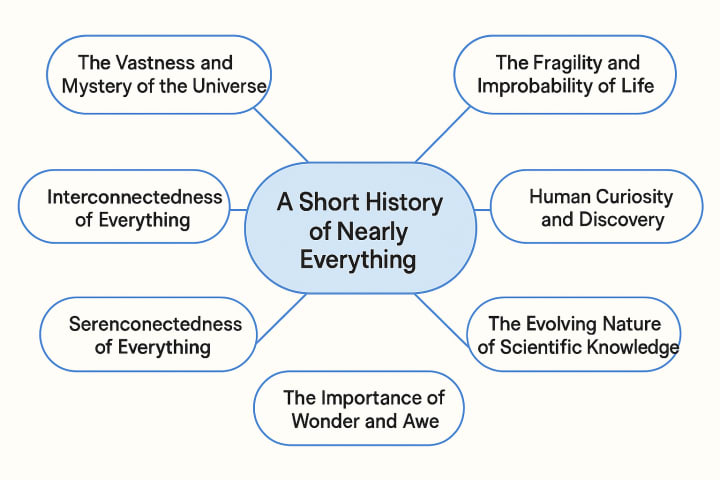
Bill Bryson's A Short History of Nearly Everything touches on many fascinating ideas, but here are some of the key themes that stand out:
1. The Vastness and Mystery of the Universe
Bryson emphasizes how incredibly vast, complex, and still-mysterious the universe is. From the Big Bang to black holes, he reveals how much we don’t know—and how humbling that should be.
2. The Fragility and Improbability of Life
The fact that life exists at all—especially intelligent life—is presented as a statistical miracle. Bryson explores the razor-thin margins that allow life on Earth to thrive, reminding readers how rare and fragile our existence truly is.
3. Human Curiosity and Discovery
At its core, the book celebrates human curiosity. It tells the stories of countless scientists—famous and forgotten—who asked big questions and made groundbreaking discoveries, often against great odds or with very little credit.
4. The Evolving Nature of Scientific Knowledge
Bryson shows that science is not static. It evolves with new evidence and better tools. Many ideas once taken as fact have since been proven wrong, and this uncertainty is a natural—and necessary—part of scientific progress.
5. Serendipity and Mistakes in Science
Many major discoveries happened by accident, through trial-and-error, or in unexpected ways. Bryson highlights how science often advances not just through genius, but also through persistence, failure, and luck.
6. Interconnectedness of Everything
From atoms to galaxies, Bryson draws connections across disciplines—astronomy, geology, biology, chemistry—to show that everything in the natural world is interlinked, and understanding one part helps illuminate the whole.
7. The Importance of Wonder and Awe
Above all, the book is a celebration of wonder. Bryson invites readers to see the natural world not just through facts, but through awe, encouraging a sense of childlike curiosity and appreciation for the universe we live in.
Final Thought
This book is more than just facts and figures—it’s an invitation to marvel at reality. So if you’ve ever wanted to understand the world without falling asleep halfway through a chapter, this is your next great read.
Pass it on, gift it, or pick it up yourself. Because the best journey you’ll ever take might just start on page one.
About the Creator
KURIOUSK
I share real-life experiences and the latest developments. Curious to know how technology shapes our lives? Follow, like, comment, share, and use stories for free. Get in touch: [email protected]. Support my work: KURIOUSK.
Can a Dollar Spent in the Lab Change Your Neighborhood?
"... to increase our spending on research and development by 25%. That's something the U.S. does very well. That dynamism alongside a welfare state in the European community - that's the synthesis I want to achieve." —Jose Luis Rodriguez Zapatero, Prime Minister of Spain, 2004-11.
By KURIOUSK9 months ago in Motivation
My New Book is Finally Here
My poetry collection Beautiful and Brutal Things is done. It's actually done and finally published over 270 pages. Over a year of my life went into this book. More than a year, really. Long days at my computer, sometimes seven days a week because I couldn't stop even when I probably should have. Then two months of editing that felt harder than the writing itself. But it's finished, and I'm still standing, and the book is real.
By Tim Carmichael3 days ago in BookClub
Stars, Scandals & Sirens
Welcome to The Chapter Café, where every story unfolds like the pages of a gripping novel—and today’s menu is anything but ordinary. We’re serving up a bold blend of true crime and celebrity biographies, a literary tasting that pairs red-carpet glamour with the grit of real-life investigations.
By Kristen Barenthaler5 days ago in BookClub




Comments
There are no comments for this story
Be the first to respond and start the conversation.