
A Case for Performative Reading
Reading as status and Barnes & Noble's rebirth

Social media is addictive. It’s instant gratification, it’s an echo chamber of our personal ideologies, it’s a dream or a nightmare depending on where you find yourself online.
In recent years, social media also serves as an important part of our adolescent development. I remember in the early 20s how my friends would decorate their Myspace pages or upload hundreds of photos from their digital cameras onto their Facebooks. These forms of social media helped us learn more about who we are as young people and kept us engaged with a wider world outside of our small hometowns.
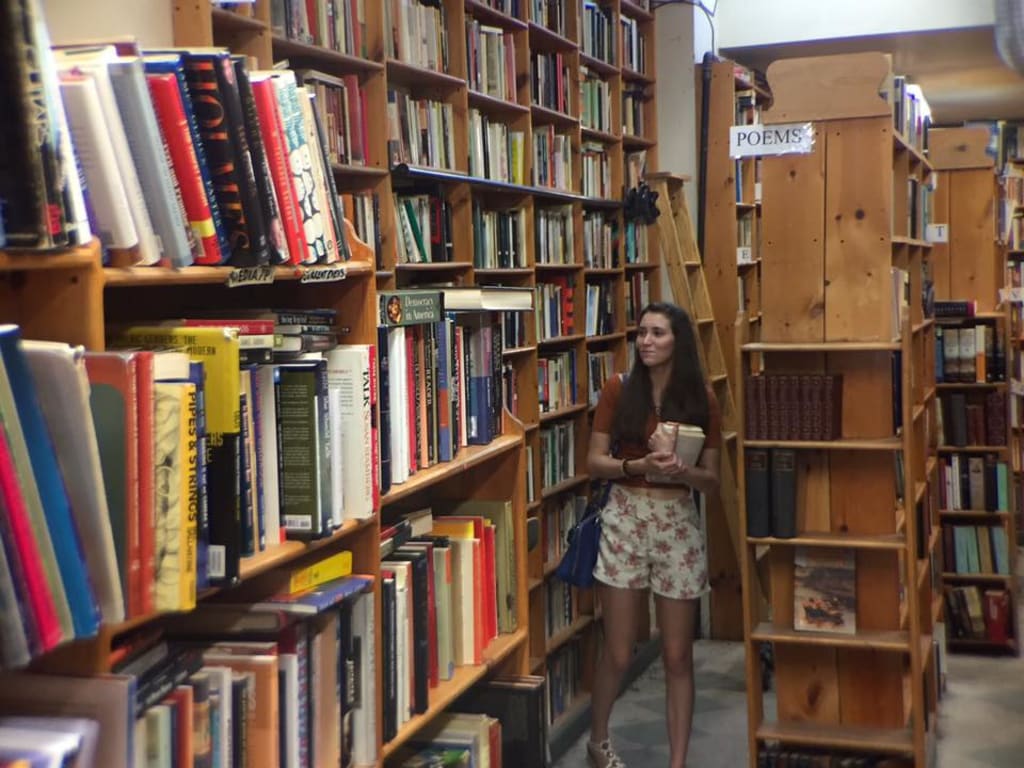
In the age of Instagram and TikTok, being a bookworm is now seen as an aesthetic choice. Something that you ‘are’ rather than a hobby you partake in. It is easy to find pictures of celebrities and influencers holding up their current read for the camera.
Some would argue that this performative form of reading is unauthentic to the experience of ‘real’ readers. But what makes a reader, a reader?
But showing off our books is actually nothing new. Books have always been social currency. Having a home library has been a status symbol in the West since the cost of mass publishing became affordable in the 1800s. And even more so with Penguin Publishing’s first modern paperback book in the 1930s. The more books you owned, the larger your wealth seemed, and the more impressive a reader you appeared to be.
If you’re on Tiktok or Instagram and you also happen to like books, you have probably stumbled across posts that look a little something like this:

You’re first impression of these posts may be that they feel forced. Is she even reading that book? I don’t see any crease marks or dogears. She probably is just trying to get attention, right?
Tucking our collective misogyny aside, bookish content often feels forced because social media itself requires us to unnaturally heighten our lived experiences for the sake of an audience. Realistic photography isn’t what’s popular, and so, much of our content is edited or posed in order to fit what’s presentable.
Social media may feel ‘cringy’ or ‘forced’ at times, but it never bothers me. Bookish content encourages people to pick up a novel, which is exactly why I don’t mind how sometimes fake and cheesy the posed reading photos often are. And with the power of shame, we are discouraging people from being stuck on social media. It’s no longer quirky to be addicted to your phone. Influencers and watchers alike are slowly switching out their screen time for reading time.
When young people see something they perceive as cool, they are likely to emulate the behavior. This is because teens are attempting to find themselves and discover their interests. I think it’s a great thing that so many popular celebrities are now showing off which books they are enjoying (or pretending to enjoy) because their audience is likely to go and take a chance on that book.
And with more people buying books, more money will inevitably flow into the publishing industry. This is a win for all readers.
Literacy rates in the US have declined steadily over the past few decades. This is mostly due to the change in how we teach reading to kids. Before the 1930’s we used the Phonics system to teach basic sounds and patterns of the English Language.
Phonics works. It’s what I’ve used as an ESL teacher my entire career. However, many American schools no longer teach phonics and rely heavily on the Whole Language approach. The Whole Language system relies on the belief that children will pick up the nuances of English sound rules as they continue to read. The philosophy around it is that children have a natural aptitude for language and only need rigorous practice to pick up the nuances. It forces children to read sentences over and over until understanding is derived.
As a language teacher, I can tell you that Whole Language does not work without a strong Phonics background. No one can magically take in a language, even a first language, without studying it with care.
Reverting back to a Phonics-first style of education would undoubtedly increase the literacy rates. When reading feels easy, people are far more likely to pick up a book for pleasure. And as we know, reading is important for a multitude of reasons. The development of empathy and pattern detection being two crucial skills all students should strive for.

For book lovers, book content is preaching to the choir. We already understand our reading tastes and know the power that literature has. But for a large majority of the population, reading seems difficult or boring.
I think it’s great that online creators are encouraging a new group of people to get into the hobby. The more money going into the publishing industry, the more money there will be for authors, in particular, debut authors. TikTok books are giving a fresh breath of life to authors and books that might not have had historically fair advertisement opportunities.
Even if the books people are picking up aren’t to your taste, more money in the publishing industry is still a win for all readers. I, for example, do not care for the Romantasy genre, which is probably the most widespread and popular genre on BookTok at the moment. But I never feel annoyed by the excited BookToker holding up their book. I only feel excited that this person is starting their reading journey, and along with it, another person is contributing to book sales.
The revival of Barnes and Nobles is my primary example of how BookTok has positively affected the reading community. After Borders closed in 2011, B&N was the only remaining national bookstore chain in the US. But it was quickly losing money, due to Amazon selling books at an unethically low price that other stores could not compete with. Before COVID, B&N closed a total of 620 stores and laid off thousands of employees.
But the pandemic held a silver lining for the company. Online sales, especially of Manga and Comic books skyrocketed. With bookish online content promoting certain authors and people’s desire to reenter the real world, B&N saw a revival of its physical stores. As of 2025, 65 stores have been reopened across the country. No matter how cringy you may find their book tastes or content, online content creators are largely to thank for this turnaround.
Not all book content is going to be for you. Some creators may be problematic or support authors who are bigoted or ignorant. It’s all about weeding out what you don’t want to see and creating a positive online space that encourages you to find good books and an uplifting community.
As an ESL teacher, watching young people all over the world find their passion for books is a supreme joy in my life. I hope that if you stumble upon bookish content this week, you’ll feel inspired, rather than judgemental.
Thank you for reading! I hope you can pick up a good book. I’m currently reading Hemingway’s A Farewell to Arms and listening to Rebecca K.Reilly’s Greta & Valdin on audio. (I’m a sucker for a juicy literary fiction)
Works Cited:
https://www.businessinsider.com/barnes-and-noble-history-bookstore-amazon-feud-rise-and-fall-2023-2
About the Creator
Keep reading
More stories from Kera Hollow and writers in BookClub and other communities.
Rachel Reviews: Lakefront Wolves by Joseph Deegan
Meet Finn. He's an 18 year old kid who has potential. He's bright with great school scores and he's also an athlete, a footballer of some prowess. He has it all going for him, it would seem, and yet, he's determined to send what could be a well-planned, stable existence firmly off the rails. He drinks, he smokes, he takes drugs, he has violent tendencies and he's in danger of losing not only his mind but all that he holds dear.
By Rachel Deeming10 days ago in BookClub
8 Books That Help You Stay Calm Around Difficult People
Dealing with difficult people is one of the most universal challenges we face. Whether it’s a critical coworker, an argumentative relative, a passive-aggressive friend, or a demanding boss, these interactions can quickly drain our emotional energy. The problem isn’t simply the behavior of others—it’s how those behaviors trigger our reactions.
By Diana Meresc5 days ago in BookClub


Comments
There are no comments for this story
Be the first to respond and start the conversation.