
8 Heavy But Enlightening Books
Books That Challenge and Change You


Reading isn’t merely a pastime—it is an immersion into complex ideologies, powerful narratives, and intellectual introspection. For readers who crave depth, philosophical rigor, and psychological excavation, heavy but enlightening books offer more than just entertainment—they are transformative journeys. Below is a list of 8 extraordinary books that demand attention, patience, and reflection, but reward the reader with a broadened consciousness and profound insight.
1. Infinite Jest by David Foster Wallace
Infinite Jest is a monumental work of postmodern literature that delves into the darker sides of American life—addiction, entertainment, depression, and fractured identity. Set in a near-future dystopia, it follows a sprawling cast centered around a tennis academy and a rehabilitation center. Wallace's prose is highly intricate, laced with footnotes and philosophical asides that demand close attention. The novel interrogates how society numbs its pain through distraction and consumption. Though daunting in scope and structure, Infinite Jest offers rich rewards to the persistent reader. It’s a powerful exploration of loneliness, intelligence, and the search for genuine human connection in a media-saturated world.
2. Being and Time by Martin Heidegger
Heidegger's Being and Time is a foundational text in existentialist philosophy and phenomenology. It addresses the fundamental question of what it means to “be,” using the term “Dasein” to describe human existence. Heidegger argues that understanding being requires a deep engagement with our temporal, finite nature—particularly our awareness of death. His dense terminology and abstract style make the work notoriously difficult, but it remains essential for anyone exploring metaphysics or ontology. Being and Time shifts the philosophical focus from static entities to lived experience, making it one of the most transformative philosophical texts in the Western tradition.
3. The Brothers Karamazov by Fyodor Dostoevsky
This epic Russian novel blends philosophy, psychology, and theology into a murder mystery that examines the deepest aspects of human nature. Dostoevsky uses the Karamazov brothers—Alyosha, Ivan, and Dmitri—to represent different facets of faith, reason, and sensuality. Through their conflicts and tragedies, the novel explores free will, moral responsibility, and the existence of God. Its famous chapters, like “The Grand Inquisitor,” are among the most powerful critiques of organized religion ever written. With profound emotional resonance and intellectual scope, The Brothers Karamazov is more than just a novel—it’s a spiritual and philosophical journey.
4. Gravity’s Rainbow by Thomas Pynchon
Gravity’s Rainbow is an explosive postmodern epic set during and after World War II, centered around the development and implications of the V-2 rocket. The novel spirals into a chaotic blend of historical satire, scientific theory, and metaphysical paranoia. Pynchon’s prose is challenging, with non-linear narratives, multilingual passages, and hundreds of characters. It critiques government surveillance, corporate control, and humanity’s search for meaning amidst technological and political forces. Though difficult to penetrate, Gravity’s Rainbow is widely hailed as one of the greatest achievements in 20th-century literature—a kaleidoscopic vision of a fragmented, absurd, and deeply troubling modern world.
5. The Magic Mountain by Thomas Mann
Thomas Mann’s The Magic Mountain is a profound meditation on time, illness, death, and the intellectual currents of pre-World War I Europe. Set in a Swiss sanatorium, the novel follows Hans Castorp, a young German engineer whose short visit turns into a seven-year stay. There, he encounters a cast of characters representing ideologies such as humanism, radicalism, and nihilism. Mann uses this isolated environment as a microcosm of European thought and decay. The narrative unfolds slowly, with philosophical digressions and symbolic richness that reward careful reading. It’s a challenging, rewarding journey into the human psyche and the existential crisis of modernity.
6. The Recognitions by William Gaddis
Following the journey of Wyatt Gwyon, a disillusioned painter who becomes an art forger, the book navigates a network of characters obsessed with imitation and pretense. Gaddis blends erudite references from theology, mythology, and classical literature to highlight the crisis of modern authenticity. With intricate, dialogue-heavy prose and a fragmented structure, the novel demands rigorous attention. Yet it powerfully critiques the commodification of art and the erosion of truth in contemporary society. A towering achievement, it rewards readers with rich, existential insights.
7. To the Lighthouse by Virginia Woolf
Virginia Woolf’s To the Lighthouse is a lyrical exploration of memory, time, and human consciousness through the lives of the Ramsay family and their guests over two visits to their summer home. Utilizing stream-of-consciousness narration, Woolf reveals the interior worlds of her characters with poetic precision. Woolf’s prose is elegant and introspective, making this a contemplative reading experience. To the Lighthouse remains one of the most profound meditations on the passage of time and the power of perception in literature.
8. Thus Spoke Zarathustra by Friedrich Nietzsche
In Thus Spoke Zarathustra, Nietzsche introduces his key philosophical ideas—including the Übermensch, eternal recurrence, and the death of God—through a poetic, prophetic voice. Written in a biblical, aphoristic style, the text is both philosophical and literary, rich with metaphor and symbolic narrative. Nietzsche's tone shifts between exaltation and despair, mirroring the spiritual struggles of modern existence. Complex and provocative, this work challenges readers to rethink morality, purpose, and individual will. It is essential for anyone seeking to understand existentialist and postmodern thought.
Why These Books Matter Today
In a world dominated by bite-sized content and surface-level narratives, these heavy books offer a counterpoint—depth, intellectual rigor, and philosophical introspection. They teach us patience, sharpen our analytical skills, and open portals to perspectives that challenge and expand our worldview.
They are not books to breeze through. They are companions on a lifelong quest for understanding, for grasping what it means to be conscious, moral, and truly alive.
Whether you're seeking to navigate the existential quandaries of life, reflect on systems of power and oppression, or simply deepen your empathy and understanding, these texts are profound guides.
About the Creator
Diana Meresc
“Diana Meresc“ bring honest, genuine and thoroughly researched ideas that can bring a difference in your life so that you can live a long healthy life.
Keep reading
More stories from Diana Meresc and writers in BookClub and other communities.
8 Self-Help Books to Take Charge Of Your Life
In a world of endless distractions and overwhelming responsibilities, taking control of one’s life can feel like a daunting task. Fortunately, the right self-help books offer actionable guidance, mindset shifts, and time-tested strategies that empower individuals to reclaim their direction, purpose, and confidence. Below is a list of 8 self-help books that not only inspire but equip you to take charge of your life, one decision at a time.
By Diana Meresc10 months ago in BookClub
Rachel Reviews: Lakefront Wolves by Joseph Deegan
Meet Finn. He's an 18 year old kid who has potential. He's bright with great school scores and he's also an athlete, a footballer of some prowess. He has it all going for him, it would seem, and yet, he's determined to send what could be a well-planned, stable existence firmly off the rails. He drinks, he smokes, he takes drugs, he has violent tendencies and he's in danger of losing not only his mind but all that he holds dear.
By Rachel Deeming12 days ago in BookClub
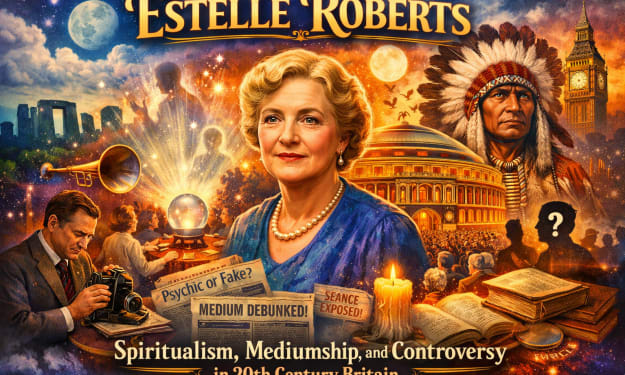
Estelle Roberts
The Rise of Modern Spiritualist Mediumship Public fascination with communication beyond death reached extraordinary levels during the late nineteenth and early twentieth centuries. Spiritualism, a religious and social movement built upon the belief that human consciousness survives physical death and remains capable of communicating with the living, spread rapidly throughout Britain, Europe, and North America. Séances, trance lectures, automatic writing, and spirit photography attracted large audiences and intense debate. Newspapers reported demonstrations with curiosity and skepticism, while scientific investigators attempted to test claims associated with psychic phenomena.
By Marcus Hedareabout 10 hours ago in BookClub



Comments
There are no comments for this story
Be the first to respond and start the conversation.