
7 Books So Amazing Everyone’s Pretending They've Read Them
Discover 7 Books Everyone Talks About—But Few Have Actually Finished


In a world where social media highlights and dinner-table discussions often involve references to popular literature, there exists a curious phenomenon: books that everyone claims to have read but few actually have. These are the literary masterpieces that spark debate, inspire memes, and establish cultural literacy. Why do we pretend to read certain books? Often, it’s because they carry an aura of intellectual prestige, are frequently cited in academia or pop culture, or challenge readers with complex themes and ideas.
In this article, we’ll explore 7 books so amazing everyone’s pretending they've read them. For each, we’ll provide a detailed review, discuss its themes and impact, and explain why it continues to captivate readers—and why it’s worth reading for real.
1. "Paradise Lost" by John Milton
Review: Paradise Lost is an epic poem that explores the fall of man, the nature of free will, and the struggle between good and evil. Milton’s use of elevated language, complex syntax, and vivid imagery creates a work of immense literary power. The story of Adam and Eve, Satan, and the cosmic battle for humanity’s soul delves into theological, philosophical, and moral questions. While challenging due to its archaic style, the poem offers profound insights into human ambition, temptation, and redemption.
Impact: Paradise Lost has influenced literature, theology, and art for centuries. Its themes of rebellion, morality, and divine justice continue to resonate, making it a staple of classical literary discussion and a book often cited more than read.
2. "The Metamorphosis" by Franz Kafka
Review: Kafka’s The Metamorphosis tells the surreal story of Gregor Samsa, who wakes up transformed into a giant insect, and explores alienation, identity, and family dynamics. Kafka’s concise, yet psychologically rich narrative examines existential anxieties, societal expectations, and human isolation. Despite its brevity, the novella is deeply impactful, leaving readers with enduring questions about personal and social responsibility.
Impact: The Metamorphosis has become a cultural icon, frequently analyzed in literature and psychology courses. Its themes of absurdity, alienation, and identity make it both timeless and widely referenced, even by those who haven’t fully read it.
3. "Gravity’s Rainbow" by Thomas Pynchon
Review: Pynchon’s Gravity’s Rainbow is a dense, challenging masterpiece that explores the intersections of science, war, and paranoia during World War II. Its intricate plot and surrealist elements demand careful attention, yet the payoff is immense: readers are confronted with profound insights into human behavior, technological obsession, and historical forces. Pynchon’s dark humor and complex symbolism have inspired literary scholars to dissect the book endlessly.
Impact: Often considered one of the most difficult novels in the English language, Gravity’s Rainbow has shaped postmodern literature with its bold experimentation, blending of genres, and philosophical inquiry. Its reputation makes it a book people claim to have read, even if they haven’t tackled its full depth.
4. "Anna Karenina" by Leo Tolstoy
Review: The tragic story of Anna, who struggles between passion and societal expectation, is intertwined with subplots that examine morality, politics, and human ambition. Tolstoy’s keen observations on human behavior and social dynamics, combined with his rich narrative style, create a timeless novel that resonates across cultures.
Impact: Anna Karenina is often cited as one of the greatest novels ever written, shaping discussions about morality, gender, and societal norms.
5. "Heart of Darkness" by Joseph Conrad
Review: Conrad’s Heart of Darkness explores imperialism, moral ambiguity, and the darkness inherent in human nature. The novella follows Marlow’s journey up the Congo River, exposing the brutality of colonial exploitation and the psychological effects of power and greed. Conrad’s dense, atmospheric prose and symbolic storytelling make this work both haunting and intellectually challenging.
Impact: Heart of Darkness has influenced literature, postcolonial studies, and philosophical discussions on morality and human nature. Its reputation as a profound and unsettling masterpiece makes it a book people often mention to signal literary awareness.
6. "Catch-22" by Joseph Heller
Review: Heller’s satirical novel captures the absurdity and horror of war through the story of Captain Yossarian and his attempts to survive bureaucratic insanity. Heller blends dark humor, absurdism, and keen social critique to expose the contradictions of authority, morality, and human behavior. The novel’s biting wit and narrative innovation make it a timeless reflection on institutional absurdity.
Impact: Catch-22 revolutionized war literature, providing a lens to critique systems of power while maintaining literary brilliance. Its influence extends beyond literature into politics, philosophy, and pop culture.
7. "Lolita" by Vladimir Nabokov
Review: Lolita is a provocative exploration of obsession, desire, and manipulation, narrated by the unreliable Humbert Humbert. Nabokov’s elegant, lyrical prose contrasts starkly with the disturbing subject matter, forcing readers to grapple with ethical questions while marveling at linguistic mastery. The novel’s psychological depth, controversial themes, and narrative innovation have sparked extensive debate and critical acclaim.
Impact: Despite—or perhaps because of—its controversial content, Lolita remains a key text in discussions of narrative perspective, moral ambiguity, and the power of language. Its notoriety contributes to its status as a book people feel compelled to mention in intellectual circles.
Conclusion
These 7 books so amazing everyone’s pretending they've read are more than just literary status symbols—they are profound explorations of human nature, society, and language. While their complexity may intimidate casual readers, engaging with them can transform one’s perspective, sharpen critical thinking, and deepen cultural literacy. Instead of pretending, diving into these works—even gradually—offers a rewarding journey through some of the most influential literature ever written.
About the Creator
Diana Meresc
“Diana Meresc“ bring honest, genuine and thoroughly researched ideas that can bring a difference in your life so that you can live a long healthy life.
Keep reading
More stories from Diana Meresc and writers in BookClub and other communities.
8 Books So Beautiful You'll Forget to Sleep
In a world where distractions are endless and time feels fleeting, few experiences rival the magic of a book that completely captures our attention. Some stories are so mesmerizing, so exquisitely crafted, that we willingly sacrifice sleep just to linger in their pages a little longer. These are the books that pull us in with breathtaking prose, unforgettable characters, and worlds so vivid they feel alive. Below is a list of 8 books so beautiful you'll forget to sleep.
By Diana Meresc5 months ago in BookClub
Rachel Reviews: The Spiral Archive by Pieter Hendrik
It's difficult for me to know where to start with a review of this book as it was, for me, an entirely unique experience and one that I'll probably never have again. I don't want that to be interpreted as unenjoyable but it has left me scratching my head a little and ruminating on its content, its themes and its characters.
By Rachel Deeming6 days ago in BookClub
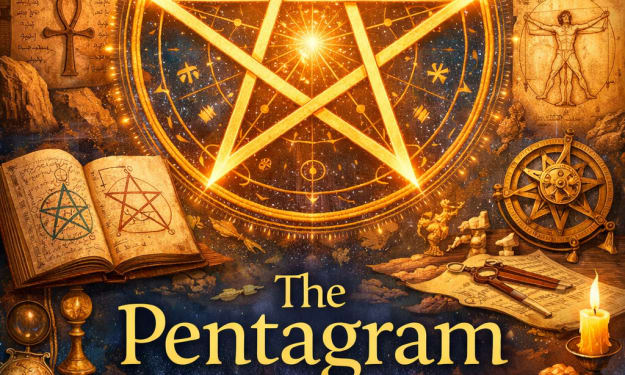
The Pentagram
A Symbol Older Than Written Memory The pentagram ranks among the oldest geometric symbols known to human civilization. Defined as a five-pointed star formed by a single unbroken line, the figure appears in material culture dating back more than five thousand years. Archaeological evidence places early examples in Mesopotamian inscriptions, where the form carried associations with celestial order, spatial direction, and authority. From those earliest appearances, the pentagram moved fluidly across cultures, languages, and belief systems, adapting its meaning while retaining its distinctive structure.
By Marcus Hedare3 days ago in BookClub
The CEO of Everything
They say "jack of all trades, master of none," but they forgot to mention the part where the jack of all trades is also the camera woman, the makeup artist, and the person currently yelling at a tangled Wii microphone cable in a her own bathroom while recording herself singing and trying to make it look realistic and professional. (As professional as you can make it with nothing but a cell phone camera and a mic that doesn't work)
By Sara Wilson6 days ago in Humans



Comments
There are no comments for this story
Be the first to respond and start the conversation.