
5 books that changed the world for the better
These expert-recommended books reveal how big ideas can shape — and sometimes redefine — human progress

Taken literally, the statement introduces a paradox — meeting in solitude — but that very tension is what makes books so powerful. We experience them alone, yet they facilitate conversations with others, with new ideas, and with ourselves.
In that way, books have always helped drive progress. Some introduce new technologies, philosophies, or political ideas. Others synthesize history to reveal patterns and introduce lessons from the past. Still others tell stories, real or invented, that remind us of essential human truths. All have the power to inspire readers to think differently, use their imagination, and ask new questions.
We asked five experts who attended Progress Conference 2025 to share one book they believe changed the world for the better. Their selections span science, philosophy, fiction, and more, but each shows how the dialogue between author and reader can have profound impacts across disciplines and generations — and how ideas shared in solitude can drive collective progress.
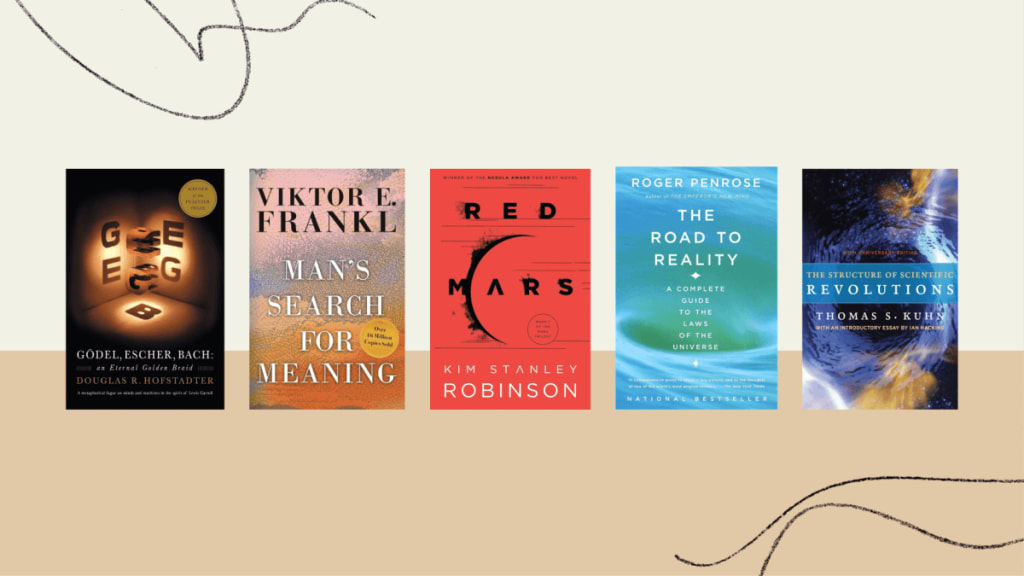
Gödel, Escher, Bach: An Eternal Golden Braid by Douglas R. Hofstadter (1979)
Winner of the Pulitzer Prize for General Nonfiction in 1980, Douglas R. Hofstadter’s Gödel, Escher, Bach: An Eternal Golden Braid (“GEB” for short) is celebrated not only for its intellectual ambition, but also for its inventive and playful prose.
Drawing on the works of logician Kurt Gödel, artist M. C. Escher, and composer Johann Sebastian Bach, Hofstadter explores how seemingly unrelated fields each produce works with “self-reference,” like drawings where one part exists only because it’s creating the other, musical patterns that loop back on themselves, and computer code that can modify or run itself. A cognitive and computer scientist by training, Hofstadter uses these interdisciplinary links to ask a critical question: Can self-referential systems, like those found in logic, music, art, and programming, help us understand the nature of consciousness?
Since its publication, the book has inspired many to see the world as more interconnected. It has also encouraged a generation of thinkers to embrace modes of inquiry that don’t fit neatly within a single discipline. Though not a technical or academic text, GEB has influenced how researchers think about intelligence, neural networks, and consciousness. Gabriel Weinberg, founder of DuckDuckGo, calls the book “eye-opening” and says it changed the world for the better by “revealing deep, interdisciplinary connections in philosophy, mathematics, art, music, and more.”
Man’s Search for Meaning by Viktor E. Frankl (1946)
In one of the most influential books of the 20th century, psychiatrist Viktor Frankl documents the three years he spent in Nazi concentration camps. His memoir, Man’s Search for Meaning, confronts the daily realities of violence, dehumanization, and suffering, but its lasting power lies in Frankl’s exploration of how meaning can help people endure even the worst of circumstances. He describes how prisoners who held onto a sense of purpose — whether it was reuniting with a loved one, achieving a goal, or simply maintaining hope — often survived longer than those who could not find meaning in their lives.
After his liberation, Frankl developed logotherapy, a form of psychotherapy based on the idea that the deep human drive to find purpose is central to one’s capacity for resilience, hope, and fulfillment. The impact of Frankl’s book and subsequent work on psychology, ethics, and the discourse around meaning in modern life is difficult to overstate.
For Stand Together’s Ryan Stowers, whose own work centers on helping people realize their potential, Frankl’s insights remain among the most powerful of our time: “Frankl’s core concepts have shaped the modern dialogue around human potential and existential significance — from classrooms and therapy couches to our everyday conversations about how we rise to meet life’s challenges and choose to create a better world.”
Red Mars by Kim Stanley Robinson (1992)
Kim Stanley Robinson’s groundbreaking science fiction novel follows 100 people who leave Earth in 2026 to reshape Mars into a planet fit for human life. As the settlers navigate futuristic technological challenges, they also grapple with timeless human problems related to relationships, power, politics, and more.
Red Mars helped bring the idea of terraforming into the scientific mainstream and continues to influence long-term thinking about life beyond Earth. Casey Handmer, founder of Terraform Industries, calls the novel “an extended and loving distillation of the work of the thousands of generations who have dreamed of a second world for humanity.” He also praises Robinson’s vivid and poetic writing: “Stan’s hauntingly beautiful prose places the reader in a landscape that, even after 35 years of robotic exploration, pulses with tangible realness. When I read this work, I can taste the bitter grit of Mars between my teeth.”
The Road to Reality: A Complete Guide to the Laws of the Universe by Roger Penrose (2004)
In the preface to his 1,100-page opus, mathematician and physicist Roger Penrose writes, “The purpose of this book is to convey to the reader some feeling for what is surely one of the most important and exciting voyages of discovery that humanity has embarked upon. This is the search for the underlying principles that govern the behaviour of our universe.”
And with that, so begins The Road to Reality, in which Penrose takes the reader through more than 2,000 years of scientific discoveries, from classical mechanics and Newtonian physics to the breakthroughs of the 20th century. Along the way, he draws deep connections between physics and mathematics, challenges prevailing assumptions, and offers his own theories. It’s both a reflection on how far we’ve come and a roadmap toward humanity’s ultimate scientific goal: a unified theory that explains how everything in the universe works.
While the book is highly technical in parts, experts also praise it as philosophical and even poetic. AI expert Arun Rao calls it a profoundly influential work, describing it as “both a textbook and a meditation.” He says it changed the world for the better by “revealing how profound mathematical beauty shapes the laws that govern existence,” adding that Penrose “offers poetic explanations of deep physics concepts you may have known, but will now see in a new light.”
The Structure of Scientific Revolutions by Thomas Kuhn (1962)
Philosopher Thomas Kuhn’s The Structure of Scientific Revolutions is a groundbreaking analysis of how scientific progress actually happens, and in doing so, he forever changed the way we think about change itself.
In the book, Kuhn challenges the formerly prevailing view that science advances through the steady accumulation of knowledge. Instead, he argues, progress unfolds in cycles: Long periods of what he calls “normal science” are punctuated by discoveries that existing theories cannot explain, giving rise to “scientific revolutions” that establish new frameworks for understanding the world.
The Structure of Scientific Revolutions gave us a new vocabulary for talking about progress and helped people understand the conditions under which meaningful change occurs.
For Ben Klutsey, executive director of the Mercatus Center at George Mason University, Kuhn’s work remains essential. “He revealed how anomalies within an existing framework can trigger crises that ultimately lead to new paradigms — fundamentally changing how we understand scientific change,” says Klutsey. “Kuhn’s ideas also reshaped thinking in many other disciplines, inspiring new ways to talk about disruption, innovation, and the dynamics of transformation.”
About the Creator
General gyan
"General Gyan shares relationship tips, AI insights, and amazing facts—bringing you knowledge that’s smart, fun, and inspiring for curious minds everywhere."
Keep reading
More stories from General gyan and writers in BookClub and other communities.
6 of the Best New Books Out November
We’ve hit the time of the year when best-of lists are coming out left and right. Here, our CEO Jeff O’Neal discusses TIME’s best-of books as well as Barnes & Noble’s Book of the Year (which I agree feels like a sweet throwback).
By General gyan4 months ago in BookClub
Rachel Reviews: Lakefront Wolves by Joseph Deegan
Meet Finn. He's an 18 year old kid who has potential. He's bright with great school scores and he's also an athlete, a footballer of some prowess. He has it all going for him, it would seem, and yet, he's determined to send what could be a well-planned, stable existence firmly off the rails. He drinks, he smokes, he takes drugs, he has violent tendencies and he's in danger of losing not only his mind but all that he holds dear.
By Rachel Deeming12 days ago in BookClub
7 Historical Romance Books You Must Read in 2026
Historical romance captivates readers by transporting them to eras filled with passion, intrigue, and societal constraints. These stories blend the allure of history with the timeless appeal of love, offering more than just escapism—they provide a window into past cultures, values, and human emotions.
By Diana Meresc6 days ago in BookClub
Early March 2026: 4 Goals Accomplished
It's early March and I've now accomplished my 4th writing goal for the year of 2026. Before diving into the behind-the-scenes of it... why not tell you up front what that accomplishment was? I was published in a 2nd publication for this year. Published in Helix Literary Magazine out of Central Connecticut State University. You can read it for free right now!
By Stephen Kramer Avitabile7 days ago in Writers



Comments
There are no comments for this story
Be the first to respond and start the conversation.