

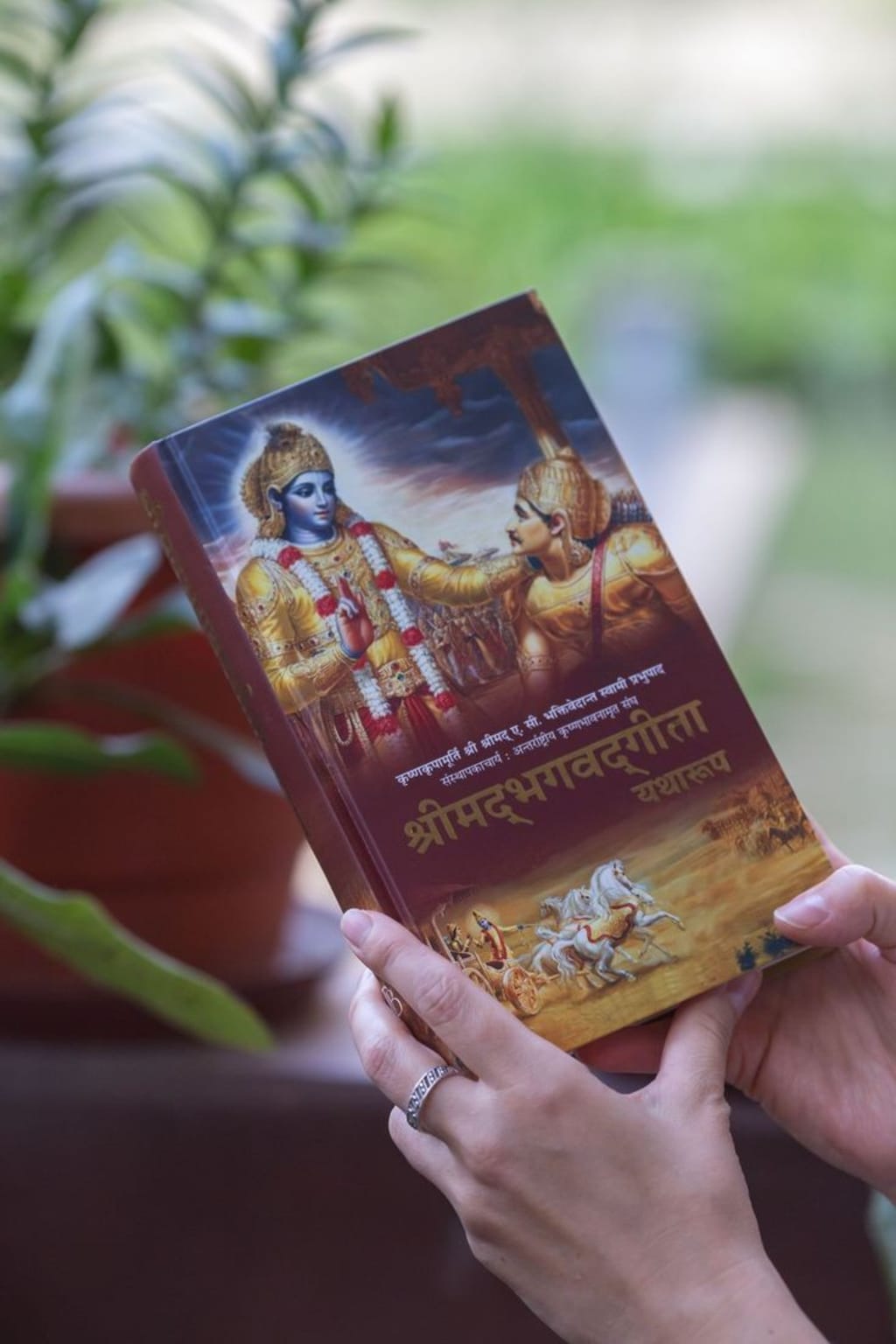
In exploring the teachings of "The Great Geeta," the individual discovered three transformative lessons that profoundly impacted their understanding of life and human interaction. Those three important lessons are listed below :
🌻The first lesson they learned was the intrinsic value of humility. Observing the prevalence of arrogance and self-importance in the world, they recognized a deep need for genuine humility. We are called humankind and it's important for us to be a human and be kind both. This realization was crystallized through an encounter with Guru Ranat Swami, an American monk from Chicago. Despite his notable achievements and status, Swami led a life marked by simplicity and service. He participated in routine tasks like chopping vegetables and cleaning, which left a lasting impression on the individual. They saw that true inspiration comes not from one's talents or accomplishments but from the ability to remain grounded and humble despite them. The individual's experience with Swami highlighted that humility is a powerful virtue, transcending mere skill or status. While they acknowledged that achieving true humility is a continuous journey, they committed themselves to practice it and integrate it into their daily life.
🌻The second significant insight was the complexity of moral judgments and the nature of right and wrong. The individual observed that contemporary society often simplifies moral issues into black-and-white categories, labeling people and situations as either good or bad. However, the teachings of the Gita challenged this binary perspective. They came to understand that the world is replete with nuances and gray areas that defy such straightforward categorizations. Reflecting on the Mahabharat, they grappled with the intricacies of characters like Bhishma and Draupadi. The individual pondered whether it was fair or accurate to judge these figures without fully understanding their personal circumstances and the broader context of their actions. This realization led them to appreciate the importance of empathy and the need to avoid hastily labeling people based on limited perspectives. They endeavored to approach situations with a more nuanced view, recognizing the multiple dimensions of human behavior and moral complexity.
🌻The third lesson derived from "The Great Geeta" was the value of embracing one's uniqueness while working toward a common purpose. The individual was inspired by the diversity of characters in the Mahabharat, such as Yudhishthira and Arjuna, who each fulfilled their roles authentically and distinctively. This diversity was not seen as a hindrance but as a strength that contributed to their collective mission. They reflected on their own experiences with monks from various backgrounds, including those who had studied at prestigious institutions and worked in high-profile careers. Despite their different paths, these individuals were united by a shared goal of service and making a positive impact. The individual realized that true excellence and unity emerge from recognizing and valuing each person’s unique contributions while aligning with a common purpose. This insight encouraged them to embrace their individuality and seek ways to integrate their unique strengths into collaborative efforts.
In summary, the teachings of "The Great Geeta" offered the individual profound lessons in humility, moral complexity, and the value of diversity. They learned that humility is a powerful quality that transcends external achievements and inspires genuine connection. They came to appreciate the intricate nature of moral judgments, understanding that the world is rarely black and white, but filled with shades of gray that require empathy and nuanced thinking. Finally, they were inspired to embrace their uniqueness while working towards shared goals, recognizing that diversity and authenticity contribute to both personal growth and collective success. These insights became foundational in shaping their approach to life, relationships, and their broader sense of purpose.
About the Creator
Keep reading
More stories from Vashundhara and writers in BookClub and other communities.
Rachel Reviews: Lakefront Wolves by Joseph Deegan
Meet Finn. He's an 18 year old kid who has potential. He's bright with great school scores and he's also an athlete, a footballer of some prowess. He has it all going for him, it would seem, and yet, he's determined to send what could be a well-planned, stable existence firmly off the rails. He drinks, he smokes, he takes drugs, he has violent tendencies and he's in danger of losing not only his mind but all that he holds dear.
By Rachel Deeming13 days ago in BookClub
7 Books That Will Push You Further Than You Thought Possible
Every so often, we encounter a book that doesn’t merely inform us—it reshapes how we think, act, and approach our limits. These are the books that challenge our comfort zones, ignite ambition, and force us to confront the gap between who we are and who we could become.
By Diana Meresc5 days ago in BookClub
Top tipple tricks
Been thinking a lot about drinking, lately. Not least because of a recent episode of over-indulgence and the inevitable after effects. Some readers may recall the earlier articles I wrote about beating the booze. Here I set out an experiment in techniques for cutting down on my alcohol intake. The experiment was successful, the techniques worked, and I have armed myself with an arsenal of weapons in the war against the demon drink. I have yet to fire the first round however. It's all a question of timing (perhaps procrastination).
By Raymond G. Taylor6 days ago in Psyche



Comments (1)
Nice article