
The Truth No One Wants to Hear about 1992's Candyman Film
Was Candyman Really as Diverse as We Thought?
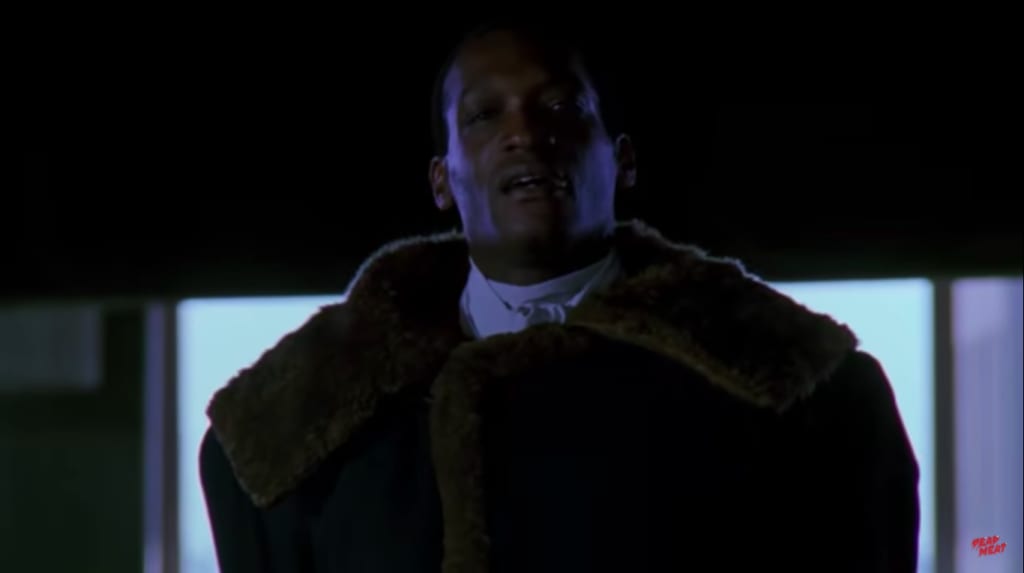
In preparation for the new Candyman film, directed by Nia DaCosta, produced and cowritten by Jordan Peele, I decided to revisit the original and REALLY watch it through a racial lens and…we need to discuss.
Before I get into this film critique, disclaimer:
It does contain spoilers so if you haven’t seen the original Candyman movie, you might want to click off of this post and revisit it after you watch that first, but before you do, be sure to subscribe to make this easy to find when you return.
So now that we’ve got that out of the way
Candyman is a film released in 1992 that’s based on a short story, called the Forbidden, written by Author and Playwright Clive Barker.
The film was directed and cowritten by Bernard Rose and honestly, it was pretty groundbreaking for 1992 for a multitude of reasons.
For one, it wasn’t common back then to see this type of diversity in horror films, but also, it’s a film where the horror we see is greater than just a serial killing boogie man…it explores the horrors of racism, the horrors of poverty, and the horrors of urban blight.
Overall, it’s a really great film and one that’s important to the horror genre, but rewatching it nearly 20 years later, I realized that groundbreaking as this movie may have been during its original release, it actually SIGNIFICANTLY missed the mark on what I think the creators were hoping to accomplish.
The film’s protagonist is a young, white woman named Helen who’s researching urban legends for a graduate project. Early on in the film, Helen is accompanied by her Black friend and classmate, Bernadette, who happens to be working on the same project but we quickly learn that Bernadette’s sole purpose in the film is to die in order to push our white heroine’s story arc forward.
That’s literally it.
Bernadette has no storyline of her own. We simply see her playing the role of the Black sidekick until her murder launches us into the next phase of the film.
The film also introduces us to a young Black, single mother named Anne-Marie. Anne-Marie lives in the housing projects that serve as the backdrop for most of our film and she befriends our protagonist, Helen, and agrees to speak with her about the Urban legend that haunts her community. Eventually Anne Marie too, finds herself on the receiving end of tragedy for the sole purpose of driving Helen’s story forward when her infant child is taken, and presumably killed. We don’t really learn anything about Anne-Marie. We don’t know her backstory, or her future goals. We have no details on what her life has been like living in the housing project. We only get tiny glimpses into who she is as a person, but her trauma is the catalyst that gives our protagonist, Helen an objective for the rest of the film: Find and save the baby at all costs.
Black trauma as a catalyst for white character development is a plot device that’s been far overdone.
For a lot of people, over the years, Candyman has been billed as a Black story, but while there actually might be more Black characters in the film than white ones, not a single Black character actually has a story of their own. In fact, they’re really not even characters, at all but rather, props strategically placed with the goal of getting our white protagonist from point A to point B in the storyline.
The one exception is the namesake of the film…our story villain, the Candyman.
We learn throughout the film that as a human, he was a very successful artist, and also, the son of slaves. Despite all odds against him, he managed to do fairly well financially and made his way into high society where he met and fell in love with a white woman….something that was unheard of at the time. After impregnating his white lover, a mob of angry racists show up to torture and murder him in one of the most horrific ways possible. While his body dies, his spirit lives on through the stories people tell as he spends his new eternity terrorizing the community where he died and seeking vengeance for the wrong that was done.
It makes sense that he would become a vengeful spirit given the nature of his death but what doesn’t quite make sense to me about this particular film is why his vengeance was aimed at a Black community who had so much in common with him, opposed to wealthy white Chicago residents who resembled the people who ended his life.
You’d think a backstory this horrific would serve the purpose of humanizing our villain and helping the viewers to understand him more, but nope. In fact, even after recounting the horrible story of his death, Candyman remains so dehumanized that we never even learn his real name. The story of how he came to be is only given to us for the big plot twist that our protagonist, Helen, is actually his white lover and everything he’s done in this film has been to get her to join him in the afterlife.
Candyman is very much Helen’s story. Black people just happen to be there too, and this is the problem we run into when entirely white teams try to tell Black stories.
The writers were white, the producers were white, the director… you guessed it, was white and while their motives with the film were well intentioned, it’s simply impossible to tell good stories about people who are different than you without the input of those people in the creative process.
The 1992 story is not a “bad” film by any means,
But after revisiting it and watching it with a significantly more critical eye…I’m really excited to see how this story transforms with Black writers, producers, and directors in the driver’s seat.
So, have YOU seen the original candy man? Did you think it was a hit or a miss?
Let me know in the comments below
And if you loved this movie critique be sure to subscribe for more!
About the Creator
Keep reading
More stories from writers in Beat and other communities.
The View from the World’s Tallest Bridge
Title: Subtitle: Article (700 words): High above a deep mountain valley, where clouds drift beneath the roadway and the earth appears miles below, stands the world’s tallest bridge — the Duge Bridge in China. Rising an astonishing 565 meters (about 1,854 feet) above the Beipan River, this remarkable structure has become not only a symbol of modern engineering but also a destination for travelers eager to witness one of the most spectacular views on Earth.
By Irshad Abbasi about 4 hours ago in Beat
The Solitude of The Chupacabra
Many say that the Chupacabra is a rather recent and modern tale, a mangy coyote or rabied dog. Some point out that it’s just twisted evolution. But very few know the true backstory of the shapeshifter that led to the bloodsucking legend. And perhaps once you will come to know and understand more, you might “forget” a few cattle out to wander.
By Oneg In The Arctic3 days ago in Fiction



Comments
There are no comments for this story
Be the first to respond and start the conversation.