
The Girl Who Only Spoke in Songs
: He never heard her speak a single word—but her voice still haunts his dreams.


The Girl Who Only Spoke in Songs
The first time I heard her voice, she was standing under a sycamore tree, singing “Unchained Melody” in a voice so fragile it made the leaves stop rustling.
She wasn’t supposed to be there.
The school courtyard was always empty by 6 PM, except for me—always me—waiting for my brother to finish football practice so we could go home. But there she was, leaning against the brick wall barefoot, like something out of a forgotten dream, swaying slightly, her eyes closed like she was singing to ghosts.
I didn't speak. I didn't move.
I just listened.
And even though she never looked at me, something in her song felt… personal. Like she'd pulled it from the part of my heart I didn't even know existed.
That was the beginning.
Her name was Iris. No one knew her last name. She had transferred mid-semester, came in like fog—soft, strange, and impossible to ignore.
And she didn’t talk.
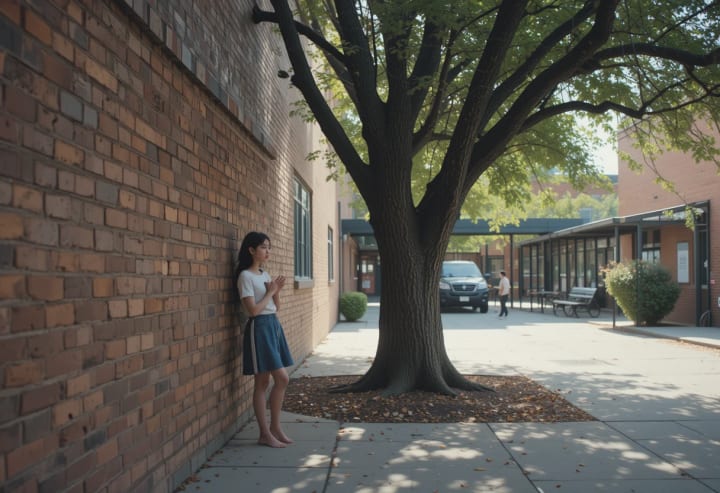
Not to teachers. Not in class. Not even when she was called on. People thought she was mute, or stubborn, or both. Some were cruel. Some tried to make her speak. But when the pressure came, she’d just blink slowly, as if listening to a rhythm none of us could hear.
But when no one was watching, she'd sing.
Softly. Always old songs. Love songs. From a time before either of us was born. Sam Cooke. Patsy Cline. Billie Holiday. Songs like secrets. Songs like spells.
I started waiting for her.
Every Tuesday and Thursday near the courtyard tree. She never acknowledged me, not at first. But she’d sing. And I’d listen. It became our unspoken ritual.
One day, I whispered, "Why only songs?"
She turned her head slightly. A pause. Then she began humming “Can’t Help Falling in Love.” Her lips parted like a prayer, and I understood—this was her language. Her only way of speaking.
Still, I wanted to know more.
The more time I spent with her, the more I learned to listen differently.
She didn’t nod or shake her head.
She sang “Yes” with Aretha.
She sang “No” with Etta James.
She sang heartbreak, joy, sarcasm, confusion—each emotion woven into melodies decades old.
Somehow, she could carry an entire conversation with one verse, and I became fluent in her music. I began answering her with snippets of lyrics from my phone, smiling like an idiot when she’d respond with a harmony or verse in return.
It was like a game.
It was like a dream.
“Does it ever bother you?” I asked her once, after I played her a piece of a Fleetwood Mac track and she answered with a full chorus of “Dreams.”
That was the first time she didn’t respond with music.
Instead, she turned toward me, eyes wide with something like fear—or maybe sorrow—and walked away. No song. No note.
Just silence.
That night, I played every record I could find. Scratched vinyl, dusty cassettes, faded YouTube videos. Trying to find something that sounded like what I felt in that moment: the ache of loving someone who refuses to let you fully know them.
Weeks passed. Our rhythm returned, but it wasn’t the same.
I asked fewer questions.
She sang fewer answers.
One Friday, after a long afternoon thunderstorm, I found her sitting on the swings behind the school. Hair wet, legs crossed, her mouth pressed to a small handheld cassette player.
She handed me a tape. No label.
I took it home, confused, but hopeful. I waited until midnight. Slipped it into my old tape deck.
It was her voice.
Not singing.
Speaking.
“I was four,” she said softly, like she was afraid even the tape would judge her. “My mom used to sing to me every night. She said music was where the truth lived. That if I ever got too sad to speak, I should just sing instead.”
There was a long pause.
“Then she left. Not died—just left. Took her voice with her. After that, I forgot how to talk. But I remembered the songs. They’re all I have.”
Another pause.
“Sometimes, I wonder if it’s better this way. To be understood through someone else's words. To sing instead of say. To feel… instead of explain.”
Click. Tape ended.
I didn’t see her for a week after that.
When she came back, she wore headphones and avoided my gaze. She didn’t sing, not even a hum.
So I made my own tape.
Just static and my own clumsy voice saying, “You don’t have to speak to be heard, Iris. But you deserve to be heard anyway.”
When I gave it to her, she cried.
Silent tears, but real ones.
Then she reached into her coat pocket and handed me something.
An old cassette labeled “For when you miss me.”
The next day, she was gone.
No warning. No note. No last song beneath the sycamore.
Just gone.
The teachers didn’t say much. Rumors spread. Another transfer. Another place. Another set of ears to sing to. Maybe she ran away. Maybe she found her mother. Maybe she got tired of waiting for people to listen.
But I still have the tape.
I don’t play it often.
Not because I don’t miss her—
But because her voice still lives in my head, tucked between melodies and memory.
Some people leave behind echoes.
She left behind music.
And in that music, I still hear her laughing. Crying. Loving.
Living.
About the Creator
Keep reading
More stories from waseem khan and writers in Beat and other communities.
I Love Rock and Roll
I Love Rock and Roll The first time I heard We Will Rock You, I was twelve years old and sitting on my uncle’s worn leather couch. He had a record player that looked ancient to me—heavy, wooden, smelling faintly of dust and time. He placed the vinyl on the turntable, the faint crackle of static filled the air, and then it happened
By waseem khan7 months ago in Beat
Review of 'Man on the Run'
My wife and I saw Man on the Run, a nearly 2-hour documentary on Amazon Prime, about Wings, Paul McCartney's group that flew around the world from shortly after The Beatles broke up in early 1970 to shortly after John Lennon was murdered at the end of 1980, making a Beatles reunion forever impossible.
By Paul Levinson6 days ago in Beat
Why More Adults Are Rediscovering Joy Through Dance Classes Kingston
There comes a point in adulthood when the days start to blur together. Work, errands, responsibilities, repeat. Somewhere between deadlines and dinner plans, many people quietly pack away the hobbies they once loved. Painting becomes impractical. Team sports feel too competitive. Music lessons seem indulgent. And yet, that creative itch never really disappears.
By Rochelle Martinez3 days ago in Beat




Comments
There are no comments for this story
Be the first to respond and start the conversation.