
Reinterpreting Tradition in the Modern World: The Experience of Afghan Musicians in the West
Exploring how Afghan musicians in the diaspora negotiate cultural heritage and innovation. Examining the creative dialogue between tradition and global musical influences in Western contexts.

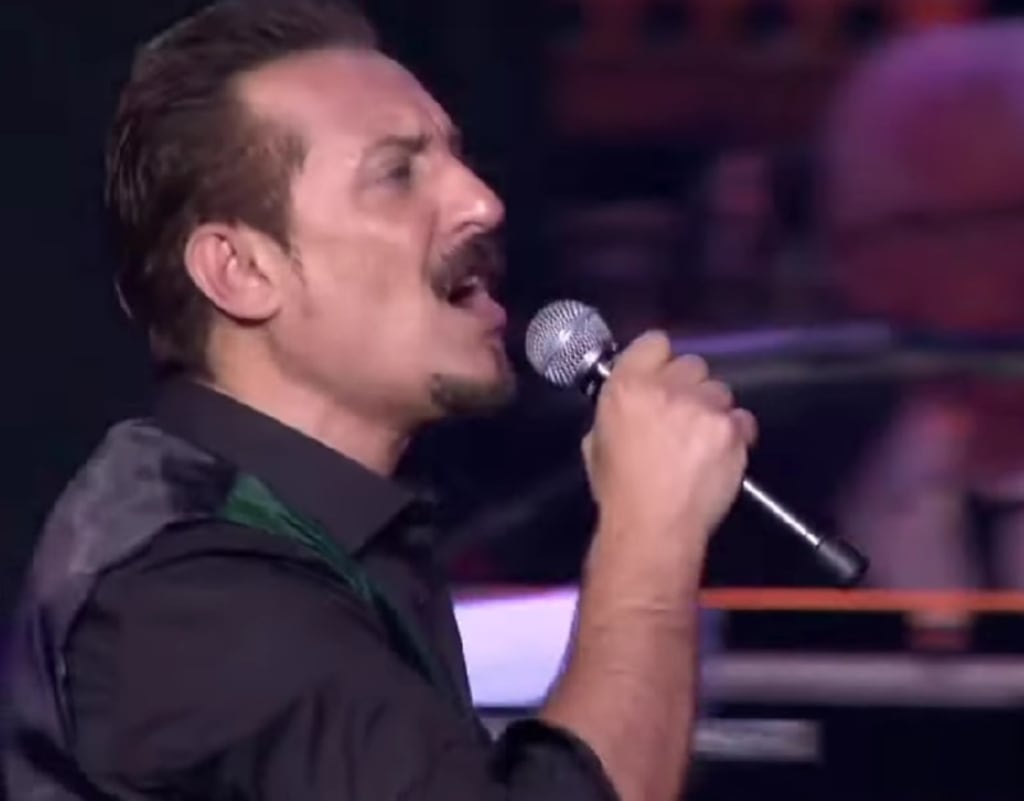
Reinterpreting Tradition in the Modern World: The Experience of Afghan Musicians in the West
Author: Islamuddin Feroz, Former Professor, Department of Music, Faculty of Fine Arts, University of Kabul
Abstract
In the face of global migration trends and the formation of diasporic communities, Afghan musicians residing in Western countries encounter complex and multifaceted challenges and opportunities. This article examines how these artists engage with the musical traditions of Afghanistan, including indigenous instruments, local melodies, classical modes, and broad cultural references. The research demonstrates that the reinterpretation of these traditions in a diasporic context is not merely a repetition of the past, but a dynamic, creative, and innovative process that allows artists to redefine their identity, reconstruct cultural memory, and establish a dialogue between Eastern and Western cultures. Analysis of musical examples and artists’ narratives shows that for Afghan musicians, the reinterpretation of tradition serves both as a tool for preserving and transmitting cultural heritage in exile and as a means of producing meaning, expressing migratory experiences, and establishing effective and widespread connections with a global audience.
Keywords: Afghan music, diaspora, tradition reinterpretation, artist migration, cultural identity, globalization
Introduction
In recent decades, Afghanistan has faced multiple political, social, and cultural crises that have forced many musicians to leave their homeland and migrate. In this context, Afghan artists abroad, particularly in the West, encounter two distinct arenas: one is the new cultural environment with its audiences, technologies, and stylistic variations, and the other is the musical and cultural heritage they carry from their homeland. This duality simultaneously presents both opportunities and challenges. A key question arises: “How do Afghan musicians in the West engage with their musical heritage?” In other words: “What is the meaning and function of tradition reinterpretation in the modern world?” Addressing this question can enhance our understanding of diasporic art and the ways meaning is produced at the intersections of diverse cultural spaces. The present study aims to analyze this process. It first examines the nature of “tradition” in Afghan music, then investigates the conditions of migration and diasporic experience, and finally presents examples of Afghan musicians residing in the West who have creatively engaged in the reinterpretation of tradition. This research focuses on how these artists interact with musical and cultural heritage, redefine artistic identity, and produce meaning in multicultural contexts, showing how musical traditions can act as a bridge between past and present, East and West, and individual and collective experience.
The Concept of Tradition and Reinterpretation of Tradition in Afghan Music
To understand the phenomenon of tradition reinterpretation, one must first address the very nature of tradition in Afghan music. Here, “tradition” does not merely refer to a set of ancient melodies and tunes, but rather to a system of knowledge, emotion, worldview, and musical praxis that has developed over centuries within Afghanistan’s geographical and cultural context. Afghan music has emerged from the interaction and coexistence of various ethnic groups—Pashtun, Tajik, Hazara, Uzbek, Turkmen, and Nuristani—and consequently possesses a multi-layered and polyphonic structure. Each region contributes to this tradition with its own dialects, rhythms, and instrumental arrangements: from the melodies of the North and Badakhshan to the love songs of Herat and the martial tunes of Kandahar. Indigenous instruments such as the rubab, dambura, tanbur, tabla, dhol, sarinda, and harmonium are not merely musical tools but carriers of cultural identity, each imbued with symbolic and semantic meaning. These instruments appear in social ceremonies, religious rituals, festivals, and oral narratives, serving as preservers of history and collective memory. Afghan musical tradition has always been in dialogue with surrounding cultures. Shared musical traditions from India and Pakistan to the east and south, Iran to the west, and Central Asia to the north have made Afghan music inherently cross-border and dynamic from its inception. In the twentieth century, with the expansion of media and urbanization, Afghan music underwent modernization. Artists such as Ahmad Zahir, Sarban, Zaland, Zahir Howida, Ahmad Wali, Wahid Qasemi, Rukhsana, Mahvash, and others, by employing Western instruments like guitar and organ, attempted to reconcile tradition with modernity. Indeed, their music represented some of the earliest conscious manifestations of “tradition reinterpretation” in a modern context.
However, the concept of “reinterpreting tradition” extends beyond merely using an old instrument or melody. Culturally and aesthetically, reinterpretation refers to a re-examination of past heritage in a new context; an effort to keep roots alive while responding to contemporary needs. In this process, the artist seeks to balance fidelity to authenticity with the necessity of innovation. In the contemporary era, especially among Afghan musicians in the West, tradition reinterpretation has become a form of identity and cultural practice. These artists employ indigenous melodies and instruments in new forms, taking tradition out of its local setting and introducing it to a broader global audience. They view tradition not as a closed or completed entity but as a living, open text that can be rewritten and recreated (Nakhaie, 2025, p.64). Thus, tradition in Afghan music represents a historical and cultural continuum, continuously redefined according to the collective needs and experiences of the people. Tradition reinterpretation, in essence, continues this natural process of transformation—an effort to convey the voice of the past to the present without losing its meaning and spirit.
Migration, Diaspora, and Afghan Music in the West
The migration of Afghan artists to Western countries is a phenomenon that has intensified in recent decades, especially following successive wars, political insecurity, and the reestablishment of Taliban rule. These relocations have not only changed their place of residence but also brought profound transformations in their cultural and artistic way of life. Afghan artists, across generations, have settled in societies that differ fundamentally from Afghanistan in cultural, linguistic, and social contexts. In these environments, they encounter audiences often unfamiliar with Afghan music and its roots, yet, through new technologies and digital media, they are receptive to fresh sounds and cross-cultural collaborations (Kölbl, 2021, p.7). Residence in the West presents a dual aspect for Afghan artists: on one hand, it provides opportunities for experimentation, innovation, and global presence; access to modern studios, digital distribution networks, international music festivals, and freedom of expression are conditions rarely available in their homeland. On the other hand, this position comes with deep identity and cultural challenges: the risk of disconnection from roots, pressure to align with Western market tastes, and the fear of losing the authenticity of traditional music are among their main concerns. Studies on Afghan musicians in Europe show that many consider themselves guardians of Afghan musical heritage, feeling responsible for keeping the country’s vocal and instrumental traditions alive in exile, even as new generations grow up in entirely different environments. This sense of cultural commitment has made music not only a means of livelihood or entertainment but also a form of memory and cultural resistance (Foschini, 2023). From a theoretical perspective, the diaspora can be seen as a context for the development of a reflective artistic identity. The Afghan artist in the West exists between two cultural worlds: the one they originate from and the one in which they now live. This intermediary position compels them to creatively mediate between heritage and the new environment. The result is the emergence of new musical forms that reflect Afghanistan’s indigenous traditions while being influenced by global musical structures and tastes. Migration and diaspora thus serve as driving forces for the reinterpretation of tradition. Afghan artists in the West turn to reinterpreting their cultural roots both to redefine themselves and to survive in the global market. By combining traditional and modern elements, they transform music into a space for dialogue, identity reconstruction, and expression of exile experiences (Kölbl, 2021, pp. 9–11).
Reinterpreting Tradition in the Works of Afghan Musicians
In all the examined examples, the reinterpretation of tradition in the works of Afghan musicians residing in the West manifests in diverse and multilayered forms. This process is not a single act but a combination of musical, cultural, and identity elements, each gaining meaning in interaction with the others. The main dimensions of this reinterpretation can be categorized and explained as follows:
1. Use of Indigenous Instruments and Melodies in a Modern Context
Many Afghan musicians in the West remain faithful to traditional instruments such as rubab, dambura, tabla, tanbur, and harmonium. These instruments are not only performance tools but also carriers of cultural memory and identity. However, their function has transformed in the new context. They are no longer played solely in traditional gatherings or local ceremonies; rather, they are reproduced in modern studios, using digital recording, mixing, and electronic arrangements, reaching international audiences through global platforms like YouTube and Spotify. In this new space, Afghan artists have sought to place indigenous instruments in dialogue with modern Western instruments to create a hybrid, multilayered, and global sound. For instance, combining the rubab with electric guitar, keyboard, and digital drums creates a harmony between East and West; a sound that retains the depth and resonance of tradition while presenting freshness. Such combinations can be heard in the works of Wahid Qasemi, Akhtar Shoukat, Farhad Darya, and several other Afghan musicians, who have managed to recreate classical and local Afghan music in a modern, global format. This transformation should not be interpreted as a break from tradition but as a conscious effort to revive authenticity in a contemporary framework. What occurs in these works is a dialogue between past and present, where traditional Afghan instruments, alongside modern technology, create a renewed narrative of musical identity. This approach preserves cultural heritage while enabling Afghan music to be heard globally and maintain a living connection with new generations, both in Afghanistan and in the diaspora (Shoukat, 2013).
2. Integration with New Musical Elements and Styles
One of the most prominent features of tradition reinterpretation in contemporary Afghan music is the conscious blending of local music with global styles such as pop, rock, jazz, and electronic music. This fusion is not merely an aesthetic or technical experiment but a cultural response to life in migration and multicultural environments, where Afghan artists are in constant contact with diverse musical cultures, tastes, and instruments, compelling them to adapt their artistic language. Afghan musicians in the West, due to living in multilingual and multicultural environments and having access to advanced studios and new production technologies, have expanded their musical language beyond traditional boundaries. This experience has enabled them to create works that remain faithful to their indigenous roots while being understandable and appealing to global audiences. For example, many Afghan singers and composers use rhythms and melodies from various regions of Afghanistan—including Pashto, Qataghani, Logari, Badakhshi, Hazara, and Panjshir—and present them in pop, rock, or pop-fusion arrangements. In these works, Afghan cultural roots are reproduced in a modern form, allowing Afghan listeners to feel familiarity and belonging, while non-Afghan audiences can enjoy the energy, rhythm, and sonic diversity. Ultimately, this approach has resulted in a form of intercultural or transnational music that crosses geographical, linguistic, and ethnic boundaries, narrating the experiences of migration, transformation, and cultural connection. Examples include the song “Mai Bli Bli, Norband Norbandi”, a collaboration between prominent rubab player Homayoun Sakhi and Shafiq Mureed, which vividly embodies this process (Mureed & Sakhi, 2023).
In this piece, the dambura, Hazara rhythm, and melody combine with the rubab—symbolic of classical and traditional Afghan music—alongside pop arrangements and modern beats, producing a unique fusion of indigenous and contemporary sounds. This juxtaposition not only showcases the interaction of tradition and innovation but also demonstrates the capacity of Afghan local music to adapt and evolve in a global context. In such works, the rubab, with its soft, resonant, and contemplative tone, connects past and present, while the dambura, with its livelier sound and rhythmic energy, conveys the vibrancy, popular character, and dynamism of music from Hazara regions. The combination of these instruments in a pop setting is aesthetically compelling and illustrates the dynamic potential of Afghan musical tradition to thrive in new formats without losing its authentic essence. Such works clearly embody “tradition reinterpretation” in the context of migration, where Afghan artists, using indigenous instruments and modern tools, transform music into a language of cross-cultural and intergenerational dialogue.
3. Representing Migration and Exile Experiences Through Music
For many Afghan artists, tradition reinterpretation is not merely an aesthetic practice but a means of expressing emotions and narrating migratory experiences. In their works, local melodies are often paired with lyrics reflecting separation from the homeland, feelings of estrangement, longing, and hope for return. Music here becomes a language for memory and cultural connection, enabling the recreation of memories of a place now distant. Thus, musical tradition functions not only as a reconstruction of the past but also as a bridge between lost homeland and present life. Prominent examples of this type of tradition reinterpretation are evident in the works of Afghan musicians residing in the West, particularly Farhad Darya, Dawood Sarkhosh, Amirjan Saboori, and Dawood Pejman, who use lyrics and melodies that convey nostalgia and separation from the homeland to communicate the migratory experience to their audiences. Their works show that music can serve both as a means of preserving cultural identity and as a medium for connecting with diasporic experiences (Kölbl, 2021, p.15).
4. Reflection and Reconsideration of Stabilized Identity
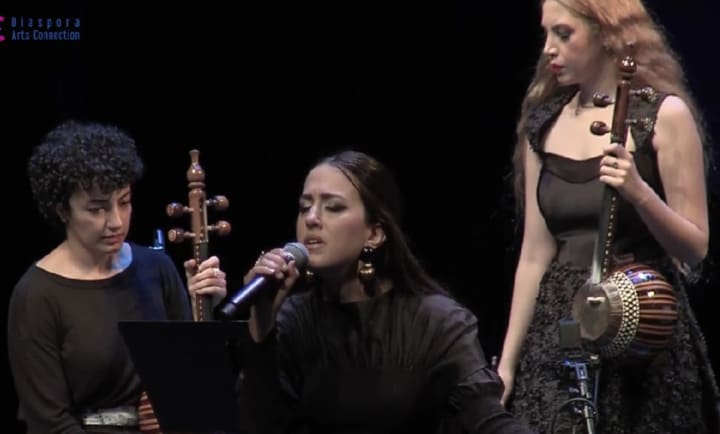
In the process of tradition reinterpretation, Afghan artists in the West naturally confront profound identity questions. They are no longer merely representatives of traditional Afghan culture, nor are they fully part of the Western cultural space; rather, they occupy an intermediary position that imbues their works with reflection and reconsideration regarding the meaning and stability of cultural identity. Their music often narrates internal struggles between two cultural worlds, where Eastern roots merge with Western experience, resulting in a new, multilayered, and fluid identity. This reflective process and reinterpretation of tradition constitute a fundamental function of Afghan music in the modern world, allowing artists to preserve cultural authenticity while connecting with global audiences. For instance, Bano Mozhgan Shahnaz Kabir, a prominent artist, clearly demonstrates this blended identity in her music; her works incorporate both Eastern and traditional roots and Western influences, representing a hybrid, intercultural identity (Shahnaz Kabir, 2020).
5. Interaction and Dialogue with the Western Music Market and Audience
Afghan artists in exile, in order to sustain their artistic activity and gain visibility in the global arena, are inevitably required to engage with the production, distribution, and market systems of Western music. This interaction not only transforms the way music is presented but also reshapes the processes of production, promotion, and even the definition of the “audience.” In this context, Afghan artists redefine their musical tradition so that it becomes understandable, listenable, and appealing to non-Afghan listeners, without compromising its cultural spirit and authenticity. This adaptive process sometimes leads to changes in song structure, lyrical language, performance style, and visual imagery. Many Afghan singers abroad have adopted multilingualism; they blend Persian, Pashto, or Dari lyrics with English verses to connect with a global audience. Additionally, the use of modern studios, electronic arrangements, and professional music video production has further enhanced the visibility of their works in the international market. Importantly, many of these artists, while engaging with the global market, have managed to preserve the essential essence of Afghan music. They use the market not as a limiting force but as an opportunity for cultural dialogue and presentation—a dialogue between East and West, tradition and modernity—through which Afghan music is heard globally as a voice of identity, memory, and Eastern aesthetics. A prominent example of this approach can be seen in the pop-rock song “Salam Alaik” by Farhad Darya; a piece that, through contemporary language and rhythm yet with Afghan emotional and cultural roots, resonates meaningfully with both Afghan and Western audiences (Daria, 2018). This work symbolizes a form of cultural mediation, where music becomes a bridge between two worlds. On one hand, its modern structure and rhythm conform to global music production standards, while on the other, its emotional content and Eastern spirit are rooted in Afghan collective memory and identity. In general, the reinterpretation of tradition in the works of Afghan musicians in the West can be seen as a dynamic and multilayered dialogue between past and present, East and West, individual and society. In this dialogue, music is not only a medium for artistic expression but also a tool for redefining cultural identity within the context of migration and the contemporary world. Afghan artists in the diaspora, through voice, instruments, and narrative, build a bridge between the auditory heritage of their homeland and the lived experience in the West—a bridge where roots and new experiences converge. In their creative process, they utilize tradition not as a static inheritance but as a living, inspiring, and reinterpretable resource. In their works, the past is present not as repetition but as transformation and reinvention. By combining traditional instruments such as rubab, tanbur, harmonium, dambura, and others with modern instruments, and blending local melodies and rhythms with global structures such as pop or rock, they demonstrate that tradition can acquire new meaning and vitality amid global changes. This form of tradition reinterpretation is a conscious cultural act, an effort to balance authenticity with innovation. Through reproducing their music in exile, Afghan artists effectively engage in a dialogue with two worlds: with their own ethnic and territorial memory and identity, and with a diverse, polyphonic world that requires cultural acceptance and interaction. For this reason, the music of this generation of Afghan artists can be described as “intercultural music”; music that echoes indigenous traditions while reflecting the modern world. By creating such sounds, they symbolically show that tradition does not exist in opposition to modernity but thrives through dialogue with it; and it is within this dialogue that new meanings of identity, belonging, and aesthetics are formed.
Conclusion
Afghan music in the West, particularly the works of Afghan artists in the diaspora, offers a clear example of how tradition is reinterpreted in the context of globalization and cultural migration. The findings of this study indicate that the reinterpretation of tradition among these artists is not merely the preservation or repetition of the past but a creative and dynamic process in which traditional elements are reproduced in new and global forms. For these artists, music is not only a means of artistic expression but also a tool for redefining identity, maintaining connection with the homeland, and engaging in dialogue with other cultures. In the experience of Afghan artists residing in the West, tradition operates as a living and evolving phenomenon. Using indigenous instruments such as rubab, dambura, tanbur, harmonium, and tabla, alongside modern recording and production technologies, they have constructed a bridge between past and present, East and West, and memory and innovation. This music reflects their intercultural life and layered identity—a form of identity in which the boundary between tradition and modernity becomes a space for dialogue and creativity rather than separation.
Overall, the reinterpretation of tradition among Afghan diaspora artists can be understood as a strategy for cultural resilience and identity reconstruction in exile. Through their music, they confront the risk of cultural forgetting while simultaneously creating a new voice for presence in the contemporary world. Their music carries an aesthetics of migration: a sound that emerges from absence and longing yet culminates in hope and cultural connection. Finally, this study emphasizes that examining the phenomenon of tradition reinterpretation in Afghan music requires deeper field research—investigations into artists’ personal experiences, their interaction with audiences, and the impact of digital technologies and new media on shaping this type of music. Such studies can expand our understanding of the role of music in cultural reconstruction among migrant communities and its capacity for global dialogue.
References
Darya, Farhad. (2018). Salamalik Kabul. https://www.youtube.com/watch?v=69stl3Pw3oI
Foschini, Fabrizio. (2023). Hearts Turned Away from Music: Afghan musicians’ paths to exile. https://afghanistanpeacecampaign.org/2023/04/24/hearts-turned-away-from-music-afghan-musicians-paths-to-exile/?utm_source=chatgpt.com
Kölbl, Marko. (2021). Ethnomusicology, Fieldwork, and the Refugee Experience: Notes on Afghan Music in Austria. Music & Minorities. Department of Folk Music Research and Ethnomusicology, mdw – University of Music and Performing Arts Vienna, Austria. Pp 1-23.
Mureed, Shafiq & Sakhi, Homayoun. (2023). Maye Bali Bali- Norbande Norbandie. https://www.youtube.com/watch?v=99Qw5nrjV7w
Nakhaie, Maryam. (2025). Cultural Disjuncture and Music among the Second Generation of Afghan Immigrants in Iran. Pp 59-69.
Shoukat, Akhtar. (2013). Hama omur bar nadaram. https://www.youtube.com/watch?v=SM9HtI23aLk&list=RDR2KXveyazjs&start_radio=1
Shahnaz Kabir, Modjgan. (2020). Interview with Hamayon & Mozhgan Shahnaz Kabiri. Ariana Television YouTube Channel: Sobho Zindagi.
About the Creator
Prof. Islamuddin Feroz
Greetings and welcome to all friends and enthusiasts of Afghan culture, arts, and music!
I am Islamuddin Feroz, former Head and Professor of the Department of Music at the Faculty of Fine Arts, University of Kabul.
Keep reading
More stories from Prof. Islamuddin Feroz and writers in Beat and other communities.
Ludacris and Nelly draw backlash over bookings at MAGA-coded music festival
Ludacris and Nelly headlining a mostly right-wing event is good for them. It’s also great for the genre of hip hop. The two rap veterans have showcased their talents on other stages. Why can’t they perform for mostly MAGA folks and grab that bag?
By Skyler Saunders5 days ago in Beat



Comments
There are no comments for this story
Be the first to respond and start the conversation.