
Paris Paloma Teaches Us About the Character of Place
my thoughts on "Village Song"

Place usually falls into the “where” of the “who, what, when, where, why, how?” establishment of a story. But what if “where” was also “who”?
Paris Paloma teaches us through the lyrics of Village Song how it is possible for a setting to become a character of its own.
Paloma’s music style seems to fall mostly into alternative, indie, and folk. It’s possible you’ve heard at least parts of Labour, also by Paloma, which currently has 30M views on YouTube. But before the release of Labour and her album Cacophony, I first discovered Paloma through Village Song. It remains my favorite of her creations.
If you are unfamiliar with my lyrical deep dives, we will be exploring the lyrics of this song and why they are so meaningful. Please listen to the song before reading on.
Village Song by Paris Paloma
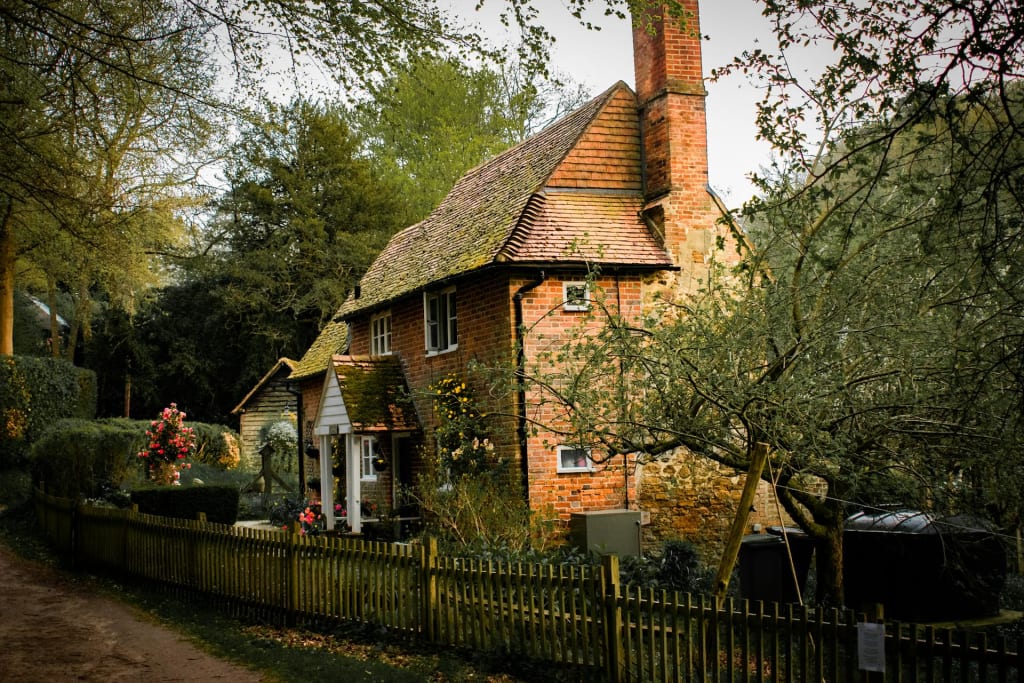
Verse 1 of Village Song opens with a quaint scene of a woman cooking in a cottage by a willow tree. This introduces the significance of small interactions between people and place. Also in Verse 1, we learn that the narrator is quite familiar with the history of this village; The first owner of the neighboring white house took his own life. The narrator wonders if the new owner knows this history of their home. Here, the narrator asks us to consider the importance of place, our knowledge of it, and the role it plays in our lives.
So, how does the village, itself, come to life?
“And the blackberry juice drips like blood on the leaves
And the blood on the fox drips like dew from its teeth
And the dew in the field falls like petals, so sweet
And the petals they fall and turn brown at my feet
And the rhythms of autumn wash over me, ah”
-Paris Paloma, Village Song
Connection brings the place to life. In the first Chorus, we can see that the lines are connected by words: “blood”, “dew”, and “petals”. That connection is then summarized in the final line of the Chorus as “the rhythms of autumn”. So, the patterns of these connections are also significant to the character of this place.
In Verse 2, we learn more about the inhabitants of the village: an elderly man, his wife and her family who have all passed and are at rest beneath the dew. The narrator considers that the elderly man will soon join them. Here, the story is enriched further by considering the importance of togetherness; The collective holds the story of the village. Even in death, they are a part of it, and the village is a part of them.
“And the apples they fall like the shells from the guns
And the shotgun, it misses the hare when he runs
And he moves like the wind with cold air in his lungs
And his little warm heart beats in fear like a drum”
-Paris Paloma, Village Song
In the second Chorus, movement is introduced: apples falling, gun shells falling, hare running, wind, breath, heart beats, drum — a rhythm of the collective. This sense of collective movement, a song of the village, gives the lyrics even more evidence that the village, itself, is alive. This is further confirmed in the bridge:
“And the village it lives through the rhythms of autumn”
-Paris Paloma, Village Song
This line significantly summarizes the heart of the scene: the village is brought to life through the patterns and the rhythms of autumn, a time of a change. How does this help us understand the village as a character of its own?
Would the inhabitants be there if the village didn’t exist? No. And we can see that there is not one focal villager. Even the narrator seems an interloper, going in and out of the village. But when the narrator returns, “the rhythms of autumn” wash over them, as if the village itself is reaching out its arm and welcoming the narrator home in a warm embrace.
The village has universal significance within the story. There is a familiar and intimate connection between the village and the villagers. Patterns and the rhythms of change bring life to the village. In these ways, Paloma has shown us that this place, the village, is the main character of the story. It moves, breathes, and has an identity of its own.
***
Hello wanderer!
If you enjoyed this lyrical deep dive, you may want to check these out:
xoxo,
for now,
-your friend, lost in thought
About the Creator
Sam Eliza Green
Writer, wanderer, wild at heart. Sagas, poems, novels. Stay a while. There’s a place for you here.
Keep reading
More stories from Sam Eliza Green and writers in Beat and other communities.
Mon Rovîa Teaches Us How To Be Still
A song is worth the listen if it has an emotional impact; The music gets you going, out of a funk, or pulls you into another world entirely. Perhaps that’s why we make playlists of songs with similar vibes: to recreate a specific mood with music. Sometimes, a snappy beat is enough to hook a listener's attention, and it can often be angelic vocals that keep pulling you in.
By Sam Eliza Green2 years ago in Beat
Review of 'Man on the Run'
My wife and I saw Man on the Run, a nearly 2-hour documentary on Amazon Prime, about Wings, Paul McCartney's group that flew around the world from shortly after The Beatles broke up in early 1970 to shortly after John Lennon was murdered at the end of 1980, making a Beatles reunion forever impossible.
By Paul Levinson6 days ago in Beat
MAYLIE?
MAYLIE (born December 2, 2004) is an international pop artist and songwriter, known as Somelsy on Instagram. Born into a musical family and raised in a quiet town near the capital, she was immersed in music from infancy. As the granddaughter of a guitarist from a vocal-instrumental ensemble, she began experimenting with the guitar and synthesizer even before she could speak. It was her grandpa who instilled in her a lifelong love for music. Her Instagram account is entirely dedicated to her grandfather's guitar collection. The collection includes about 10 guitars of various ages, even from the 1980s.
By Alex Croft5 days ago in Beat
Unofficial Challenge: Black History Celebration
Forward: February 28th, 10:53 PM, EST... The final hour of Black History Month, 2026. Hello fellow writers. I've had this challenge waiting in my drafts for most of the month. But I held off on publishing it, until now.
By Sam Spinelli6 days ago in Writers



Comments (1)
I am a simple person. I see Paris Paloma, I click and read. Loved this!