
Mandalay Singer's Story: The Eclectic Sound and Style of Nicola Hitchcock
She is best remembered as Mandalay's frontwoman. But Nicola Hitchcock's body of work extends far beyond her 7-year stint as the "Mandalay singer"


At the turn of the new millennium, in 2001, Nicola Hitchcock was on the verge of major stardom. Back then, she occupied the role she is best known for today: frontwoman of the British trip-hop duo Mandalay, for whom she contributed lyrics and her trademark shivery vocals.
But Mandalay abruptly disbanded in 2002, just as they'd begun to make a name for themselves across the pond in America.
Since then, Nicola has popped up sporadically as a solo artist and session vocalist. Still, despite a voice that has been compared to the likes of Madonna and Liz Fraser (of Cocteau Twins fame), she remains an enigma in the music world -- unfairly so according to many fans who have stuck around since her Mandalay days.
Among their comments on Mandalay-related YouTube videos read:
"Unfairly underrated."
"It's so devastating. Her voice could have carried any band."
"Such a shame, why were they not successful?"
For answers to the last question, as well as a dispelling of the persona that is Nicola Hitchcock, keep reading for an in-depth glimpse into her life and career.
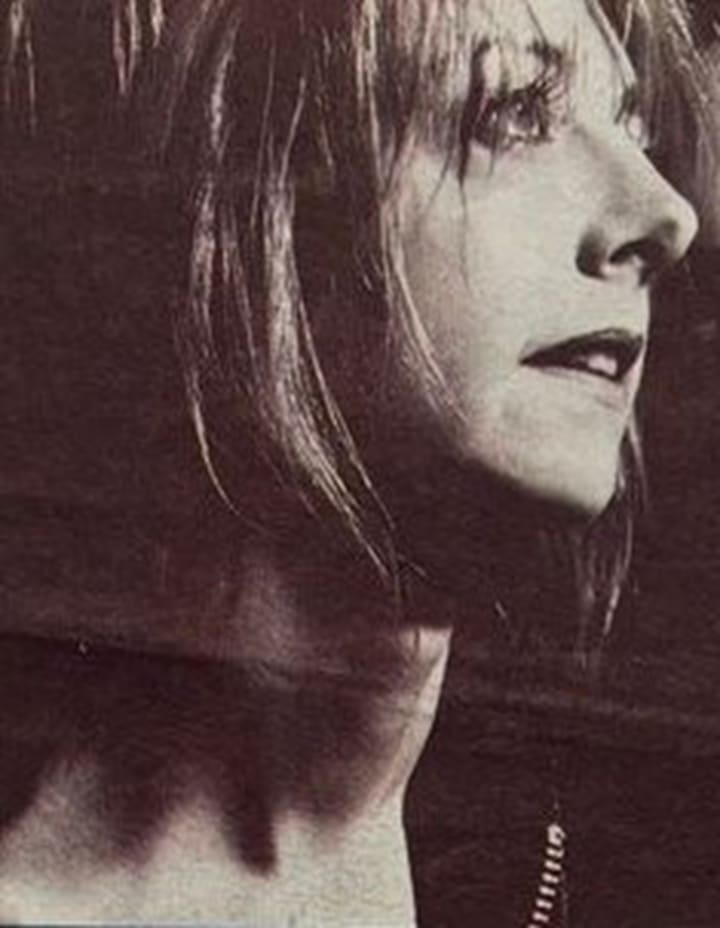
Mandalay Singer's Early Years
Nicola Corinne Hitchcock was born in Paddington, London to William and Corinne (nee Hannam) Hitchcock on July 17th (as for the year, she once quipped, "I'm as old as you want me to be!"). Both parents were active in showbusiness. Her mother was a budding actress before starting a family. And Nicola has described her father, a TV director and producer, as a "natural musician" who could "pick a tune out of any instrument."
Though her parents divorced when she was only three, their influence on her lifelong love of words and creativity is clear. It is particularly evident in Nicola's recollections of times spent with her father. "My Dad was a music addict, always had commercial radio playing in the car and in the house," she says. "He'd sit beside me at the piano making up duets, him at the bass end, me at the top."
Long car rides between the two households were also a setting for musical enactment. Nicola and her two sisters, along with their father, passed the time by making up rhymes and stories. Once at their father's place, the test pressings scattered about the living room were of particular fascination. "I remember... putting them on and jumping around to them as a kid," Nicola recollects.
Nicola received her first guitar on her 9th birthday and promptly began teaching herself chords and writing songs. "From a very young age, it was a source of joy and solace for me," she said. "Just me and my guitar, I could play and sing for hours on my own quite happily." Kate Bush, David Bowie, the Beatles as well as the Motown genre were among her early inspirations.
At 15, Nicola began gaining stage experience as a backing vocalist for a variety of cover bands along London's live music circuit. During this time, she learned to play harmonica, accordion, keyboard, and percussion to complement her formidable vocal and guitar skills. She also got her first taste of working in studios.
Early Professional Work
Despite her passion, Nicola admits it took her a while to think about music as a career. Her initial aspirations were to teach music to infant children. When she began the training, however, she felt out of place. Nonetheless, Nicola still managed to add yet a couple more new skills to her musical repertoire, including classical composition and opera singing. She particularly enjoyed the latter. "I had a lovely and enthusiastic teacher and really wanted to learn," she said.
Even so, going solo was not a natural choice for Nicola. She once recalled: "I was what you might call a late developer in terms of confidence." But after taking a self-development course, Nicola finally mustered the courage to reply to a box advertisement in Melody Maker, a British weekly music magazine. "Box adverts were always more serious," she explains, "because they were more expensive, and this band said they had a record deal."

The band she alludes to was Eternal Triangle, a British new wave band, active in the early 1980's. Nicola got the job, and contributed background vocals and keyboards to their sole album, Touch and Let Go, in 1984, as well as its two associated singles. She also played a handful of live dates with Eternal Triangle before they ultimately folded.
"After that," Nicola said, "I had the confidence to try to write and perform solo." She went onto write numerous songs, and finally made a 3-song cassette, which she sent to various record labels while performing her original work at folk clubs throughout London.
Eventually, F-Beat Records responded Nicola's tape and signed her to her first album.

"Bowl of Chalk," a "Remarkable" Debut
Nicola Hitchcock's debut album, entitled Bowl of Chalk, was released in 1993. Though it was well-received, fans of Mandalay -- Nicola's main claim to fame -- would have hardly recognized her. The recording itself was low key and acoustic, with folk accents of accordions, whistles, and hand drums rounding out the 12 stripped-down yet atmospheric compositions. British jazz and folk musician Danny Thompson even contributed double bass on several tracks. The highlight of Bowl of Chalk, however, was Nicola's deliquesced, vibrato-rich vocals, heard loud and clear at the forefront of every song.
As per Colin Irwin of Folk Roots Magazine:
"...there's something indefinably magical in her delivery and in the very human troubled personal conflicts in her exceptional lyrics... a remarkable debut."
Following the release of Bowl of Chalk, Nicola Hitchcock enjoyed a newfound enriched reputation on London's folk and acoustic circuit. She performed full-band concerts at the Guildford, Cambridge, and Phoenix Folk Festivals.
Unfortunately, however, F-Beat Records folded, along with the remainder of Bowl of Chalk's promotional plans, shortly after its release.
Voice of Mandalay
Inspired by the developing trip-hop scene spearheaded by the likes of Portishead and Massive Attack, Nicola sought to expand her musical horizons. The idea of working in a co-writing partnership particularly intrigued her, and she replied to another ad in Melody Maker for a vocalist and collaborator. Multi-instrumentalist and producer Saul Freeman, previously half of the acclaimed pop duo Thieves, had placed the ad.
"We met. We worked on three songs together," Nicola told Musical Discoveries in 2001. This initial partnership evolved into what would become the sensational trip-hop duo, Mandalay.

Mandalay would take its name from the stately home of the Alfred Hitchcock (no relation) film Rebecca. Originally spelled as Manderley ("we spell it Mandalay because it scanned better that way"), this new project's sound would be an extreme departure from Nicola's primarily acoustic debut. One of the few similarities would be that Mandalay, like her solo work, adhered to a "less is more" philosophy emphasizing precision of the music's timing and space. This led to compositions that, while simplistic, were far from lifeless. Guitars and accordions were traded for smooth dance beats and avant-garde textures. As always, Nicola's voice was the driving force.
Mandalay's other half, Saul Freeman, explained: "... we've ended up doing what we do because you can get caught up in instrumental dance music but eventually miss songs, which is where Nicola's background came in."
The duo's first single, Flowers Bloom, was released in September 1996 on Organic records, and named Single of the Week in Melody Maker. This led to a full record deal with the newly established label V2 Music.
Mandalay's Debut Album, Empathy
Mandalay's debut full-length album, Empathy, was released in March of 1998. Empathy came to the attention of Madonna, who proclaimed the promising duo her "new favorite band." She even chose This Life, one of the singles from the album, to be featured in the soundtrack for her new film, The Next Best Thing. The track also appeared on the soundtrack to the British film, This Year's Love.
The Australian tabloid, Sydney Morning Herald, was also impressed, writing, "This is the album Madonna was trying to make with Ray of Light. Sultry without reeking of sex... a patina of sadness without mistaking seriousness for worthiness."
Instinct & Solace
Mandalay released their second album, Instinct, in 2000. It was co-produced by Andy Bradfield, known for his work with Bjork and Everything but the Girl. Instinct showcased a slight evolution to Mandalay's sound, drawing inspiration from jazz and classical genres.
Two more singles were also released: Not Seventeen and Deep Love.
A year thereafter, Mandalay released a compilation album, Solace, exclusively in the US where they were known mainly by hearsay and association. This release was comprised of select tracks from their two previous albums, both unavailable in the American market, and was packaged with an 11-track remix album.
Solace sold over 44,000 copies in the US, and the duo went on a brief tour to promote it.
Mandalay, by all appearances, seemed to be on the rise. But for Nicola Hitchcock, the taste of potential fame turned out to be far from a dream come true. Instead, it marked the prelude to a personal hell -- an epiphany that came to her during the US tour.
Nicola told Musical Discoveries in 2005.
"I think it came home to me in the US that if Mandalay were to become successful... I would be spending more and more, if not most, of my time with people that I was having a great deal of difficulty being with... So in a way, the sniff of success was a wake-up call."
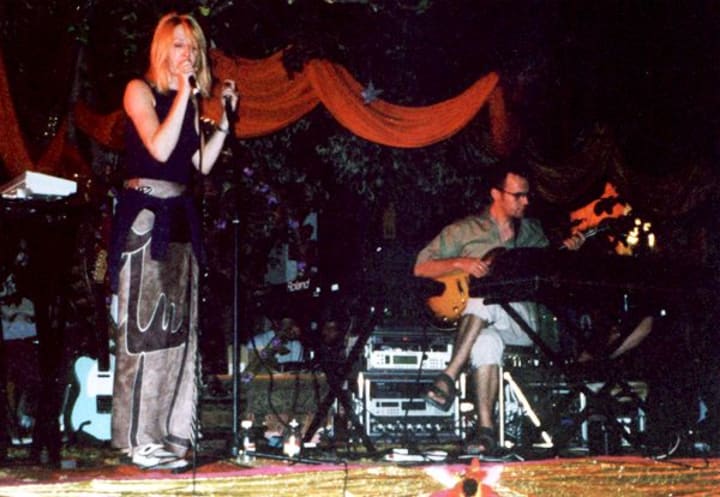
Of all Mandalay's songs, Nicola has said that Insensible is her favorite, and is the song she feels best represents the duo. The lyrics, she says, are about "being betrayed and not finding out until after the fact." A deeper dive into her Mandalay material reveals this to be a recurring theme in her songwriting during this period. She says their track, It's Enough Now, is about "a relationship breaking down but not being able to end it."
Nicola expressed signs of these very sentiments when discussing the subject on the message board of her official website in 2003:
"I had been hanging on and trying to ignore my feelings (ie. wanting to get out of it) for a long time because I believed in the music we were making together. We had differences of opinion regarding business more than the music and eventually reached stalemate. I'm sure you would like more in depth info than that, but I don't want to get into naming names and stuff. So just know that musically I loved what we did and was always committed to it, and it took a lot of courage and strength to walk away. But for my health and sanity, it was a good decision."
Post-Mandalay Projects: "Passive Aggressive" and More
Nicola Hitchcock has also been upfront about the challenges that followed her departure from Mandalay, both personally and professionally. "To be honest, it took some years to sort out all the leftover financial and business affairs after Mandalay broke up," she said. Her career was subsequently interrupted by a battle with Epstein Barr virus, and a move from hometown London to the purer ions of rural Devon.
Fronting Mandalay did come with its perks, however. Nicola's trademark songwriting and vocal abilities had captured the attention of several avant-garde composers, including the late Hector Zazou, and Lenny Ibizzare. Underground artist and DJ Chris Brann, also intrigued by the former Mandalay singer, came her way with collaborative offers.

Nicola's personal favorites of these post-Mandalay collaborations eventually became her long-awaited second solo album, Passive Aggressive, released on her own newly formed Tempted Records.
Passive Aggressive largely continued with Mandalay's trend of electronic avant-garde soundscapes and down-tempo dance beats. Intertwined here and there throughout the album were accents of simple piano progressions with some tracks even opening with classical-esque orchestral sequences.
It had proved a daunting process, as Nicola still professed an admiration for Saul Freeman's sound manipulations, which she knew would no longer be a part of her work. Though now that she was free to follow her own path, this new album was also a way to make right, in a sense, some of the more unfulfilling moments of her time with Mandalay. Among these was "to have been included in the music and respected for my musicianship and ability as a producer."
Nicola's efforts on this front, as well as the rest of the album, were well-received. A review of Passive Aggressive from an unspecified author states: "... Plaintive, melancholy and full of feeling; Nicola’s songs have an honesty that you can feel in her voice even before you hear it in the words."
Additional Collaborations
After such a long-awaited comeback, however, musical output began to slow down for Nicola Hitchcock following the release of Passive Aggressive. But that as it may, she lent her trademark vocals and heartfelt songwriting to two more collaborations. The first, in 2006, was for electronica duo Sleepthief's debut album, the Dawnseeker. The second was on electronic rock artist Steve Jansen's album, Tender Extinction, released in 2014.
Quarterbright EP and Song for Rachel
In between these associations, Nicola also released a self-published EP, entitled Quarterbright, in 2012. The EP consisted of three new songs. These tracks hearkened back somewhat to her acoustic debut, yet remnants of her more recent electronic work were still present.
Shortly after the Quarterbright EP, however, Nicola seemed to all but drop off the radar screen. In 2020, she suddenly resurfaced with a self-published single titled Song for Rachel, a poignant and soul-bearing piece, in memory of her best friend, who passed away unexpectedly in 2006. Rachel had also been the subject of the song Heart on Nicola's Passive Aggressive album.
Future Aspirations?
Whether this last brief emergence is the "swan song" of Nicola Hitchcock remains to be seen. No matter what happens, the former voice of Mandalay has made it clear she takes joy in the fact that people are still listening. It is evidenced by the following passage on what remains of her official website:
"Music has been a strong source of solace and comfort for me, so maybe subconsciously I wanted to try and do the same for other people," Nicola wrote. "At the same time writing songs is a definitely a cathartic process for me... It wasn’t until people began contacting me online via Mandalay’s message board that I knew what I was doing was reaching some people on a deep emotional level in a positive and affirming way and was helping them through difficult times. That meant (and still means) the most to me – fame and commercial recognition pale by comparison."
. . . . . . . . . . . . . . . . . . . . . . . . . . . . . . . .
Select Tracks from "Bowl of Chalk"
Strange Times
Strange Times is often my favorite track (although it is impossible to decide on a perennial favorite!). The lyrics suggest introspection of the complexities of human relationships in a rapidly changing world while longing for connection amidst chaos. Since this dynamic seems to be the essence of my relationship with society, it resonated deeply. The songs about isolation are usually my favorite on any album.
Maire
Nicola once said that the above song, Maire, was her favorite on her Bowl of Chalk album. The lyrics convey a deep sense of yearning for connection and the pain that comes with absence. It suggests a feeling of disconnect with someone one deeply cares about. The emotional weight of this piece can resonate with people who have had similar experiences.
Select Tracks from "Empathy"
Kissing the Day
Enthralled by these evocative and seemingly cryptic lyrics of this work, I once asked Nicola what this song was about. She replied that it was about being in a place where you want out, but only with no regrets or hard feelings. The "kissing the day" hook is representative of your escape from the situation. As this is something I have longed to feel for years, this Mandalay track has a special place in my heart.
All My Sins
What makes these lyrics so genius is the amount of rumination packed in so few words. We see themes of emotional torture and the defining of one's identity, as well as a longing for closure and forgiveness, all while traipsing through the purities of nature.
Insensible
Insensible, Nicola has said, is the song she feels "most represents Mandalay." and is her "all-time Mandalay favorite." As for the lyrics, it's about "being betrayed and finding out after the fact," she says.
Select Tracks from "Instinct"
It's Enough Now
Nicola says the track It's Enough Now, emotionally & lyrically, is about a relationship breaking down but not being able to end it. It was musically inspired by a backing track from Saul Freeman.
Like Her
Nicola bears her soul in the track, Like Her, which she has said is about being estranged from her sister over a misunderstanding. "We had always been very close before this," she said. "Sad but true." The lyrics might appear sparse, but they're driven by Nicola's genuine and intimate delivery.
Select Track from "Passive Aggressive:"
Heart
Heart was Nicola's favorite track on Passive Aggressive album. She wrote it when her best female friend was critically ill in the hospital. "I went in to see her and she was lying curled up in the middle of the bed, unconscious," Nicola said. "...she's a tall and sassy woman, but she looked so small. I felt so helpless." She proceeded to pull up the file on her computer containing Chris Brann's track and sing. Similar to Like Her with Mandalay (above), the lyrics are sparse but emotional.
Title Track from "Quarterbright" EP:
Quarterbright
Quarterbright take on a more acoustic feel than Nicola's previous work. It is minimalist in composition, and intimate with a slight experimental flair. Of course, her voice is unmistakably her own.
"Song for Rachel" Single:
Song For Rachel
Nicola suddenly (and briefly) re-emerged with Song for Rachel in 2020. It is the perfect conglomerate of Nicola's debut style and that of her subsequent work with Mandalay. Dreamy and affectionate, Nicola delivers a heartfelt tribute. Emotions are raw, but the mix is smooth.
About the Creator
Liesl Grunewald
6G NOLA Native . Dancer, Diver, & Martial Artist for life . Aspiring athletics & movement polymath . Creative techie . Slightly reformed neurotic.
Keep reading
More stories from Liesl Grunewald and writers in Beat and other communities.
12 Things You Didn't Know About Australian Actress Cassandra Harris
Anyone who knows me knows that I have written extensively on the subject of Australian actress Cassandra Harris on numerous occasions. It is therefore pretty well-established that Cassandra Harris is one of my favorite people in showbusiness.
By Liesl Grunewaldabout a year ago in Geeks
It's 2026. Songs Turning 10 This Year
In 2016, we saw the rise of short form videos and what would lead to the birth of TikTok. We cannot forget the Snapchat filters no matter how cringe worthy some of them might have been. It was also the year in which the hit series Stranger Things debuted.
By Jasmine Aguilar6 days ago in Beat




Comments
There are no comments for this story
Be the first to respond and start the conversation.