
I wish, I wish
A new thinking of an old Appalachian ballad

Since childhood, I’ve always been fascinated – haunted – by the music of Appalachia, despite not having settled here until well into adulthood. Traditional Appalachian folk tunes are often sung accompanied by the soul-stirring strings of home-grown fiddle playing that’s been passed down for generations. As often, though, Appalachian songs, especially ballads, aren’t accompanied at all, but offered only with a raw, untrained, and undecorated vocal style. It is a striking metaphor for the culture of Appalachia itself, developed by fiercely independent people who make do with nothing of the bells and whistles that a less forgotten region can rely itself on.
These people, so often unjustly written off as hillbillies and hicks, actually power our nation, still enduring the exploitation of the coal, then fracked gas industries. Generations of Appalachians have been and continue to be destroyed by black lung, company abuse, destruction of the land relied on to live, and the apathy – no, antipathy – of politicians and institutions that are tasked with protecting Americans. Such extensive trauma has opened the door for further exploitation, like from those who profit off of the opioid epidemic, which started in and still devastates Appalachian communities.
Yet Appalachians remain strong, standing against the external forces that would have them beaten down. They fight for the basic right of clean water and against unnecessary, polluting and exploitative projects, like new fossil fuel pipelines, just as they fought the Coal Wars for labor rights. And they continue to fight for and teach with their way of life – one rich with the wisdom of working with the land for food and medicine, and making what you need despite what you don’t have. The United States would quite literally not be the same without this stoic, yet ridiculed and overlooked region.
The paradoxical quality demonstrated in the relationship between Appalachia and the rest of the US finds parallels in Appalachia itself, including in its music. Appalachian ballads tend to be dark, often hopeless, outlets for traumas endured in tension with the Appalachian reality of strength and continued fight despite traumas. These tunes offer a critical pressure valve for the deep, inevitable emotions of a people so often abused. It’s this, alongside the raw, unapologetic nature of traditional Appalachian music, that gives it such a haunting quality. You cannot listen and be untouched.
While I could never come close to achieving the haunting vocal quality that born and raised Appalachians have passed from generation to generation (and, embarrassingly, I do not sing well in general), I have chosen to sing my song unaccompanied, in my own untrained voice, because in Appalachian music, any type of voice is welcome. For this piece, I have rewritten a traditional Appalachian ballad titled I Wish My Baby Was Born. The original song mourns the loss of a potential new life at the hands of death. My lyrics mourn the loss of a potential old life – one before exploitation, one lost at the hands of destruction. (For context, I encourage you to also listen to the original version of the song here. To my knowledge, this is the first recorded version, sung by Dillard Chandler, who long ago lent his voice and knowledge to document the folk songs of Appalachia).
My lyrics are simple and intentionally ambiguous as Appalachian music often is, allowing the narrator a higher level of discretion and the listener a higher level of interpretation. Does the narrator wish their mother had left Appalachia instead of died, or that she had been spared through death? Is the steel river a new gas pipeline ripping and tearing its way through the land needed to survive, or is it from a drug-laden syringe tip, often the only escape from such abuse? Who is the devil, the fiend?
One thing that is not left to ambiguity, though, is the spread of such trauma across generations, not at the fault of the people themselves, but at the fault of exploitative external forces. Again, I stress that the hopelessness of the music is in tension with the fighting reality and strength of Appalachian people. The song also utilizes both religious and natural imagery, as is an oft-used metaphorical device in traditional Appalachian music to layer obscurity and the capacity for interpretation.
While I again acknowledge that my version will not come remotely close to the power of original Appalachian music, I hope that by writing it and sharing it in this space, at least one less person will overlook this beautiful, haunted region. I hope it will inspire someone to look into not only its music, but its history; to read about the Coal Wars; to learn of industry-induced disasters like the Buffalo Creek Flood; and to become aware of continued exploitation and devastation by polluting projects like the Mountain Valley pipeline and the impacts of the opioid epidemic. Most importantly, I hope it will inspire someone to visit this awe-filled place: to experience this dark, enchanting land, and come to see the strength and wisdom of some of the people that fill it and fight for it.
Before you go on to the lyrics, I want to say two more things:
First, I must acknowledge that what is generally described as and what I refer to as Appalachian music and culture is actually frequently adapted from the many centuries-old tunes and ways brought by settlers from the British Isles; on the other hand, the music and culture of the Indigenous peoples of the region has existed for much longer, and much of the nature-based wisdom I previously mentioned was learned from these Indigenous peoples.
Second, if you pronounce it Appa – LAY – shuh, I will throw an Apple-atcha.
-----
Lyrics:
I wish, I wish
Mama had gone
And ne’er seen
The devil’s return
And she’s laid down
‘Side Papaw’s stone
His black lungs
‘Neath the green fern
We may breathe
But we ain’t alive
While the steel river flows
Where the apple should grow
May it be dammed
And fore’er dried
That fiend’s mark
Lifted from our souls
I wish, I wish
I’d ne’er been born
My spirit flung far
From this eternal pain
High above
The falling mountainside
There I fly
O’er the burnin’ rain.
About the Creator
E. L. Stacy
E. L. Stacy’s love for writing began at childhood’s first stroke of a pen. Now 20 years into adulthood, E. continues to write as a means of confronting the world around her - past, present, and future.
Keep reading
More stories from E. L. Stacy and writers in Beat and other communities.
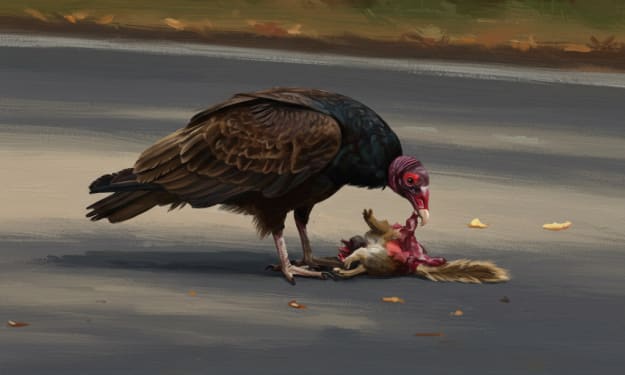
The buzzard and the squirrel. Runner-Up in The Metamorphosis of the Mind Challenge.
Everything is the same, never better. The same… The same…. The same….. The same tiresome playlist on the radio, same trees clawing overhead, same beat-to-death roads and same jarring potholes. I feel my breath catch under the sameness as I drag myself to work. The weight is becoming too much to bear. A snapping approaches, but then something startles the sameness: a tiny beacon in the monotonous landscape.
By E. L. Stacy11 months ago in Psyche
Review of 'Man on the Run'
My wife and I saw Man on the Run, a nearly 2-hour documentary on Amazon Prime, about Wings, Paul McCartney's group that flew around the world from shortly after The Beatles broke up in early 1970 to shortly after John Lennon was murdered at the end of 1980, making a Beatles reunion forever impossible.
By Paul Levinsonabout 24 hours ago in Beat


Comments
There are no comments for this story
Be the first to respond and start the conversation.