
How to Authenticate an Expensive Vintage Guitar Before Buying to Avoid Counterfeits in 2025
Learn expert authentication methods for vintage guitars.


In 2024, experts estimate that over 70% of signed guitar authentication requests revealed forgeries, costing collectors millions in worthless purchases. Last November, U.S. law enforcement seized 3,000 counterfeit Gibson guitars valued at more than $18 million at Long Beach Seaport—the largest seizure of counterfeit musical instruments to date.
The stakes for guitar buyers have never been higher.
- Counterfeiting Crisis: The global guitar market reached $12.8 billion in 2025, with counterfeit goods from China and Hong Kong accounting for 46% of all U.S. Customs seizures in 2023
- Financial Risk: The average loss per fake vintage guitar purchase is $3,200, with Beatles memorabilia carrying an 85% fake rate
- Authentication ROI: Professional appraisals cost $89-$300 but can prevent losses exceeding $10,000 on high-value instruments
- Emerging Solution: Major brands are deploying NFC (Near Field Communication) technology paired with blockchain verification to combat counterfeiting and create tamper-proof authentication systems
Specialist services now focus solely on authenticating music memorabilia, reflecting how widespread the problem has become.
Understanding the Counterfeit Guitar Landscape in 2025
The Scale of the Problem
The counterfeiting epidemic has reached unprecedented levels. According to the Association of Certified Fraud Examiners, counterfeit products and pirating now occupy the top spot in the world's top five organized criminal enterprises, surpassing drug trafficking and human trafficking.
In the musical instrument market specifically, counterfeit guitars have become increasingly sophisticated. Fraudsters in China, Hong Kong, and Eastern Europe produce near-identical replicas using advanced manufacturing techniques. The financial incentive is staggering—a $500 counterfeit guitar sold as authentic generates 1,200-2,400% profit margins.
Key Data Point: As demand for musical instruments grows from $14.72 billion in 2024 to $15.37 billion in 2025, counterfeiters are thriving in low-cost manufacturing regions, particularly across Southeast Asia.
Why Gibson Guitars Are the Primary Target

Gibson instruments dominate counterfeiting operations for a simple reason: brand recognition combined with high resale value. A 1959 Gibson Les Paul Standard commands $50,000-$200,000 at auction, making the intellectual property theft extremely profitable.
The 2008 bust of Chinese companies paylessguitar.com and musoland.com revealed their brazen marketing claim: "We can make any kind of guitar with any kind of logo you want." This operation produced 1,200 counterfeit guitars before authorities seized the inventory.
How to Verify Serial Numbers and Manufacturer Records
Step 1: Locate the Serial Number
Different manufacturers place serial numbers in distinct locations. This variation itself can be a red flag for fakes.
- Back of headstock (most common)
- Neck plate (pre-1954 models)
- Bridge plate (1950-1954)
- Front or back of headstock (modern-made)
Gibson Instruments:
- Back of headstock (solid-body guitars)
- Inside bass-side F-hole (hollow-body models)
- Inside sound hole (acoustic guitars)
Martin Acoustics:
- Inside body, visible through sound hole
- Neck block (block of wood where neck joins body)
Gretsch Guitars:
- Hand-scribed on back control covers
- Inside control cavity
- Top of headstock
Rickenbacker:
- Jack plate
- Top of headstock
Taylor Guitars:
- Inside body on neck block
Step 2: Understanding Manufacturer Numbering Systems
Each brand uses fundamentally different serial numbering approaches. A 1959 Gibson Les Paul with identical serial numbers to another model represents a manufacturing impossibility.
Fender Serial Number Timeline:
Gibson Serial Number Evolution:
Gibson reset their numbering system multiple times throughout history. A serial number like "0171 60611" found on many counterfeit guitars represents a 2002 Les Paul Standard according to official Gibson records. However, if the instrument is supposedly a 2024 Les Paul Custom, the number is instantly exposed as fake.
Critical Finding: Many counterfeit Gibson guitars use the serial number 0171 followed by five random digits, with some counterfeits using the exact identical full serial number across different instruments.
Step 3: Cross-Reference with Manufacturer Databases
Modern authentication requires consulting official manufacturer databases.
Recommended Resources:
- Fender Serial Lookup: serialnumberlookup.fender.com
- Gibson Serial Database: On Gibson's website (verification through official channels)
- Martin Guitars: Dating your Martin guide available on martinguitar.com
- Get My Guitar Database: Comprehensive lookup covering Fender, Gibson, Martin, Taylor, Gretsch, Rickenbacker, and dozens more
- Edgewater Guitars: Pre-CBS Fender authentication specialists offering detailed neck date stamp verification
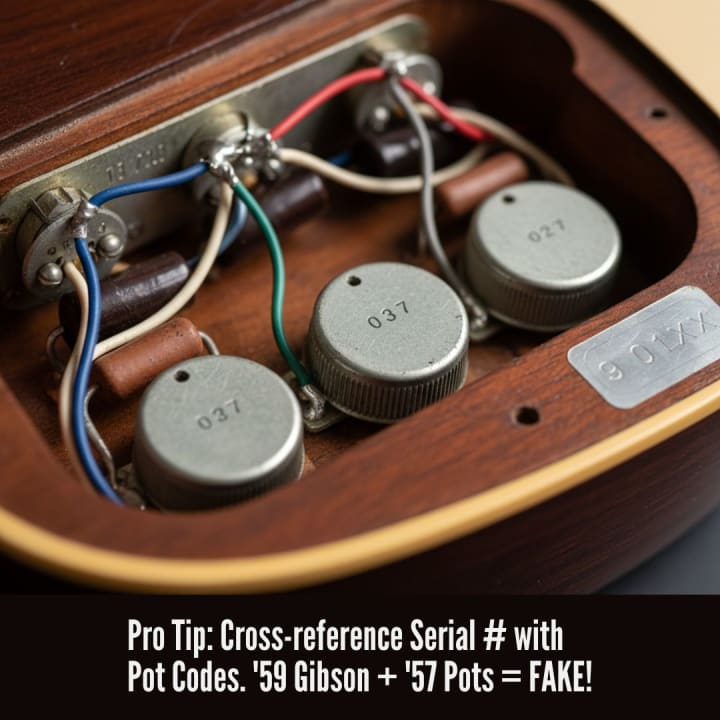
Pro Tip: Cross-reference serial numbers with pot codes (potentiometer codes) located inside the guitar. If a 1959 Gibson has serial number dating from 1959 but pot codes stamped "1973," the guitar is either heavily modified or fake.
Identifying Authentic Materials and Wood Construction
Body Wood Identification
Authentic vintage guitars feature specific tonewoods with distinct visual and tactile characteristics that counterfeiters struggle to replicate accurately.
Mahogany (Most Common for Counterfeits):
- Warm, punchy tone with concentrated midrange
- Reddish-brown color with muted grain pattern
- Lighter and less dense than rosewood
- Less expensive than premium alternatives
Rosewood (Premium Indicator):
- Deep brown with red, orange, and purple hues
- Dramatic, eye-catching grain patterns
- Denser and heavier than mahogany
- Significantly more expensive (especially Brazilian rosewood, now restricted)
- Delivers richer sound with clear highs and complex overtones
Maple (Quality Marker):
- Stunning figured grain patterns
- Light color, sometimes with flamed characteristics
- High density gives more sustain
- Bright sound with less complex overtones
- Requires expert visual inspection
Spruce (Premium Soundboards):
- Clearer, brighter tone with good projection
- Lighter color with distinctive grain
- Used primarily for acoustic guitar tops
- Cedar alternative: delivers warm sound with proper overtones
Red Flags in Material Construction
Counterfeit guitars reveal themselves through material inconsistencies:
- Plastic-like binding instead of genuine plastic or wood binding
- Uniform grain patterns instead of natural variations
- Incorrect wood finish appearance (glossy polyurethane instead of aged nitrocellulose)
- Mismatched wood aging (brand new body with artificially aged neck)
- Paint thickness variations that don't follow natural wear patterns

Authentication Insight: Professional authenticators use electronic paint thickness gauges. Original vintage finishes measure 4-8 mils thick, while modern refinishes often measure 2-4 mils (too thin) or 10+ mils (too thick).
The Hardware Examination Protocol
Checking Tuning Machines (Tuners)
Tuners provide one of the easiest visual comparisons between authentic instruments and counterfeits. High-quality counterfeits still get these details wrong.
Authentic vs. Counterfeit Tuner Comparison:
Real Grover Tuners:
- Mirror-like finish on back side
- Smooth, gradual curves on tuning keys
- Precisely manufactured washers spacing tuning key from machine head
- Consistent manufacturing quality across all six tuners
- Proper weight and response when turned
Fake Tuners (Common on Counterfeits):
- Hazy or opaque finish on back side
- Sharp angles and crude shapes on tuning keys
- Cheap, inconsistent washers
- Noticeable variations between tuners
- Lighter weight, loose feel during operation
- Tuning doesn't hold pitch properly
Expert Observation: Guitarist Kennis Russell identifies fake Gibson Les Pauls within seconds by examining tuners, noting that counterfeit Grover tuners have distinct manufacturing differences experienced musicians can feel by hand.
Bridge and Saddle Analysis
The bridge reveals authentic craftsmanship versus factory shortcuts.
Gibson Authentic Characteristics:
- Precisely machined bridge with consistent geometry
- Proper saddle material (bone, not plastic)
- Exact string spacing calculations
- Original hardware finish without corrosion patterns inconsistent with age
Counterfeit Red Flags:
- Bridge fit is loose or requires shimming
- Saddle shows incorrect wear patterns
- String spacing off-center or irregular
- Hardware corrosion appears artificial or uniform
- Bridge design doesn't match documented specifications
Electronics and Pot Investigation
This represents the ultimate authentication secret—the one place counterfeiters consistently fail.
The Hidden Truth About Pickups and Cavities:
The electronics cavities reveal the most damning evidence of counterfeiting. On authentic guitars (Gibson, Fender, PRS, etc.):
- Pickup and electronics cavities show meticulous finish work
- No solder burns on the wood
- Minimal excess wire length
- Wires routed cleanly without crossing
- Interior never painted black (original finish extends to cavity)
- Component placement follows exact specifications
- Potentiometer (pot) codes match expected production era
Fake Guitar Indicators:
- Cavities are "an absolute mess" according to authentication experts
- Solder burns visible on wood
- Excess wire length with poor routing
- Crossed and tangled wiring
- Interior painted black (common on cheap knock-offs)
- Pots don't align with serial number production dates
- Component brands don't match period specifications

Verification Method: If you're examining a guitar online, request internal cavity photos. Most serious sellers of authentic instruments welcome this scrutiny. Refusal to show cavity details is nearly 100% confirmation of counterfeiting.
Visual Authentication: The Headstock Analysis
The Most Telling Visual Differences
The headstock concentration of brand-specific design elements makes it the first place collectors examine.
Gibson Les Paul Headstock Checklist:
Real vs. Fake Gibson Les Paul Headstock Study:
Examination of documented fakes reveals systematic failures. The fake headstock examined by Gibson expert verification shows:
- Horns lacking pronounced angle compared to authentics
- Logo font inconsistencies with official Gibson specifications
- Truss rod cover mounted at visible angle instead of flush
- Split diamond inlay sizing incorrect and misaligned
Fender Headstock Verification
Fender uses distinctly different headstock geometry compared to Gibson, making cross-brand knowledge essential.
Pre-CBS Fender Characteristics:
- Headstock angle at 0 degrees (straight alignment with neck)
- Strings meet machine head poles at correct height through body design
- Logo orientation and font specific to production era
- Spaghetti logo (1954-1960) vs. block logo (1960+) variation
Red Flags on Counterfeit Fenders:
- Headstock tilts backward like Gibson (wrong design entirely)
- Logo font doesn't match era specifications
- String alignment problems requiring compensatory adjustments
Scientific Authentication Methods for Serious Collectors
UV Light Examination
Professional authenticators use ultraviolet light to reveal finishes' true age and authenticity.
What Original Finishes Show Under UV Light:
- Specific fluorescence patterns unique to vintage nitrocellulose
- Different UV response in worn areas versus protected areas
- Primer visibility through thin spots
- Consistent aging patterns across the instrument
- Natural variation reflecting genuine age
Modern Refinishes Display:
- Uniform fluorescence across entire guitar
- No aging pattern variations
- Different UV response than period-correct finishes
- Primer patterns inconsistent with authentic aging
Pro Application: Many counterfeits use modern polyurethane finishes or improper refinishing techniques that fluoresce distinctly different from authentic vintage nitrocellulose under UV examination.
Paint Thickness Measurement
Electronic paint thickness gauges provide objective, measurable authentication data.
Standard Specifications:
- Original Pre-CBS Fender Finishes: 4-8 mils thick
- Original Gibson Finishes: Similar 4-8 mil range
- Modern Refinishes: Often 2-4 mils (too thin) or 10+ mils (too thick)
- Consistent Readings: Original finishes show variation following natural wear patterns
- Uniform Readings: Artificial finishes show same thickness everywhere

Field Test Procedure:
- Use calibrated paint thickness gauge
- Take measurements at 10+ locations across body
- Document readings at high-wear areas (lower bout) and protected areas
- Compare patterns to known authentic examples
- Consultation with professional authenticators if readings unusual
Microscopic Analysis and Layer Inspection
High-level authentication sometimes requires laboratory-grade examination.
Professionals Can Determine:
- Finish layer counting (original vs. refinish layers)
- Pigment particle analysis confirming era-specific formulations
- Primer composition verification
- Wood grain visibility through finish (authentic shows wood grain, modern refinishes often obscure it)
- Chemical composition of lacquer or polyurethane
When Microscopic Analysis Is Justified:
- High-value instruments (over $15,000)
- Rare custom colors with unusual authenticity questions
- Legal disputes or insurance claims
- Academic research or institutional acquisitions
Condition Assessment and Red Flags
Understanding Natural Aging Patterns
Authentic vintage guitars display aging that tells a story of genuine use and environmental exposure.
Signs of Legitimate Age (Consistent with Instrument Era):
- Finish Checking: Fine cracks following wood grain, deeper penetration into finish, yellowing or amber coloration in crack lines
- Natural Wear: Frets show wear from playing, particularly high-action frets
- Binding Yellowing: Aged cream-colored binding shows natural darkening consistent with 50+ years
- Hardware Patina: Tuners, bridge hardware show oxidation patterns specific to metal type and age
- Color Shifting: Sunburst finishes show predictable amber shift, fading of reds to orange
- Edge Wear: Edges of body show gradual wear from handling, not artificial gouging
Red Flags Indicating Artificial Aging
Counterfeiters frequently apply fake aging, creating obviously artificial wear patterns.
Artificial Wear Indicators:
- Too-Uniform Checking: Geometric patterns instead of organic grain-following cracks
- Surface-Only Cracks: Checking that doesn't penetrate finish layers
- Incorrect Crack Location: Checking concentrated in low-wear areas instead of high-stress zones
- Wrong Coloration: Cracks lack natural yellowing or amber tones
- Sudden Wear Appearance: All distressing applied at once instead of gradual, layered wear
- Fret Condition Mismatch: Heavily worn frets on otherwise pristine-condition guitar
- Color Inconsistency: Fading pattern doesn't match light exposure for documented use history
Serial Number Cross-Verification Against Pot Codes
Understanding Potentiometer Dating
Inside every solid-body electric guitar (Gibson, Fender, etc.), potentiometers (pots) have date codes that should correlate with serial number production dates.
Pot Code Structure:
Most potentiometers manufactured in the U.S. during the vintage era display three-digit date codes:
- First digit: Month (1-9 for January-September, 0 for October, X for November, Y for December)
- Second digit: Year of decade (e.g., 6 = 1966)
- Third digit: Week of year (1-52)
Cross-Reference Example:
- Serial Number: Indicates 1959 Gibson Les Paul
- Pot Codes: Stamped "037" (March 1957)
- Verdict: FAKE – Pots predate supposed manufacture by 2 years
This inconsistency proves the guitar is either heavily modified or entirely counterfeit.
Building a Database for Your Collection
Professional collectors maintain spreadsheets cross-referencing:
- Serial numbers with manufacturing range
- Pot codes with their corresponding dates
- Capacitor date codes
- Output transformer specifications
- Tuner types and eras
- Hardware configurations
Any significant deviation across these components indicates possible counterfeiting or heavy modification reducing value.
Documentation and Provenance Requirements
Certificate of Authenticity (COA) Evaluation
A legitimate Certificate of Authenticity should include:
- Essential Information:
- Specific guitar model and year of manufacture
- Condition assessment with detailed photograph
- Verification of original specifications
- Serial number documentation
- Professional authenticator credentials and contact information
- Statement of authenticity confidence level
- Authentication methodology used
- Date of authentication
- Expiration date (if applicable)
- Professional signature or seal
Red Flags on Suspect COAs:
- Generic templates without instrument-specific details
- No authenticator identification or credentials
- Vague language like "appears authentic" instead of definitive statements
- Expiration dates suggesting temporary authentication
- Multiple authenticators (inconsistent reviews)
- COA produced by seller instead of independent third-party
Superstar Guitars Authentication Standard:
The world's premier authenticated guitar auction platform charges €90-€150 ($100-$165 USD) for comprehensive written certification. This baseline cost reflects the expertise required for professional authentication
Provenance Documentation Strategy
Provenance, the documented history of ownership, dramatically increases value and authentication confidence.
Complete Provenance Should Include:
- Original Purchase Documentation: Invoice, receipt, or manufacturer records
- Photographic Evidence: Pictures of original owner using the guitar
- Ownership Chain: Clear record of each subsequent owner
- Event Documentation: Recorded performances, album credits, documented appearances
- Expert Evaluations: Any prior professional authentication or appraisals
- Conservation Records: Any repairs or maintenance performed
Photo-Matching Verification:
For high-value instruments, professional authenticators verify photo-matching. This requires:
- Identifying unique identifying characteristics (finish marks, wear patterns, binding irregularities)
- Cross-referencing these characteristics with documented photographs
- Confirming 100% match (not just similar appearance)
- Checking background and context details in photographs
A single high-quality photograph of a documented legendary musician playing the specific guitar (with visible wood grain and condition details) substantially increases authentication confidence[20].
Professional Authentication Services and Cost Expectations
When to Seek Professional Authentication
Situations Requiring Professional Service:
- High-value instruments (over $5,000-$10,000)
- Instruments with questionable provenance
- Pre-purchase verification for major investments
- Insurance appraisal requirements
- Legal disputes or authentication challenges
- Rare models or custom configurations
Cost Structure for Professional Services
Informal Valuations: Free (most dealers)
Insurance Appraisals: $150-$300 per instrument (formal documentation)
- Starts at $150 for individual appraisal
- Varies based on collection size
- Updated valuations often included at no additional charge
Celebrity/High-Value Authentication: €90-€150 ($100-$165 USD)
- Superstar Guitars authentication standard
- Comprehensive written letter of certification
- Includes signature verification and provenance research
Guitar Appraisal (Formal Assessment): $89-$200 per instrument
- Detailed condition assessment
- Current market valuation
- Professional documentation
- Insurance-acceptable format
Specialized Services: $300-$1,000+
- Court-admissible expert testimony
- Chemical analysis of finishes
- Microscopic evaluation
- Forensic documentation
Choosing Authenticators with Verified Credentials
Professional Credentials to Verify:
- Membership in recognized guitar associations
- Years of hands-on authentication experience (10+ years ideal)
- Published authentication methodologies
- References from major auction houses
- Insurance company approval
- Documented track record of authentication accuracy
Authoritative Organizations:
- American Society of Appraisers (ASA)
- International Society of Appraisers (ISA)
- Professional Numismatists Guild (PNG) - for rare collector items
- Industry-specific certifications from major manufacturers
- Auction house affiliations (Christie's, Sotheby's expertise)
Emerging Technologies: NFC and Blockchain Authentication
How NFC (Near Field Communication) Works for Guitar Authentication
Major guitar manufacturers are deploying NFC technology paired with blockchain to create tamper-proof authentication systems.
The Process:
- Unique Product Identifier: Each guitar receives a unique identifier generated from its characteristics
- Blockchain Recording: This identifier gets recorded on a blockchain (creating immutable ledger)
- NFC Tag Encoding: NFC tag embedded in or attached to guitar encodes with tap-unique URL
- Tap Authentication: Customer taps smartphone on NFC chip, triggering verification process
- Cryptographic Verification: System uses cryptographic protocols to verify authenticity
- Ownership Registration: Verification result recorded on blockchain with transaction hash
- Immutable Record: Each tap creates permanent blockchain record of authentication
Technical Protection Features:
- Tamper-Resistant Design: NFC chip destructs if tampered with
- Unique Authentication Message: Each tap generates different secure message (impossible to duplicate)
- Dynamic Data: Tap-interaction data includes timestamp, user location, device ID
- Cryptographic Security: Uses message authentication codes (MACs), one-time passwords (OTPs), or digital signatures
Current Implementation:
As of 2025, brands are actively deploying NFC technology with blockchain backing. collectID's system demonstrates the real-world application—users can tap their phone to check authenticity and register ownership via app, with ownership transfers recorded on blockchain during resale.
Blockchain's Role in Guitar Authentication
Blockchain technology addresses the core problem: creating permanent, unchangeable authentication records.
Advantages:
- Immutability: Once recorded, authentication data cannot be altered
- Transparency: Entire ownership history visible to all parties
- Decentralization: No single point of failure or corruption
- Provenance Tracking: Complete chain of custody from manufacturer to current owner
- Resale Support: Brands can monetize secondary market through authenticated resale tracking
Current Limitations:
- Requires manufacturer adoption and implementation
- Not yet universal across all guitar brands
- Requires smartphone NFC capability from users
- Educational barrier for older collectors less familiar with blockchain
Protecting Your Investment
Authenticating expensive vintage guitars requires diligence, expertise, and often professional assistance. The average loss from counterfeit purchases ($3,200) represents just a fraction of potential losses on high-value instruments.
Your protection strategy should include:
- Serial number verification against manufacturer databases (always first step)
- Hardware and material inspection examining the details counterfeiter skip
- Professional appraisal for instruments exceeding $5,000
- Documentation acquisition including provenance and COAs
- Insurance protection with stated-value coverage and regular re-appraisal
- Ongoing education staying current with authentication techniques
The guitar market will continue growing to $26.2 billion by 2035, creating ever-greater incentive for sophisticated counterfeiting operations[4]. Your knowledge advantage, understanding these authentication principles—is the most valuable protection available.
About the Creator
Resyn Marketplace
Resyn is a commission-free marketplace where musicians buy, sell, and trade gear safely. Connect with verified sellers, discover unique instruments, and keep 100% of what you earn. No fees. No flippers. Just real players.
Keep reading
More stories from Resyn Marketplace and writers in Beat and other communities.
Stratocaster vs Telecaster: The Differences That Matter When Choosing Your Next Guitar
The Stratocaster vs Telecaster debate is a timeless one, with both Fender legends having shaped rock, country, blues, funk, and indie over 70 years and remaining the go-to choice for players at every level. While they share a common bloodline, the differences that matter most - tone, feel, hardware, and mod potential - can steer your buying decision in a very particular direction, because knowing how a Strat and a Tele differ in real-world use will save you time, money, and buyer's remorse.
By Resyn Marketplace5 months ago in Beat
It's 2026. Songs Turning 10 This Year
In 2016, we saw the rise of short form videos and what would lead to the birth of TikTok. We cannot forget the Snapchat filters no matter how cringe worthy some of them might have been. It was also the year in which the hit series Stranger Things debuted.
By Jasmine Aguilar6 days ago in Beat




Comments
There are no comments for this story
Be the first to respond and start the conversation.