
From Hope to Despair: Reflecting on the Iraq Invasion 20 Years Later
A retrospective analysis of the 8-year invasion of this critical West Asian country led by the U.S in March 2003 that had disastrous consequences for Iraq and its people. This article examines the causes, casualties, and costs linked to the contentious military occupation, that commenced with positive prospects for Iraqis, but concluded with gloom and despondency for most.

“Reports that say that something hasn't happened are always interesting to me, because as we know, there are known knowns; there are things we know we know. We also know there are known unknowns; that is to say we know there are some things we do not know. But there are also unknown unknowns—the ones we don't know we don't know.”
Do not frazzle your brain thinking this is a riddle, tongue twister, or a discourse by a cult leader. This is an actual statement made by the then U.S. defence secretary Donald Rumsfeld in February 2002, when asked about intelligence reports indicating that Iraq’s dictator Saddam Hussein is supplying terrorist groups with weapons of mass destruction (WMDs).
Last month marked the 20th anniversary since the contentious U.S.-led military intervention of Iraq began, which was initiated as to free the oil-rich nation from a despot and herald peace and democracy for Iraqis. This article explores whether those objectives were met, the consequences of the occupation, and how it changed the political landscape of West Asia forever.
Weapons of Mass Deception
In the wake of the September 11, 2001 (9/11) attacks, the administration of then U.S. President George W. Bush drew up a broad foreign policy stratagem that famously labelled Iraq as being part of an ‘axis of evil’ that threatened American national security. It asserted that Iraqi dictator Saddam Hussein’s regime had links with the terror group Al-Qaeda, the organisation held responsible for the 9/11 bombings in New York; even claiming that Iraq possessed weapons of mass destruction (WMDs). With these assertions, Bush sought to intervene militarily in Iraq, arguing that threats emanating from that nation must be neutralised to shore up global security.
Claims of Iraq possessing WMDs later turned out be false, raising questions about the U.S. intelligence community and, more importantly, the Bush administration’s (ab)use of its citizens’ trauma and anger in the aftermath of 9/11 to justify its political rhetoric to unilaterally invade a foreign country; all in the name of a ‘War on Terror’.
However, revelations of the patchy intel came to light a while later. Also, the fact that multiple statutes of international law would be broken if U.S. followed through with military action, and that no nod was sought from the United Nations Security Council for the ‘illegal’ invasion (as per the UN Charter), reflected how America viewed itself as the world’s policeman that cannot be constrained with puny international institutions.
The Invasion
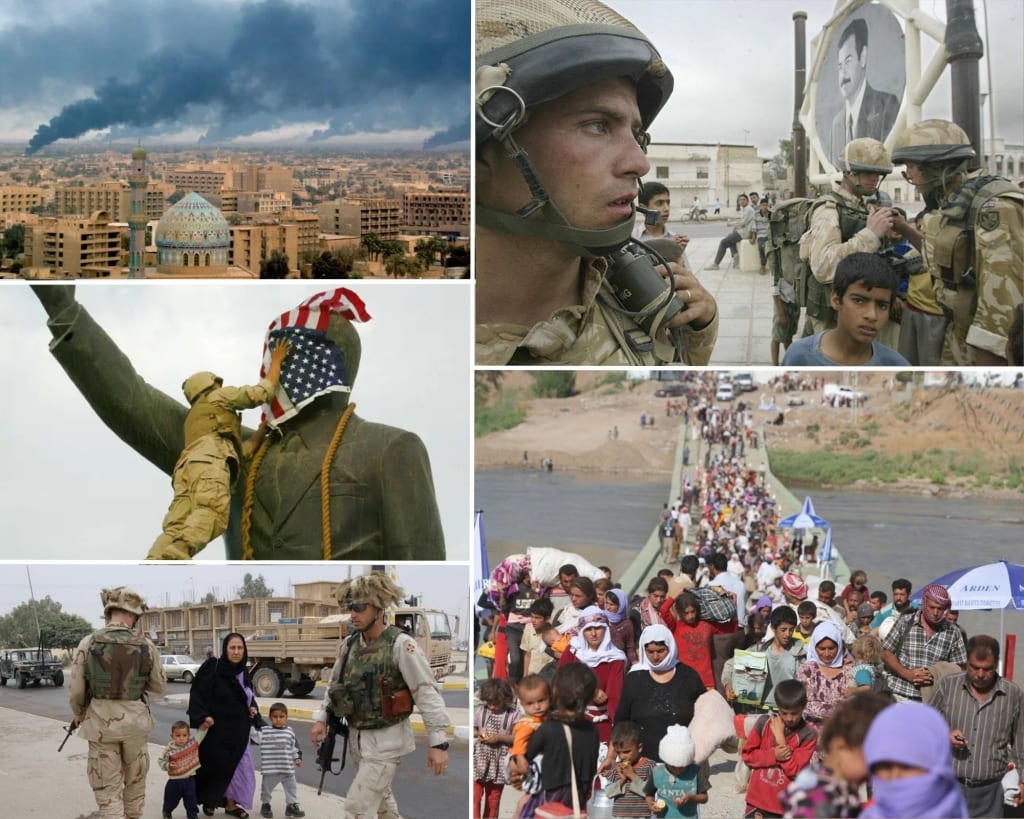
So, on March 20, 2003, a ‘coalition of the willing’ consisting of American, British, Australian and Polish armed forces launched a ground invasion of Iraq, supported by air strikes that bombed government buildings and military infrastructure. Unsurprisingly, this overwhelmed Iraqi forces who quickly surrendered. A chain of events ensued, starting with the bombing of Baghdad, takeover of Basra city, and capture of Saddam who was deposed from power.
Hence, America’s aim of toppling Saddam was quickly achieved. Bush even proclaimed that the mission was accomplished, barely six weeks after combat operations began. Saddam was tried for his crimes against humanity in October 2005 by an Iraqi Special Tribunal, found guilty, and executed in December 2006. The fact that no WMDs were found, as per a report by American weapons inspectors in October 2003 and later a Senate Intelligence report in July 2004, did not deter Uncle Sam from claiming victory. But what next?
The allied invading forces seemingly had no political plan for the country post-Saddam, to install democratic government in Iraq as pledged earlier. Hence, like a kid knocking down a beehive with a baseball bat - sure, the U.S. felt powerful in the moment, but was oblivious that it will soon be dealing with a whole lot of angry bees and stings in the aftermath.
The U.S.-led multinational force purged the erstwhile dominant Ba’ath Party members from government, replacing it with a transitional government named the Coalition Provisional Authority (CPA) which had sweeping legislative, executive and judicial powers. Its leadership included former Saddam opponents exiled abroad, who now saw an opportunity to return to their homeland. An unofficial power-sharing arrangement was agreed upon to reflect a secular Iraq, wherein the powerful Prime Minister’s position would be held by a Shia, the President’s office by a Kurd, and the Parliament Speaker’s chair by a Sunni.
From Occupation to Insurgency
Tasked with reconstructing a democratic Iraq, the de-Ba’athification process included disbanding the national army, which meant that hordes of disaffected young men, trained in handling arms, now found themselves unemployed and susceptible to extremist messaging. Most of these men became part of local militias or armed groups in search for a job and income. The CPA was replaced by an interim government in 2005, and then a permanent federal government in 2006.
However, corruption flourished unabated, with divisions along sectarian and ethnic lines being made even deeper by politicians for their narrow purposes, while the elites robbed the country of all its wealth, most of which came through oil revenues. Meanwhile, U.S. led coalition forces faced an insurgency from various groups, including remnants of the former Iraqi regime and foreign fighters.
Hence, combat operations continued to quell the insurgency and bring stability to the country. The U.S. military struggled to maintain control in the years that followed. America even faced allegations of torture and mistreatment of prisoners at Abu Ghraib prison; apart from private military contractors hired by Washington being accused of committing grave human rights abuses.
In 2007, the U.S. deployed even more troops to Iraq as part of a ‘surge’ strategy to reduce violence and pave the way for political reconciliation. In 2010, the U.S. began a drawdown of its forces, aiming to transition security responsibilities to Iraqi forces, and formally ending its troop presence in December 2011. This pullback led to a political vacuum in the country that led to it becoming a breeding ground for terrorist groups, including the rise of ISIS.
Hence, for Iraqis who welcomed the occupying forces and initially hoped that escaping Saddam’s brutal dictatorship would lead to a better future (including access to basic necessities such as electricity, clean water, and healthcare) were now subjected to more oppression of a different form. Thousands of Iraqi civilians were killed, injured, or displaced. The Brown University’s Watson Institute estimates that at least 2 lakh Iraqis were killed from 2003 to 2019, whereas 4,418 U.S. troops also died by 2010 as per the U.S. department of defence.
Dollars and Sense
The invasion was one of the most expensive wars in modern history, with estimates suggesting that the U.S. spent over $2.4 trillion on the conflict. The war's aftermath has been devastating for Iraqis. Apart from the hundreds of deaths, many more Iraqis suffer health problems as a result of exposure to depleted uranium and other toxic substances used during the war. The war had impacted Iraq's healthcare and education systems, which were already struggling before the conflict. The country's infrastructure was severely damaged, with estimates of over $100 billion in economic losses.
Millions of Iraqis were forced to flee their homes either internally or to neighbouring countries, with estimates ranging from 2.5 to 4.7 million people being displaced. The war also disrupted trade and commerce while also impacting Iraq's oil production, which is a crucial source of national revenue.
Hence, the rhetorical connection between 9/11 and WMDs made by the Bush regime to invade Iraq had disastrous strategic implications for the country and West Asia, resulting in significant human casualties, economic costs, and political repercussions for both, the U.S. and Iraq.
A Cautionary Tale
Currently, Iraqi politics is under the influence of the U.S., as well as Iran, to the annoyance of Washington as America’s action to depose Saddam meant that the dominance of Sunnis in Iraqi government in a Shia-majority country was eradicated; playing right into the hands of Tehran, as Iran itself is Shia-dominated. However, there is no discernible change in the livelihoods of common Iraqis, mainly because one third of the country still lives in poverty, its society is marred with ethnic and sectarian conflicts, and corruption is rampant in political and economic circles.
Add to it the fact that public services are almost absent and that the energy-rich nation witnesses frequent power blackouts, only goes to show the chaotic mess that Iraq currently finds itself in. Hence, in a cruel twist to Julius Caesar’s famed phrase ‘veni, vidi, vici’ (I came, I saw, I conquered), America’s meddling in Iraq seems more like ‘they came, they destroyed, they left’.
In conclusion: perhaps, the most significant global consequence has been that the invasion, devoid of UN authorisation or broad international backing, led other countries to take similar action in their respective neighbourhoods over the years. This includes regimes violently cracking down on domestic dissent (eg. Myanmar), encroaching upon contested lands through brute force (eg. Israeli ‘settlers’ in the West Bank), or even invading a neighbouring nation for flimsy reasons (eg. the Russia-Ukraine war).
Moral of the story: Pause to ponder before you proceed to invade.
About the Creator
Sainandan Iyer
* Put the FUN in dysfunctional! * Recklessly Impulsive * Wanderlust * Lo mejor en la vida lo encuentras sin haberlo buscado *
Keep reading
More stories from writers in Beat and other communities.
Ludacris and Nelly draw backlash over bookings at MAGA-coded music festival
Ludacris and Nelly headlining a mostly right-wing event is good for them. It’s also great for the genre of hip hop. The two rap veterans have showcased their talents on other stages. Why can’t they perform for mostly MAGA folks and grab that bag?
By Skyler Saunders6 days ago in Beat
T.I. Previews Final Album "Kill The King" With New Pharrell-Produced Single
T.I. dropping new heat is welcome. His flow seems strong and his lyricism layered and catchy at the same time on the single “Let ‘Em Know.” It continues his unrelated “know” series along with “U Don’t Know Me” “What You Know” “You Know What It Is” and “Yeah You Know.” This single is in support of his reported final album, Kill The King (2026). Another throughline in his career which has included King (2006).
By Skyler Saunders2 days ago in Beat
How to Succeed at the Benson Directory®
Congratulations and welcome to the Benson Directory® employee #22391! As our newest call handler, you will have the privilege of speaking with dozens of unique and interesting people on a daily basis as well as the opportunity to earn bonuses for high performance. Contained within this handbook you will find a set of ease to follow instructions designed to help you settle in to your new role and begin paving the way to success.
By S. A. Crawford4 days ago in Fiction
The Devil's Cut
“Comrade, finally you’re awake.” The voice was smooth, sensual. A flickering incandescent bar was all that lit the white, sterile room. All Vladimir remembered was everything going black. He tried to move his arms and found them strapped to the gurney.
By Matthew J. Fromm7 days ago in Fiction




Comments
There are no comments for this story
Be the first to respond and start the conversation.