
From Folk to Pop and Beyond: The Evolution of Pakistani Music
Tracing the Sonic Heritage, Cultural Shifts, and Global Reach of a Nation.
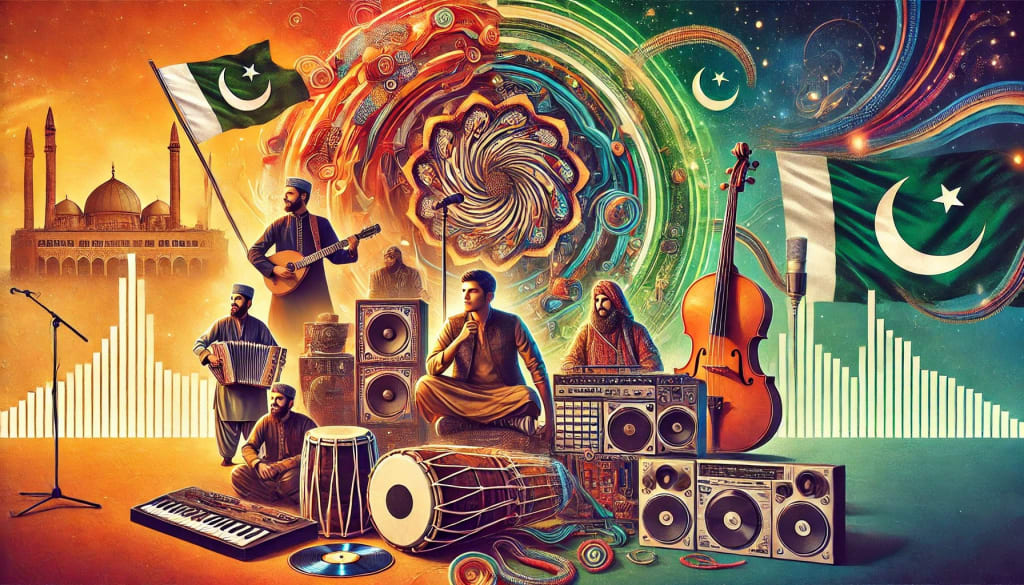
Like the nation itself, Pakistani music is a kaleidoscope of cultures, histories, and identities that have come together to form a soundscape in constant evolution. From the throbbing beats of contemporary rap and hip-hop that speak to urban youth to the soulful notes of qawwalis that reflect the nation’s spiritual foundations, Pakistan’s musical history mirrors its social, political, and technological transformations.
Pakistani music’s story begins with its folk traditions, steeped in spiritual and regional expressions. At the heart of these traditions lies qawwali, a form of Sufi devotional music that transcends mere entertainment through its mesmerizing rhythms and evocative poetry. Legends like Nusrat Fateh Ali Khan propelled qawwali to worldwide recognition by collaborating with global artists and showcasing its universal themes of love, devotion, and the pursuit of truth. Alongside qawwali, other folk sounds—from the Sindhi melodies of Mai Bhagi to the chimta-led Punjabi folk of Alam Lohar—enriched the country’s musical tapestry. However, after independence, urbanization and technological development began to bridge the gap between old and new, setting the stage for further transformation.
In the 1960s, a cultural rebirth took shape. During this time, Ahmed Rushdi’s iconic song “Ko Ko Korina” emerged, inaugurating a vibrant pop style that reflected a broader sense of social optimism. Both film and music industries flourished, with bands and solo artists blending Western instruments and techniques with local sensibilities. Yet, the following decade brought cultural conservatism, particularly under General Zia-ul-Haq’s rule. Despite increasing restrictions, music endured as a vehicle for subtle rebellion. The 1980s saw the rise of Vital Signs, whose patriotic anthem “Dil Dil Pakistan” inspired young audiences to embrace both modernity and national pride, while Nazia Hassan broke barriers as one of the first female pop stars with her disco-infused hits like “Disco Deewane.”
Around the same period, rock bands such as Junoon introduced a new dimension by weaving Sufi poetry into rock, sometimes referred to as “Sufi rock.” Their bold lyrics tackled social and political themes, turning tracks like “Sayonee” into anthems for a generation navigating complex questions of identity in a rapidly changing world. Technological advancements and private media outlets then ushered in a new millennium of musical exploration. Coke Studio, launched in 2008, brought folk and classical traditions together with rock, jazz, and electronic elements. Songs such as “Tu Jhoom” by Naseebo Lal and Abida Parveen showcased these hybrid approaches, bridging generational and cultural gaps. Coke Studio’s success also inspired TV drama OSTs, leading to experiments with similarly varied styles—such as Qurat-ul-Ain Balouch’s “Humsafar,” which demonstrated how music can powerfully enhance storytelling. As platforms like YouTube and Spotify gained popularity, Pakistani music found broader recognition, transforming local hits into global successes.
In parallel, an underground music scene began to take root in the early 2000s. Bands like Noori and Entity Paradigm (EP) blended Western rock influences with poetic Urdu lyrics, becoming rebellious voices in a shifting cultural landscape. Meanwhile, independent music portals such as Patari allowed musicians to bypass traditional gatekeepers and connect directly with fans, democratizing the industry and welcoming new genres. Over the past few years, hip-hop and rap have emerged as especially popular, once perceived as foreign to local culture but now resonating with younger audiences seeking authentic self-expression. Artists like Eva B, Faris Shafi, and Young Stunners integrate modern beats with incisive commentary on mental health, social norms, and class inequality. Faris Shafi, in particular, exemplifies this trend with “Blockbuster,” a Coke Studio collaboration featuring Shae Gill. This genre-defying track merges traditional elements, indie pop, and rap, as Shae Gill’s emotive melodies counterbalance Faris’s sharp lyricism to explore ambition, sincerity, and the pursuit of greatness.
No account of Pakistani music would be complete without acknowledging the colossal contributions of Nusrat Fateh Ali Khan and his nephew Rahat Fateh Ali Khan, symbols of qawwali’s enduring power to transcend borders. Known as the “King of Qawwali,” Nusrat Fateh Ali Khan propelled this art form to unprecedented global acclaim with renditions of “Allah Hoo,” “Dum Mast Qalandar,” and “Afreen Afreen.” His collaborations with Western musicians like Eddie Vedder and Peter Gabriel, along with his Hollywood soundtrack work, firmly established Pakistan’s musical prestige internationally. After his passing in 1997, the tradition continued through Rahat Fateh Ali Khan, whose songs like “Mann Ki Lagan” and “O Re Piya” highlight both emotional depth and widespread appeal, while his qawwalis—“Tumhe Dillagi,” “Mera Piya Ghar Aaya”—have captivated listeners worldwide.
From qawwalis to rap, Pakistani music’s transformation is more than just the evolution of sound—it is the story of a nation continually rediscovering itself amid shifting cultural, political, and technological tides. Each riff, beat, and verse contribute to a musical mosaic that grows ever more diverse, resilient, and unmistakably Pakistani. With new collaborations, digital accessibility, and a growing international fan base, the next chapter promises even richer fusions and wider reach—a testament to the country’s dynamic artistic spirit.
About the Creator
Why Didn't Anyone Tell Us
Men, move along. This is not for you. This is for the women. I was forty-five when I began menopause. It is pretty young for that to be going on in a woman’s life, but I had undiagnosed PCOS, my entire life. Thank you to all the gynecologists I had seen my entire life. That in itself should encourage women to keep seeking second opinions, especially when you are not getting correct answers or any at all.
By Alexandra Grant5 days ago in Humans


Comments