
Foreign politics, inflation, and PR: why Turkey would not be ready to come back to Eurovision
All the reasons why, if Turkey returned to Eurovision right now, it would not be well-received.


If you've been a Eurovision fan since the 2000s, or if you've been looking into the older, most iconic entries, you might be familiar with Turkish songs like We Could Be the Same by ManGa, Düm Tek Tek by Hadise, or Everyway That I Can by Sertab Erener, which landed the first and only Turkish victory of the contest to this day.
Turkey has not been participated since its withdrawal in late 2012, due to disagreements with the new voting system that would reduce the televote's influence. (Source: Wikipedia)
Many eurofans miss Turkey in the contest and would be glad if the country came back, and for good reasons: despite winning only once, the country has always sent good quality entries and maintained a sturdy qualification streak, failing to qualify to the Grand Final only once, in 2011.
This is the same qualification streak of another Eurovision powerhouse - Sweden - so it's easy to see how huge Turkey was at the time.
Unfortunately, Turkish leader Recep Tayyip Erdoğan does not see the same potential. In 2024, following Nemo's victory, he accused the contest of "destroying traditional family values" and "social corruption", i.e. having too many LGBT contestants. (Source: AP News)
Turkish eurofans promptly dismissed his take on social media, stating that the Turkish public would actually love to watch Eurovision again and that the average Turk does not really care about the LGBT+ community that much.
Turkish broadcaster TRT has also shared concerns aligned with Erdoğan's view in the past, focusing, among others, on the participation of Conchita Wurst in 2014 (Source), so unless the EBU has a homophobic awakening overnight, we cannot expect Turkey to return to the contest anytime soon.
Personally, I would love to see Turkey come back again, but as of now, I cannot help but consider this pure wishful thinking, and not just because of the attitude of Turkish institutions towards the contest.
Imagine that, instead of the EBU's homophobic awakening, we had TRT's progressive awakening and Turkey came back to Eurovision right now. Unfortunately, they would probably not be well-received, and I'll explain some reasons why.
The economy is in shambles
Over the last decade, Turkey has been plagued by inflation, which has ridiculously increased the prices and made it impossible for enterprises to make long-term expense forecasts on several services.
Here's a graph on how inflation has risen over the last 10 years:
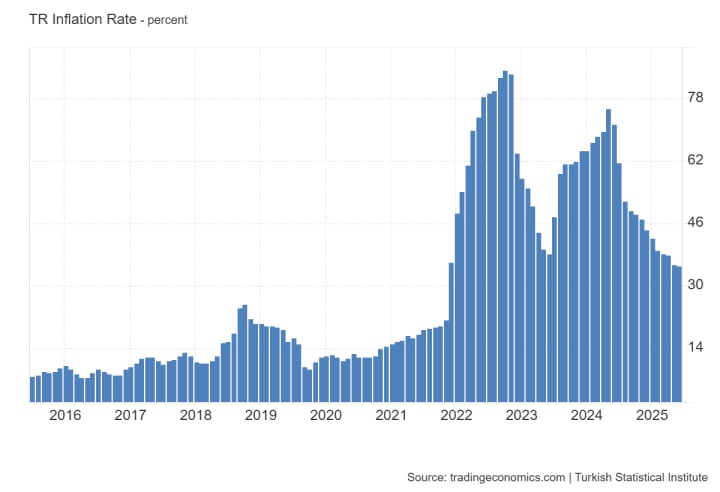
Besides, since 2018 Turkey has also been facing an economic crisis due to Erdogan's view on interest rates, which has shifted only in 2023. For more details, I recommend this article by Rustem Zhumagaliyev on OhMyEcon.org, which you can read here.
Why is this relevant to Eurovision? Because every participating country has to pay a fee to the EBU, and countries usually withdraw because they fail to pay said fee or because they contract some debt with the EBU.
And the expenses don't end here: once the representing artist is selected, the national broadcaster obviously has to allocate some costs for their trips, their staging and costumes, the supporting staff of the delegation, and so on.
With the current economic situation, would the Turkish broadcaster be able to sustain these costs without getting into debt? It's hard to say.
Turkey's reputation might be a case for exclusion
Some Eurovision countries are known for having decades-long conflicts with Turkey with long-lasting effects to this day, especially since Erdogan became president.
One of these countries is Cyprus. The island is currenly split into a Northern side, known as the Turkish Republic of Northern Cyprus (TRNC), and the Southern Side, known as the Republic of Cyprus. The latter is the one participating in Eurovision and the only internationally recognized republic on the island.
TRNC, instead, is only internationally recognized by Turkey and, elsewhere, is considered an occupied territory under Turkish control, with an unauthorized local administration.
Recently, the Movement of Cypriots for Peace and Solidarity, a group of Turkish Cypriots, has accused both Erdoğan and the current leader of the TRNC Ersin Tatar of ethnic cleansing in the territory. Specifically, Erdoğan is accused of encouraging mass migration of Turks to the TRNC to manipulate the political sentiment in the area, with the complicity of Tatar.
The Movement has also issued a letter to the president of the Republic of Cyprus, Nikos Christodoulides, urging him to take action and submit their case to the European institutions and the UN. (Source: Tovima.com).
Shall Christodoulides take care of this matter properly, it would put Turkey in a similar position as Russia and Israel, which would set up the basis to exclude the country from sports competition and Eurovision as well.
Erdoğan has also had years-long tensions with Greece, with continuous threats of an invasion and other shenanigans, including encouraging a group of migrants to cross the Turkish border with Greece, causing clashes with border guards.
Since the end of 2023, the Turkish leader has allegedly committed to improving the relationship between Turkey and Greece. (Source: France24)
However, people don't forget easily, and these older tensions alone could be a relevant reason for Greece to oppose a potential return of Turkey in the contest.
Greece is also a known ally of Cyprus and, shall the ethnic cleansing accusations be brought to an international court, Greece might step even further to support the Cypriot cause.
Erdoğan's pro-Palestine agenda might be in danger
Since October 7th, Turkish leader Erdoğan has expressed support for the Palestinian people suffering from relentless attacks by Israel (Source: Le Monde).
Most recently, he has approved of French president Emmanuel Macron's decision to recognize the state of Palestine (Source: 20minutes.fr).
Like most world leaders, his support has its flaws: Erdoğan is not supporting the recognition of Palestine only, but he is in favor of a two-state solution (source: 20minutes.fr), which means that he fails to recognize the colonial roots of the creation of Israel as a country.
Turkish government also seems to still be willing to resume trades with Israel in case of a permanent peace (source: Türkiye Today), whereas most pro-Palestine protesters tend to prefer a permanent boycott of any company or institution endorsing or having commercial relationships with Israel.
Regardless of how genuine its support for Palestine is, joining Eurovision now would be bad PR for Turkey, not only because they would be joining a competition held by an institution that has gone out of its way to protect Israel multiple times, but also because some participating countries could raise concerns about Turkey being equal to Israel and Russia for the reasons mentioned in the previous paragraphs.
This would shatter Turkey's image: how could they be genuine allies to Palestine if they are participating in another ethnic cleansing operation elsewhere?
The bottom line: how to tell if a country would be well-received at Eurovision
Considering Turkey's case, the bottom line is that we can actually predict if a country would be well-received at Eurovision and if they would last in the competition.
To understand it, we must take into account two crucial aspects:
- economy: would this country be able to pay the participation fees to the EBU? Would they fall into debt after one year or could they last longer?
- The local government: how is their relationship with other participating countries and their allies? What is their current position regarding Russia's war on Ukraine and the genocide that Israel is carrying out in Palestine? Would this lead to not-so-nice comparisons?
Now I want to hear your opinion: would you like to see Turkey back at Eurovision in the near future? Do you think they would be well-received if they joined now? Do you think there are other countries that could end up in the same way if they joined? Let me know in the comments!
About the Creator
Simona Rosso
She/her. I write about pop culture, and I love dissecting every single medium I come across.
Keep reading
More stories from Simona Rosso and writers in Beat and other communities.
Ludacris and Nelly draw backlash over bookings at MAGA-coded music festival
Ludacris and Nelly headlining a mostly right-wing event is good for them. It’s also great for the genre of hip hop. The two rap veterans have showcased their talents on other stages. Why can’t they perform for mostly MAGA folks and grab that bag?
By Skyler Saunders4 days ago in Beat



Comments
There are no comments for this story
Be the first to respond and start the conversation.