
8 Creative Ways to Write a Guitar Solo That Tells a Story
Let’s be real — writing a guitar solo can feel like trying to speak a new language with a mouth full of marbles. You sit down to play, your fingers reach for the same tired pentatonic shapes, and the solo you imagined in your head? It never quite shows up. But here’s the thing: you’re not short on talent. You’re short on tools. The right tools — creative ones — unlock the solos that live just beneath your fingertips.


So I put together 8 creative, time-tested ways to write guitar solos that actually say something. These aren’t fluff tips. They’re the same methods I use when writing solos for recordings, jam sessions, and teaching sessions — and they flat-out work.
Let’s dive in.
1. Start With a Story, Not a Scale

Before your fingers do anything, ask this: What am I trying to say with this solo?
A solo should feel like a scene from a movie. It needs tension, mood, maybe even a twist. You can tell a story using phrasing, register, dynamics, and rhythm.
Start by humming a melody instead of grabbing a scale. If your solo isn’t singable, it’s probably forgettable.
Solo Tip: Try singing your solo ideas before picking up the guitar. Focus on emotion, not technique. Your ears will guide you toward stronger melodies.
2. Use Chord Tones as Your Compass

Soloing over a progression? Target the 3rds and 7ths of each chord. These notes define the sound of the harmony and glue your solo to the track.
Try this:
Dm7 → F, C
G7 → B, F
Cmaj7 → E, B
Soloing this way adds immediate maturity and musicality to your lines. You sound like you know what you’re doing — because you do.
Solo Tip: Map out the 3rds and 7ths of each chord before you solo. Use them as “landing pads” in your phrases to create strong resolution points.
3. Limit Yourself to One String
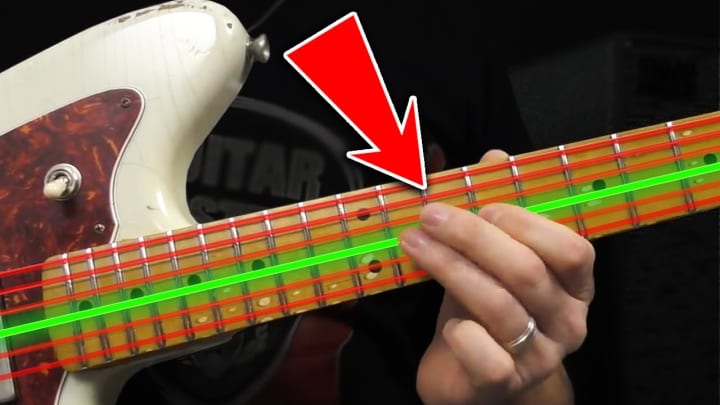
Here’s a secret weapon: solo using only one string. It removes muscle memory and forces you to think like a vocalist.
This technique:
Unlocks melody-driven thinking
Forces better use of slides, bends, and vibrato
Sharpens your ear like nothing else
Try it on the B string. You’ll write phrases that feel better because you’re not leaning on shapes — you’re leaning on expression.
Solo Tip: Choose a single string — like the B string — and improvise freely for a few minutes. Focus on phrasing, dynamics, and vibrato. Keep it musical.
4. Steal the Rhythm from the Vocal Line

Want your solo to belong in the song, not just sit on top of it?
Borrow the rhythm from the vocal line — not the notes. Build your solo with that same phrasing DNA.
Why it works:
Creates instant cohesion
Embeds your solo in the groove
Makes you sound like a thoughtful composer
Solo Tip: Pick a vocal phrase from the song and mimic its rhythm with your guitar. Change the notes, keep the rhythm. It’ll glue your solo to the track.
5. Use Dynamics Like a Film Director

Your solo should breathe. You wouldn’t yell every line in a movie script — so why play every note at the same intensity?
Start soft. Build tension. Let the melody explode. Then whisper again.
Dynamics = drama. Use it.
Solo Tip: Practice playing the same phrase at three different intensity levels — soft, medium, and loud. Notice how the energy shifts, even with the same notes.
6. Improvise Freely, Then Steal From Yourself

Set up a loop. Jam for 10 minutes. Don’t think — just play.
Then go back, listen, and transcribe yourself. You’ll be surprised how many good ideas were hiding in your stream-of-consciousness playing.
Why this rocks:
You bypass analysis paralysis
You capture your voice, raw and real
You build solos out of authentic ideas
Solo Tip: After recording your improv session, pick your favorite 8–12 bars. Refine those into a composed solo. Rinse and repeat for fresh material.
7. Start With Silence
One of the most powerful phrases you can play in a solo… is nothing.
Wait. Let the groove breathe. Let the listener lean in.
Then strike with a phrase that cuts deep.
Using space signals confidence — and gives your solo shape.
Solo Tip: Challenge yourself to delay the first note of your solo by a full measure. Listen for the tension it creates — and how much stronger your entrance feels.
8. Use Visual Shapes to Build Solo Arcs
Try thinking visually when writing a solo.
Triangle → Climb, peak, descend
Wave → Rise, fall, repeat
Staircase → Motif that builds upward
Swoop → One big emotional arc
Draw the shape on paper. Then match your phrasing to it. This gives your solo structure and feel.
Solo Tip: Before you solo, sketch a shape that matches the emotional journey you want to create. Let that shape guide your phrasing, register, and rhythm.
Let’s Talk About the Elephant in the Room…
Read full article here- 8 Creative Ways to Write a Guitar Solo That Tells a Story
About the Creator
Guitarmetrics | Your One-Stop Hub for Guitar Lessons & Accessories
Welcome to Guitarmetrics, where the world of guitars comes to life! Our platform is more than just a destination for unique and innovative guitar accessories—it’s a thriving blog and community for guitar enthusiasts around the globe.
Keep reading
More stories from Guitarmetrics | Your One-Stop Hub for Guitar Lessons & Accessories and writers in Beat and other communities.
Unlock Your Signature Tone: 7 Expert Guitar Tweaks That Make All the Difference
In this article, we’re diving deep into seven expert guitar tweaks that can transform your sound. From adjusting pickup heights to modern wiring mods, these modifications aren’t just cosmetic — they’re all about unlocking the hidden potential of your guitar, ensuring that every note rings out with clarity, warmth, and character.
By Guitarmetrics | Your One-Stop Hub for Guitar Lessons & Accessories12 months ago in Beat
It's 2026. Songs Turning 10 This Year
In 2016, we saw the rise of short form videos and what would lead to the birth of TikTok. We cannot forget the Snapchat filters no matter how cringe worthy some of them might have been. It was also the year in which the hit series Stranger Things debuted.
By Jasmine Aguilar20 days ago in Beat
The First Rainbow Baby
Pitter-patter, pitter-patter. The rain fell in rhythmic splatters, slowly slowing, but still constant. Mira rolled onto her side pulling the blanket tight against her ears, but still she could hear chitter-chatter and scurrying feet of the creatures that refused to sleep in the lower decks.
By A. J. Schoenfelda day ago in Fiction




Comments
There are no comments for this story
Be the first to respond and start the conversation.