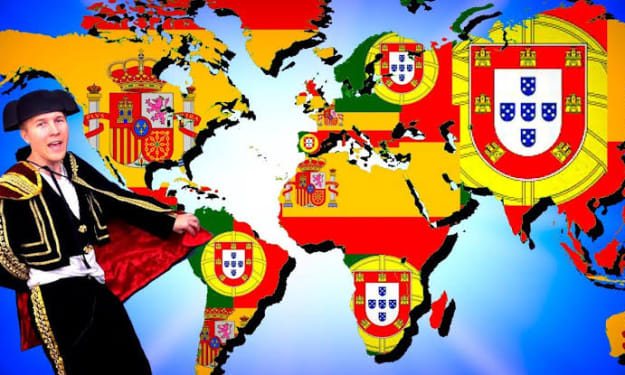
How did Portugal and Spain plan to "conquer" the World
Start of Iberian land disputes can be traced back to Christopher Columbus’s expedition to the New World. Before he had left, Columbus had failed to receive sponsorship for the trip from the Portuguese king, John II. But, upon his return to Europe, having already sailed to the West Indies under the Spanish flag, Columbus decided to stop at the port in Lisbon. When King John met with the explorer and heard of his successful adventure and new discoveries, the monarch insisted that these newly found lands should belong to Portugal, and not Spain. Unexpectedly, King John actually had somewhat of a valid argument, despite having refused to sponsor the trip that brought about thediscovery of this new land. Back in 1479, the Treaty of Alcáçovas was signed between Portugal and the Monarchs of Castile and Aragon to wrap up the War of Castilian Succession. One part of this agreement had been focused on who could lay claim to which areas throughout the Atlantic Ocean. Firstly, aside from the Canary Islands, every territory that had been fought over by the Iberian powers would be incorporated under the Portuguese crown.This included Madeira, the Azores, Guinea, Cape Verde, and the right of conquering the Kingdom of Fez.Going even further in favor of Portugal, hegemony over the entire Atlantic Ocean south of the Canary Islands was granted to the Portuguese. Exploring, trading, conquering - all of this was allowed only for Portugal within the south of the Atlantic. Due to this specific portion of the prior treaty, it was actually a fair claim for King John to declare that all of the territories discovered by Christopher Columbus should belong to his own crown. Since the West Indies were, in fact, south of the Canary Islands, it would appear that there was no alternative… Nonetheless, the Spaniards were far from keen on giving up all of the opportunities the North and South American territories had to offer. The current monarchs, Ferdinand and Isabella, protested this request and argued that it was Spain who should possess authority over the lands found by Columbus. Neither side wanted to go to war over this matter, despite both passionately insisting upon their own claims, so all three leaders decided to come to an agreement. It would be Pope Alexander VI who would bring about a resolution. With the pope having been Spanish-born, Ferdinand and Isabella likely believed that he would support their argument and favor them in whatever agreement he settled on. For King John, he may have ended up feeling this way as well. When the Papal Bull was declared, it could surely be argued that Pope Alexander had given some preferential treatment to Spain. The solution that he had come up with was to draw a line across the map from north to south, 100 leagues off the Cape Verde Islands to the west. The Portuguese were meant to remain to the east of this line, and the Spanish could stay westward. The problem with this Papal Bull though was that it truly did show preference to Spain. It stripped the Portuguese of their hopes to seize the fresh land in the New World, and it extended so far to Portugal’s side that it would likely interfere with their other expeditions as well. Furthermore, it didn’t even mention Portugal in particular, so there was no actual agreement concerning what the Portuguese were allowed to do. Seeing this clear favor to Spain, King John requested to meet with the Spanish monarchs as opposed to accepting the Pope’s decision. Given the fact that, at this point in time, Portugal was the more powerful militarily of the two - and especially at sea - Spain agreed to discuss a new solution to avoid any potential conflict. King John made his wants immediately clear - Portugal was to be given explicit rights to more land and sea. The line, he suggested, should be moved 270 leagues toward the west, and the Portuguese should have the right to whatever activity they please in any area to the east of this new divider. This would allow Portugal to enter Brazil, as well as giving them more room to adventure wherever they wished around Africa.The Spanish, who possibly felt as though they were still being given the upper hand due to the difficulty in enforcing such a line, agreed to these changes. Additionally, even if the divider would be strictly enforced, the new treaty still gave the vast majority of the New World Spain, so there was not much to be given up on their end.Portugal’s monarch, on the other hand, was more concerned with the African continent, and therefore had no problems in settling only for Brazil - which was supposedly yet to be discovered - and part of Greenland…