Ryan Williamson
Bio
Tech-savvy professional with 13+ years of experience in app development, leveraging technical knowledge to build strategic partnerships and promote innovative solutions. Passionate about engaging with technical communities, and more.
Stories (258)
Filter by community
Benefits of Data Visualization in Education Industry
It has been for the world to see that we are now inundated with data from various sources, such as news articles and social media updates. However, in the current information age, simply presenting raw data is not always the best method for understanding or conveying information gleaned from said data. This is especially relevant in education, where teachers aim to engage students and ensure they grasp complex subjects. Fortunately, data visualization offers a useful solution to this issue. The change of information into visual organizations such as charts and infographics allows teachers to improve the opportunity for growth and learning experiences.
By Ryan Williamson2 years ago in 01
Disruptive Impact of Automotive IoT on the Car Rental Sector
Anyone even vaguely familiar with the car rental industry knows that it thrives at the crossroads of travel and convenience, meeting the varying needs of tourists and business travelers. For these customers, as is the case with any other sector nowadays, a seamless and efficient rental process is vital. Now, traditionally, car rental companies have found themselves focused on refining elements such as online booking and vehicle pick-up processes, with technology playing a key role in driving these improvements. However, as customer expectations evolve in the current cut-throat market, companies are feeling a growing need to enhance the rental experience even more. So, which technology can help with that, you wonder? The simple answer is IoT.
By Ryan Williamson2 years ago in The Swamp
Advantages of Hybrid Cloud Model For The Financial Industry
The financial industry is moving from its on-premises-only storage to cloud computing. The hybrid cloud model is the one that offers safety for its data and power of the public and private cloud for its computing requirements.
By Ryan Williamson2 years ago in The Swamp
Azure Stream Analytics vs Apache Kafka: Which Tool is Better for Your Next Project?
Given all the data we generate today, analyzing data in real-time is supremely important for companies. This is why they generate a whole lot of data; they look for means to glean meaningful insights from this data. To what end? Well, to make informed decisions, and these insights are also fundamental to the efforts to maintain a competitive edge in the market. To cut a long story short, real-time data processing tools are essential for this purpose. In that context, Azure Stream Analytics and Apache Kafka emerge as two leading solutions for real-time data processing. Both bring robust capabilities for managing and analyzing data as it is generated to the table. However, deciding which tool is best for your needs can be challenging.
By Ryan Williamson2 years ago in 01
Know the Python Benefits for Manufacturing Industry
Python is not the first programming language that comes to mind when discussing automation in the manufacturing industry. Code written in Python runs slower than a compiled language, and it is not the best language for real-time control.
By Ryan Williamson2 years ago in 01
Transforming industries with IoT - A look at IoT’s Diverse Applications
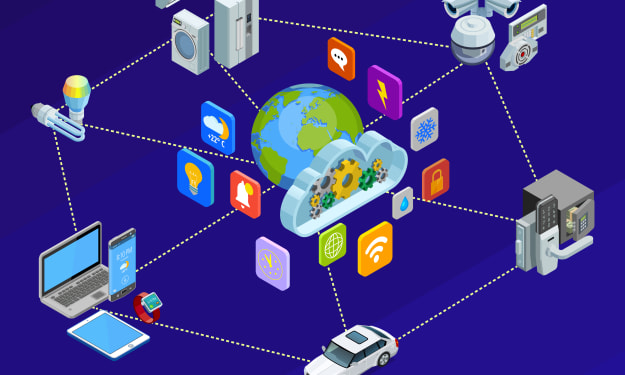
Humans collaborate and learn from one another. Machines can now do the same thing: interact, exchange information, and learn from generated and shared data. The same notion underpins and drives the Internet of Things (IoT). These devices can be used to collect and exchange data with one another, which can subsequently be used to generate meaningful and insightful information. The applications of these technologies are infinite.
By Ryan Williamson2 years ago in 01
How FinTech Companies Gain from Generative AI?
It is no secret or news that the financial services sector worldwide is undergoing a digital transformation. Before you ask, this change is driven by changing customer expectations and demands for personalization, security, higher efficiency, etc. Leading this change are interesting FinTech companies that use innovative solutions to revolutionize financial interactions and transactions. Artificial intelligence (AI), as we all know, has also stood out as a potent tool in this digital arsenal, helping FinTech firms a lot. The list includes streamlining their operations, better decision-making, and pioneering new possibilities. Generative AI, a groundbreaking AI branch, diverges from conventional methods by generating novel data or content. This branch of AI promises to reshape FinTech in more ways than one.
By Ryan Williamson2 years ago in 01
Primary Hurdles in Implementing IoT
The predominance of the Internet of Things (IoT) in our daily lives has been so profound that everybody is able to see it. In fact, we are nearer than we suspect to a future where our preferences drive thermostat adjustments, groceries are replenished independently, and traffic is optimized through real-time data examination. This interconnected network of devices, be it smartwatches or industrial sensors, a.k.a. IoT, brings with it the promise of completely transforming our lives. Nevertheless, as beneficial as it is, this interconnected future poses many challenges. What I mean to say is that despite the immense potential of IoT, realizing its benefits requires overcoming plenty of obstacles, ranging from technical complexities to concerns about security and compatibility across various platforms.
By Ryan Williamson2 years ago in The Swamp
Benefits of IoT Technology in the Banking and Finance
The long accepted banking and finance practices involved many manual processes that led to delays, errors and there was a general lack of real time analytics. The integration of internet of things (IoT) in this industry has been able to help them increase efficiency, and provide many innovative solutions that aim to increase customer experience. IoT can collect and analyze large volumes of data that can be used by this industry in real time. The use of IoT has opened up new ways to deliver personalized services and generate analytics and has transformed the conventional working of this industry into a dynamic contemporary one.
By Ryan Williamson2 years ago in 01
Challenges and Considerations in Implementing IoT in Warehouses
Warehouses across the globe are witnessing a notable transformation, with traditional manual processes and paper-based trails used for their management being replaced by tech-driven solutions. Therefore, warehouses today progressively embrace innovative solutions for streamlining operations, enhancing efficiency, and more. The Internet of Things (IoT) sticks out of the crowd among the tech advancements driving this change. IoT, which offers real-time insights into asset tracking, stock, task automation, and so on for warehouse management, carries innumerable advantages for warehousing. Nonetheless, the fact remains that IoT integration comes with its own set of challenges and considerations. It is important to acknowledge the potential obstacles and essential factors before you get ready to embrace IoT.
By Ryan Williamson2 years ago in 01
Low-Code Development: Addressing Key Challenges with Solutions
As the app development market undergoes rapid change and evolution, traditional coding practices and strategies become more and more time- and resource-intensive. This is not to say that conventional strategies are no longer potent; they demand significant time and resources frequently. Considering this shift, low-code development platforms have arisen in the market. These platforms, furnished to the brim with visual interfaces, intuitive abilities, pre-designed components, and considerably more, assist with accelerating the process of making an application. In fact, they help accelerate the process without necessitating extensive coding knowledge. Nevertheless, low-code development cannot and does not eradicate all challenges. Hence, it is important that we recognize and address these challenges -- how else can one ensure a smooth development process and successfully leverage low-code solutions?
By Ryan Williamson2 years ago in The Swamp
Influence Of IoT Technology On The Entertainment Sector
A subtle but profound transformation is sweeping through the world in which we live. This bit is not exactly news, of course; daily gadgets, which were once solitary and familiar, are now advancing at a rapid pace. Our centralized air systems can now comprehend our schedules, fridges can recognize decreasing staple supplies, and vehicles can talk with their surroundings. Quite cool, huh? Anyway, this growing network of interconnected gadgets, known as the Internet of Things (IoT), is covertly and steadily integrating into our everyday lives. Beyond our homes, industries are also starting to realize the potential of IoT. This holds true for the media and entertainment sector as well. This industry, which has been perpetually among the first to adopt new technologies, is on the brink of a revolution driven by IoT. As time goes on, it becomes increasingly fascinating to note how IoT shapes our content consumption, interactions with favorite shows and movies, and even our involvement in the entertainment realm.
By Ryan Williamson2 years ago in Education