Paul Levinson
Bio
Novels The Silk Code, The Plot To Save Socrates, It's Real Life: An Alternate History of The Beatles; LPs Twice Upon A Rhyme & Welcome Up; nonfiction The Soft Edge & Digital McLuhan, translated into 15 languages. Prof, Fordham Univ.
Stories (742)
Filter by community
Review of Westworld 1.2
As the second Presidential debate played out across lots of television in October 2016, the second episode of Westworld proceeded on HBO. Actually, it had been available On Demand for about a week -- as our own world became ever more like Westworld in our ability to control our fiction, if not our reality.
By Paul Levinson9 years ago in Futurism
Review of Westworld 1.1
If you're talking about AI science fiction—robots or androids programmed to convincingly think and act like humans, or almost like humans, or more than humans—you've got to start with Isaac Asimov and his three laws of robotics: (1) a robot can never harm a human being, or, through inaction, allow injury to befall a human, (2) a robot must follow all orders given to it by a human, except if such orders conflict with the first law, and (3) a robot should always act to preserve its own existence, except when following this third law would conflict with the first two. Thus, a robot ordered by a human to dismantle itself must follow that order, unless the robot knows that the human giving such as order was set to commit suicide, a suicide which the robot not dismantled could prevent. (This is not an exact quotation of Asimov's presentation of the three laws, but my own statement of them, with an explanatory example.)
By Paul Levinson9 years ago in Futurism
Review of Twin Peaks: The Return 1.9
That was the best line in Twin Peaks: The Return 1.9 last night—"I Don't See No Hidden Buttons" (said by the sheriff)—because, of course, he sees no hidden buttons, how could he, if they're hidden, and somehow that deeply obvious statement about what can't be seen is symptomatic of the entire Twin Peaks: The Return story, right?
By Paul Levinson9 years ago in Futurism
What Amelia Earhart Photo Says About the Power of Photography
I've been thinking about that newly uncovered photograph of Amelia Earhart and its upending of history, telling us she indeed survived that dive her plane apparently took into the Pacific Ocean in 1937.
By Paul Levinson9 years ago in Futurism
Review of Twin Peaks: The Return 1.8
Anyone who doubted that Twin Peaks is one bizarre science fiction horror story of a story got their answer tonight in episode 1.8: it is, with a vengeance, spun of gut-wrenching, stomach-churning, searingly mind-blowing wordless narrative the likes of which you don't often see on any television, unless you're maybe watching Donnie Darko someplace the 20th time.
By Paul Levinson9 years ago in Futurism
Synchronicity
It’s been this way all of my life. Like when I was in high school, and we’d be reading our homework assignments out loud, and some kid would stand up right before me and read pretty much what I had written. Not that he’d cheated or anything. I never showed my work to anyone. And yet he’d written my ideas, even using my words. I had a hard time proving that I wasn’t the cheat. “Great minds think alike,” the more enlightened among my teachers would say. But that was too pat. I knew something else was going on—I just didn’t know what.
By Paul Levinson9 years ago in Futurism
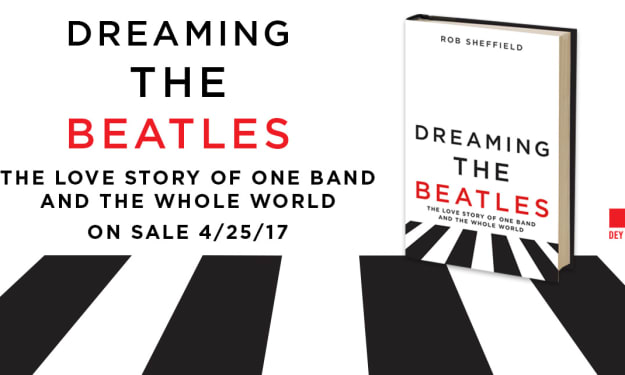
Review of Rob Sheffield's Dreaming The Beatles: 7 of X
Been a bit since I posted a review of Rob Sheffield's Dreaming the Beatles, mostly because this is not a book to be rush-read or even normally read (whatever pace that might be), but savored, and also because I've been writing some science fiction, and there's also the lure of the cool water and soft beach of Cape Cod Bay. But I wanted to record a few words about Sheffield's chapter on "Ticket to Ride", about as rich and satisfying an extended analysis you can find of a Beatles or any worthy song.
By Paul Levinson9 years ago in Beat
The Best Novel You Likely Never Heard Of
Right, it's not one of my mine. And I do this every few years — blog about a novel that's not only one of the best you likely never heard of, but, for what it's worth, is one of the best I've ever read. I guess I should also mention that the novel is science fiction — which means, it's not competing with Austen or Dickens or Tolstoy or Hemingway.
By Paul Levinson9 years ago in Futurism
Review of Rob Sheffield's Dreaming The Beatles: 6 of X
Rob Sheffield makes the case for Ringo in the next chapter of his stellar Dreaming the Beatles, putting the question regarding Ringo as whether he was an all-time genius drummer who made the Beatles possible, or "a clod who got lucky, the biggest fool who ever hit the big time". Sheffield puts his chips on the genius.
By Paul Levinson9 years ago in Beat