Juyel Khan Khan
Stories (2)
Filter by community
The Cursed Indigo Plantation
It was the monsoon season of 1987. Young researcher Avik Sen journeyed to a remote village in Nadia, where many legends surrounded an ancient "Nilkuthi," or indigo plantation house. Avik's primary goal was to uncover the history of this plantation and collect local folklore. Upon arriving in the village, Avik quickly realized that none of the villagers dared to venture near the decaying structure. They warned, "Restless spirits awaken there at night." Screams, cries, and the rattling of chains can be heard." Avik dismissed these tales as mere superstitions. The very next day, he found himself before the indigo plantation house. It was a dilapidated, rain-soaked edifice of red brick, its walls stained by creeping water hyacinths, its windows barred by rusty iron rods—the whole scene exuded a thrilling, eerie atmosphere. It was a Friday on that day. In the late afternoon, Avik ventured inside. He found himself in a large drawing-room, its walls adorned with faded portraits of long-dead English sahibs. In one of the adjoining rooms, he discovered a tattered diary. The diary, written by "Edward James Hamilton," was written in 1859. An entry read: "Today, another slave attempted to escape. I have locked him in the cellar below. This plantation is mine alone now. Those who try to flee are lost within these walls forever." As Avik read the words, a sudden, unnatural chill swept through the room. He began to tremble. Just then, a whisper brushed past his ear from behind—"Why have you come?" He whirled around to see a woman standing there, clad in a stark white sari, her hair soaking wet, and a blood-like liquid streaming from her eyes. In an instant, she vanished. Avik tried to leave, but the door was now firmly locked! He tried everything he could, but it wouldn't go away. He desperately searched for another way out when his eyes fell upon a narrow staircase, spiraling down into the cellar. As he descended into the oppressive darkness of the cellar, a pungent, suffocating stench nearly choked him. He switched on his mobile phone's flashlight and cautiously moved forward. There, scattered across the damp floor, he saw several skeletons, with heavy chains strewn about them. It seemed as if these were the remains of people once imprisoned and forgotten here. Suddenly, the voice echoed from behind him again, closer this time— “Free us…” An ice-cold hand, impossibly cold, touched his neck. Avik tried to scream, but no sound escaped his constricted throat. Looking ahead, his light illuminated at least ten shadowy figures, slowly closing in, surrounding him. All of them were whispering, a chorus of despair— “You must leave... or you too will remain here forever…” A sudden, violent flash of lightning momentarily lit up the entire cellar. In one cobweb-laden corner, he spotted the final, loose page of the diary. Scrawled on it were the words— "If anyone seeks the truth, they must set these souls free. Otherwise, they too will be trapped here for all eternity." Avik understood. There was only one way out—he had to break those accursed chains. With trembling hands, he began to wrench them apart, one by one. With each shattered link, a shadowy figure seemed to sigh and dissolve into the stale air. As the last chain broke with a resounding crack, a fierce, unearthly wind swept through the cellar, and with a groan, the main door above creaked open. Outside, the first pale light of dawn was breaking. Avik stumbled out, gasping, never daring to look back. After that day, he gave up writing, and his research too. If anyone ever asked him why, he would simply say— “To be honest, when you delve into some histories, it's not just the pages that awaken, but the souls as well...
By Juyel Khan Khan9 months ago in Horror
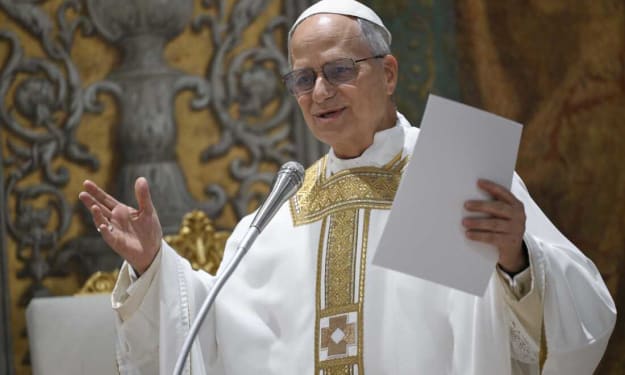
Pope Leo's stance on key issues, from climate change to LGBTQ+ rights to U.S. politics
Your request is inconsistent in some way. Pope Leo XIII held the papal office from 1878 to 1903. During that time, there wasn't much discussion or debate on climate change, LGBTQ+ rights, or the present-day political context of the United States. These issues became institutionalized and came to the forefront of discussion in the late 20th and 21st centuries. Perhaps you wanted to know about the views of the current Pope Francis, as these topics are highly relevant during his pontificate. If so, I am presenting Pope Francis's opinions below. If you genuinely want to know about Pope Leo XIII regarding these specific issues, it must be said that these topics were not even raised during his time. However, Pope Leo XIII is known for his famous encyclical "Rerum Novarum" (1891), where he spoke about workers' rights, fair wages, and social justice. It is regarded as an essential component of Catholic social teaching. These principles can indirectly be relevant to some of today's debates, such as economic inequality or the rights of the poor who are victims of environmental exploitation. Now, if your intention is to know Pope Francis's opinions, his positions are as follows: The Fundamental Values and Position of Pope Francis on Various Topics Since his election in 2013, Pope Francis has been known for his straightforward talk, his empathy for the poor and marginalized, and his bold steps in addressing complex global problems. His thinking is deeply centered on Jesus's mercy, social justice, and the protection of creation.
By Juyel Khan Khan9 months ago in History