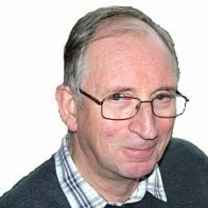
John Welford
Bio
John was a retired librarian, having spent most of his career in academic and industrial libraries.
He wrote on a number of subjects and also wrote stories as a member of the "Hinckley Scribblers".
Unfortunately John died in early July.
Stories (501)
Filter by community
Aida, by Giuseppe Verdi
Giuseppe Verdi was born near Busseto, Italy, in October 1813 and died in Milan in January 1901. He wrote more than 30 operas, Aida being one of the most celebrated. The book was written by Antonio Ghislanzoni, and the opera was commissioned by the Khedive of Egypt. The first production was in Cairo on 24 December 1871 and it has been an operatic standard ever since at opera houses all over the world. However, some of the most remarkable performances have been in the open air with the Pyramids as the backdrop, which would seem to be the most appropriate setting of all.
By John Welford5 years ago in Beat
The Battle of Zenta, 1697
Of course, the date of 11th September has a significance that will never be lost to anyone who was alive and aware on that date in 2001, but this article concerns an event that took place centuries earlier, namely in 1697. This was the Battle of Zenta, fought between the army of the Austrian Empire and the Ottoman Turks who were making inroads far into central Europe.
By John Welford5 years ago in FYI
William Tyndale: translator of the Bible
On 6th October 1536 William Tyndale was executed in what is now Belgium but at the time was part of the Spanish Netherlands. William Tyndale is renowned for being an early translator of the Bible into English, and for making a substantial contribution to the richness of the English language.
By John Welford5 years ago in FYI
The Gunpowder Plot, 1605
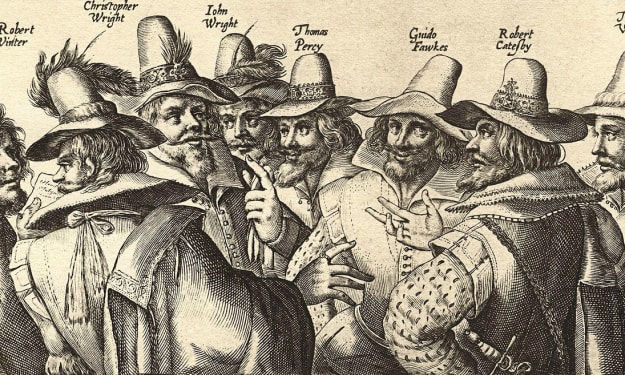
“Remember, remember, the 5th of November – gunpowder, treason and plot”. This was the day on which the opening of Parliament in 1605, attended by King James I and all the members of the Houses of Lords and Commons, would have been sabotaged by a massive explosion, had the plot succeeded. The plotters hoped thereby to start a revolution that would have resulted in the restoration of a Catholic regime in Great Britain, following years of repression of Catholics under Queen Elizabeth I and now her successor James, despite him being the son of a Catholic mother, namely Mary Queen of Scots.
By John Welford5 years ago in FYI
The Crimean War, 1853-6
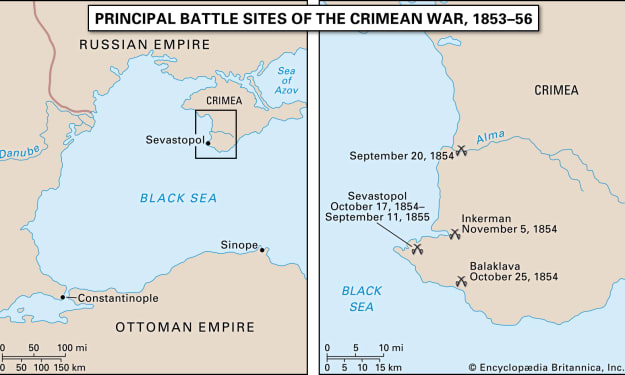
On 4th October 1853 Turkey declared war on Russia, thus setting in train the events that would lead to the Crimean War. By its end, a quarter of a million men would have died, many of them in appalling conditions from cold and disease, as opposed to being direct battle casualties.
By John Welford5 years ago in FYI
Sir Robert Peel
Sir Robert Peel, the founder of the modern Conservative Party, was born on 5th February 1788. Robert Peel’s early years Robert Peel was born at Bury in Lancashire but grew up at Drayton Manor near Tamworth in Staffordshire. This is known today as the site of a popular theme park, although the original house no longer exists. The estate was bought by Robert Peel’s father who had made a fortune in the textiles industry and used his money to buy his way into the social and political establishment.
By John Welford5 years ago in FYI
James Edward Stuart: "The Old Pretender"
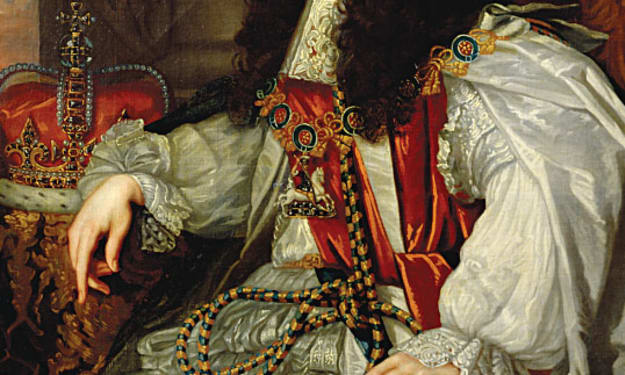
On 4th February 1716 James Francis Edward Stuart abandoned his attempt to seize the crowns of England, Scotland and Ireland from the Hanoverian King George I. He is less well-known than his son (“Bonnie Prince Charlie”) although history knows them as the Old Pretender and Young Pretender, respectively.
By John Welford5 years ago in FYI
Pope Julius II
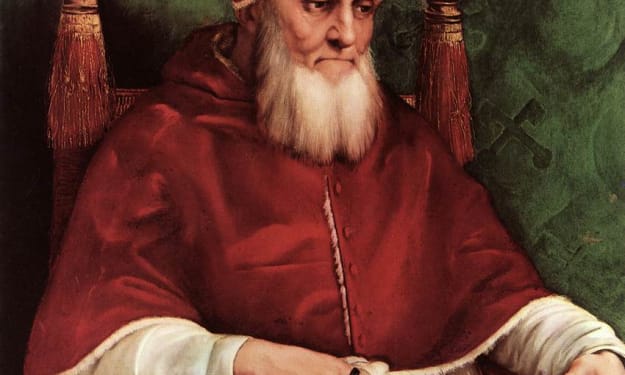
Giuliano della Rovere was elected to the office of Pope on 1st November 1503, taking the title of Julius II. Despite the corruption, double-dealing and other very worldly activities of which he was doubtless guilty, Julius’s reign would leave some remarkable legacies that have lasted to the present day.
By John Welford5 years ago in FYI
Charles Dickens and the Cleveland Street workhouse
Charles Dickens’s second novel, “Oliver Twist”, is well known for the scenes in which young Oliver is born and brought up in a workhouse. Anyone who has seen the stage or screen version of Lionel Bart’s “Oliver” will recall the moment when Oliver is ejected after he is goaded by the other boys to “ask for more”. We see the boys spending hours “picking oakum” under the oversight of Mr Bumble, the pompous and corrupt beadle, and the cruel and degrading treatment meted out to children whose only crime was to have been born poor.
By John Welford5 years ago in Geeks
Oliver Goldsmith
Oliver Goldsmith was an 18th-century writer who is best known for one novel, one poem and one play. Had he had a longer life, and/or been more energetic as a writer, he would probably have become one of English Literature’s greatest figures instead of merely a middle-ranking one.
By John Welford5 years ago in Geeks