Jacob Herr
Bio
Born & raised in the American heartland, Jacob Herr graduated from Butler University with a dual degree in theatre & history. He is a rough, tumble, and humble artist, known to write about a little bit of everything.
Stories (42)
Filter by community
The Politics of "Us VS Them"
A cult of the leader; promising national restoriation in the face of alleged disgrace. If this were an episode of Jeopardy the correct response to this phrase would be "What is Fascism?". In the eyes of the fascist leader, the so-called "disgrace" comes from the political & social outsiders (immigrants, leftists, minorities, women, LGBTQ+, etc.) & they carry out their agendas by means of a hypothetical takeover of a country's media, schools, and cultural instituions. The fascist leader decietfully peddles the necessity of a masculine, charismatic, powerful, and sometimes a very violent response; saying that he will be the ultimate solution. Fascism by it's very nature is right-winged, and rooted in the concepts of ultra-nationalism. Though, it must be made very clear that ultra-nationalism isn't exclusively right-winged. There are a pletora of ultra-nationalist movements of minority groups. There is such a thing as left-winged authroitarianism, as seen with the countrys and governments ruled by such terrible figures like Joseph Stalin, Mao Zedong, Josip Tito, Pol Pot, and the Kim family; who (combining the numbers together) killed people in the tens of millions. There are bad things on the Left. However, not all these terrible things mentioned are fascist. It's a very specific ideological sysytem, and when thinking about it, it must the thought about in it's entirety; never in these particular & seperate parts, here or there. They come as a collective. Dare I say a "ten piece body". By the time we're done here, we will examine each of these pieces to gain a better understanding of the anatomy of fascism. How this extreme system works to only ruin society under the guise of repair.
By Jacob Herr3 years ago in The Swamp
Of Maus & Morality
On January 27, 2022, (International Holocaust Rememberance Day) the news broke of a unanimous 10-0 vote by Tennesee's McGinn County School Board to remove Art Spiegelman‘s graphic novel, Maus, from the shelves of their school libraries & the curriculum of their English/Litrarature classes; due to concerns pertaining to the use of oscene language and depictions of nudity. As someone of German heritage, who was also lucky enough to be exposed to the history of the Holocaust & Holocaust literature throughout my school years & well into college (including Anne Frank's The Diary of A Young Girl, John Boyne's The Boy in the Striped Pyjamas, Elie Wiesel's Night, & Abbey Mann's Judgement at Nuremberg) I find myself in a state between perplexed, appalled, and offended to learn of this decision. To have a work like this be banned by a school board is the same sort of ignorance that the Nazis themselves are guilty of when they censored and set giant piles of books aflame for the sake of their own political gains; to control the mindset of the general population & regulate what materials and topics were taught to the nation's youth as they develop into adulthood. The same scenario applied to the fields of history & archeology (as discussed in another Vocal piece I wrote, entitled Discomfort & Intolerance). Even today, the fields of history & literature come under scrutiny by political entities, with the controversial teachings of Critical Race Theory. Though, to combat these issues through censorship & legal action, is only the continual cycle of sowing the seeds of ignorance that will only grow into the future harbingers of destruction, and leave us all horribly perplexed; wondering "How could this happen?", "Where did we go wrong?", and "What could we have done to stop it before it came to this?".
By Jacob Herr4 years ago in The Swamp
Lots of Shine, but Lacking in Substance
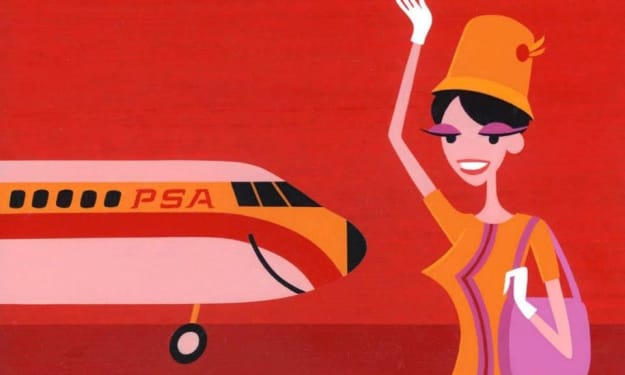
What words or ideas come to mind when imagining the experience of flying on an airplane in today's time? Perhaps some of the first would be how much the business of air travel has become a giant pain in the ass with expensive prices for everying (your seat, your food, your checked bags, etc.), irritating security measures by the T.S.A & D.O.H.S, the potential of your bags getting lost by the airline, and (depending on the length of your flight) the idea alone of sitting in a giant tube with wings for several hours with everything from runway groundings, to unnescessary turbulence, to being forced to recline your chair, to putting up with screaming babies, idiots who have to use the bathroom every 5 minutes, & fat fucks who can barely fit in their own seat; let alone the walking isle. Personally, based on some of my adventures on commerical airplanes, flying is the 11th level of Hell that Dante Allegeheri found to be so bad and so horrifying that he straight up refused to write about it; but apparently the commedians of the world are brave enough to call it out.
By Jacob Herr5 years ago in Wander
Respecting Mr. Salinger
Imagine yourself, for a moment, returning home after several years across the sea. You've just fought in one of the most vicious & deadliest wars in human history. You've miraculously stormed the beaches of Normandy, just barely survived the Battle of the Bulge, & discovered the unspeakable horrors of the Holocaust, as you march your way to victory; all the while, you've been carring a little, hand-written story in your pocket. This short story is no more than six chapters long, and every once in a while, you pull out and rework (time & again) into what will define you as a writer in your own time and beyond. What is this story? The magnum opus of Jerome David Salinger. The Catcher in the Rye. One of the most famous & infamous novels of the 20th century. A story about an idealistically lost teenager who struggles to find a sense of purpose in a world he sees as reeking of shallowness & superficiality. A story which is universally beloved & reviled by audiences galore. Yet, unlike other books of the same era & ilk, The Catcher in the Rye has never made a transition from the page to the screen, since its publication, over 70 years ago. Asking the question of why, is a question about what an author sees in their own material & how much of their passion lies within the text; passion that does far more than simply represent the plot. For it also represents the unrest & raw strength of the author. In this specific case, it represents Salinger's true personality & the workings of his subconscious. By the end of this piece, you'll gain an understanding of not only why The Catcher in the Rye has never been made into a movie, but moreover, why a story like this one is much better off being confined to the written word.
By Jacob Herr5 years ago in Humans
TV Musicals. Go Fix Yourself!
(Honrable mentions to Drew Gould, Khyel Roberson, Mike Reinhart, Richie Berner, Amanda Biro, Daniel Rollock, Stephanie Johnson, Reilly Crouse, Isaiah Moore, Maddie Davies, Nole Beran, Paige Scott, Lindsay Vallance & Beth Maio. Thank you so much for contributing your honest thoughts thowards the cration of this work.)
By Jacob Herr5 years ago in Geeks
In Defense of the Objectivist
The date is February 25, 1959. In a studio with famed American journalist, Mike Wallace, stood across from him one Ayn Rand. Born Alisa Zinovyevna Rosenbaum in Russia, she immigrated to the United States following her witnessing of the instability & tumultousness of the Russian Revolution & the rise of the Soviet Union. Over the course of living in America for more than 30 years she developed her skills in writing (mainly novels and screenplays). Such effort was often accomponied by intensive independent research into the philosophical writings of Aristotle; as well as the literary works of Fyodor Dostoevsky, Victor Hugo, Edmond Rostand, and Friedrich Schiller. At the time of this interview before the television cameras & Mr. Wallace, she had become most prominant for her political activism in testifying before the H.U.A.C (House Un-American Activities Commitee) and her publishing of two novels which would cement her as one of the most relevant, yet controversial, philsophers in modern times; The Fountainhead & Atlas Shrugged. During the televised interview, Mike Wallace read aloud to Rand a review of Atlas Shrugged from Newsweek. According to the article, Rand was deliberatley out to destroy almost every edifice in the contemporary American way of life, Judeo-Christian religion, modified & government-regulated capitalism, & rule by the majority will. Furthermore, Wallace went on to say that other reviewers accused her of scorning churches & the concept of God with the mere stroking of the pen onto paper. When asked if such criticisms were accurate. She almost nonchalantly replied "Uhh, yes."
By Jacob Herr5 years ago in Futurism
Orientalism & the American Native
The term “orientalism” has been made popular and a primary key concept of historiographic bias by the Palestinian historian and activist Edward Said, with the publishing of his book Orientalism in 1978. The concept of orientalism is that throughout the course of the 19th and early 20th Centuries, numerous cultures which existed outside of continental Europe were studied by European academics to understand the elements which made them culturally opposite to that of their native customs in England, France, Spain, Italy, and Germany. In the areas that are known today as the Middle East (then dominated by, mostly, the Ottoman Empire, India, Iran, and Egypt). However in the process of attempting to gain an understanding to each separate society’s traditions, and distinctions, many learned scholars and artists began to create a sense that in order for their fellow societies in Europe to understand this "world beyond their own" easier and faster, their scholarly findings and artistic renderings were condensed into cultural normalities which blurred the dichotomies between norms which are specifically Ottoman and those which are specifically Egyptian, Iranian, or Indian. The concept that these nations and their cultural normalities are all the same except for differences in geographic borders between the nations and empires. That the modern world now associates with stereotyping and cultural appropriation, Edward Said labeled as orientalism.
By Jacob Herr5 years ago in The Swamp
Discomfort & Intolerance
To paraphrase a line from Indiana Jones and the Last Crusade, science is the study of fact; not truth. If it’s truth that one is interested in, there are numerous podcasts pertaining philosophy and theology on Spotify. However, what does a scientist do when the person who writes their checks is looking for only a certain kind of fact? Let’s say, for example, that there is a man named Joe. Joe is a learned archeologist during a time of renewed public interest in Joe’s particular field of research. New university chairs are being endowed, new museums are being opened, the older museums are receiving an increase of funding, archeological sites are becoming popular tourist attractions, multiple books and documentaries are being released to raise awareness about important local history. Yet, all that Joe has to do in order to partake in this paradise of higher learning, is to put his soul up for sale. This fictitious conundrum was exactly what the German academic community was faced with during the regime of Adolf Hitler and the Nazi Party. It’s efforts created a Frankenstien-esc monstrosity of pseudoacademia and was used to justify their political agenda of ignorance, bigotry, racism, ethnic superiority, and genocide; only to have it’s methods continue on into the modern day (in a way which may be difficult to recognize at first glance).
By Jacob Herr6 years ago in Futurism
Delineating Democracy
In a previous article Defining Democracy: A Continuous Stream of Political Evolution, it was stated that the democratic process ought to be concrete in it’s values and goals, but also have the ability to be flexible with the everlasting changes of the human condition and the will of nature as new eras rise and fall and when technology eliminates human dependency. However, as the political events surrounding the presidency of Donald Trump, his administration, the liberal majority in the House; in contrast to the conservative majority of the Senate and Supreme Court, It must be made clear that the current model of American Democracy both does and does not follow the thesis of the older article. For democracy in the United States continually battles amongst itself to continually evolve with the changing tides of culture and technology; meanwhile certain figures of political power and position continually advocate that such progress is resulting in the abandonment of the efforts of the Founders as set down in the Constitution and Bill of Rights. An argument which closely mirrors the ever constant battle between the word of God in the Holy Bible and the word of Charles Darwin in On the Origin of Species.
By Jacob Herr6 years ago in The Swamp
Give the People What they Want
As the history of the performing arts marched forward into the modern era, the atmospheres of 20th Century drama shifted from melodramatic “bombasticism” of Aphra Behn and John Augustus Stone, to social realism and to the “epicness” and simplicity of political playwrights such as Bertolt Brecht and Luis Valdez. Instead of having audiences sit back and relax, the encouragement was to sit up, take notice, and act upon the values and messages for which the play brought forward to it’s audience; to walk into the show with one mindset and walk away from the show as a changed person, with an alternate social or political position. What is to be analyzed here is how Bertolt Brecht’s The Caucasian Chalk Circle and Luis Valdez’s Quinta Temporada illustrate how the theatre can interact with the programs of social power, in order to provoke the message of how it is the will of the people which ought to stand as most powerful of all other entities (politicians, bureaucrats, etc.).
By Jacob Herr6 years ago in The Swamp
Spiritual Truth & Blindness to Reality
On the stage, the hero’s journey to discover the truth behind the atmosphere of the play and the circumstances which have put these characters into these positions which the audience witnesses from the comfort of their seats, can be seen over and over again through time and history. However, most audiences see only the essential journey for which the story’s protagonist must embark and accomplish, followed by the spectacle which glazes the actions of the protagonist and the other characters which he or she encounters along the way; like hot fudge and caramel on an ice cream sundae. This essay is not shaped for such meager and sportive tricks. The purpose of this essay is to analyze how the protagonist’s journey for spiritual truth, fulfillment of revenge, and fulfillment of redemption in such works as Sophocles’ Oedipus Tyrannous, and William Shakespeare’s The Tragedy of Hamlet, can leave themselves blind to their environmental realities.
By Jacob Herr6 years ago in Geeks