Ishita Ramani
Bio
EbizFiling.com is a motivated and progressive concept conceived by like –minded people, which helps small, medium and large businesses to fulfill all compliance requirements of Indian Laws.
Stories (76)
Filter by community
Recent Challenges and Problems with GST
Introduction An indirect tax known as the Goods and Services Tax (GST) was implemented in India on July 1st, 2017. A single tax system took the role of numerous taxes including the central excise duty, service tax, value-added tax, etc. The primary goals of GST Registration were to harmonize tax rates across the nation, prevent tax evasion, and simplify the tax code. The introduction of GST, however, has not gone well, and there have also been a number of difficulties with GST return filing. We’ll talk about the key concerns and how they affect businesses in this blog.
By Ishita Ramani3 years ago in Journal
Understanding Section 48 of CGST
Introduction The key provision addressing how to determine the value of a supply to tax GST is found in Section 48 of the Central Goods and Services Tax (CGST) Act, 2017. For businesses and individuals involved in the supply of goods or services, understanding this component is crucial since it provides guidance on how to calculate the taxable value and follow GST rules. In this post, we’ll examine Section 48 of the CGST Act 2017 in more detail and explore its implications for taxpayers.
By Ishita Ramani3 years ago in Journal
Understanding Section 73–74 of the CGST Act
Introduction By combining different indirect taxes under one unified tax, the Goods and Services Tax (GST) Act has completely transformed the Indian tax system. A key factor in ensuring the efficient implementation and administration of the GST is the Central Goods and Services Tax (CGST) Act. The CGST Act’s Sections 73 and 74 deal with the request for payment of tax from taxpayers. To maintain compliance and prevent any legal issues, it is crucial for both taxpayers and tax authorities to comprehend these areas. We shall go into the nuances of Sections 73 and 74 in this post, as well as their importance in the GST regime.
By Ishita Ramani3 years ago in Journal
All about the mistakes to avoid while filing GSTR 1
Introduction In India, a comprehensive indirect tax known as the Goods and Services Tax (GST) is imposed on the provision of goods and services. Every person who has registered for GST is expected to submit a number of reports, including GSTR 1, a monthly or quarterly report that includes information on all outbound supplies made during the specified time. Businesses could find it challenging to submit GSTR 1 and other GST returns, and any errors in the GST filing could result in penalties and legal implications. We will go over the errors to avoid when submitting GSTR 1 in this article.
By Ishita Ramani3 years ago in Journal
7 Mistakes to avoid while filing GSTR (Goods and Service Tax Return)
Introduction: Taxpayers must exercise particular caution while filing a GST return to avoid unneeded reconciliation problems. The most common errors to avoid while submitting a Goods and Service Tax Return (GSTR) are covered in this article. Let’s begin by comprehending what a GST return is and the various forms of GST returns before delving into those errors.
By Ishita Ramani3 years ago in Journal
GST return forms- Different types of GST returns in India
What is the Goods and Services Tax (GST)? The goods and services tax (GST), a value-added tax, is levied on the majority of goods and services that are offered for domestic use. Although businesses that provide goods and services are also required to pay the GST to the government, it is an indirect tax that consumers must pay. In reality, the GST produces revenue for the government through the filing of numerous GST Returns.
By Ishita Ramani3 years ago in Journal
All about GST ITC-04 Return
Introduction India’s indirect tax system has been greatly simplified thanks to the Goods and Services Tax (GST), which has also undergone major tax reform. The possibility for businesses to claim Input Tax Credits (ITC) to offset the taxes they have paid on their purchases is an important feature of the GST. In particular, the GST ITC-04 return focuses on the laborers who are essential to sectors like textiles, gems & jewelry, and vehicle production. The significance of the GST ITC-04 return and its effects on job employees will be discussed in this article.
By Ishita Ramani3 years ago in Journal
What is the difference between GSTR 1 and GSTR 3B?
Introduction GST Returns must be filed on a monthly and quarterly basis by all registered dealers. In order to collect information from authorized dealers and transfer the ITC, the GST return filings are required. Each year, taxpayers file various forms of GST returns. The GSTR-1, which is filed for outgoing supplies, and the GSTR-3B, which is filed for both incoming and outgoing supplies, will be the two types of GST returns that we will be concentrating on in this article. We will also cover the distinctions between GSTR-1 and GSTR-3B in this article.
By Ishita Ramani3 years ago in Journal
LLP vs Private Limited Company -A Comparative Analysis
Introduction Private Limited Company (Pvt Ltd) and Limited Liability Partnership (LLP) are two often encountered company forms that entrepreneurs encounter while launching a new enterprise in India. Both are governed by separate statutes, the Limited Liability Partnership Act of 2008 and the Companies Act of 2013, respectively. While these organizations have some things in common and provide services ideal for companies of different sizes, they also differ noticeably from one another. In this post, we shall contrast Pvt Ltd and LLP from the viewpoint of an entrepreneur starting a new business.
By Ishita Ramani3 years ago in Journal
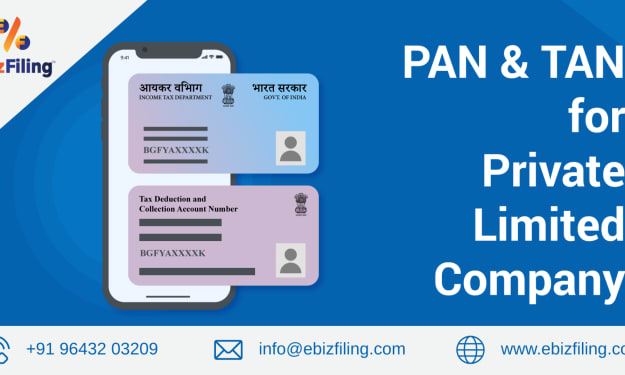
How to obtain PAN & TAN for Private Limited Company?
Introduction Incorporating a Private Limited Company requires the acquisition of essential documents such as the Permanent Account Number (PAN) and Tax Deduction Account Number (TAN). This comprehensive guide will walk you through the process of obtaining and downloading PAN and TAN for your Private Limited Company using the SPICe+ form. PAN and TAN are mandatory requirements issued by the Income Tax Department for tax-paying individuals, partnerships, and companies. Follow the step-by-step instructions outlined below to ensure a smooth and hassle-free application process.
By Ishita Ramani3 years ago in Journal
How to Appoint a Director in a Private Limited Company?
Introduction: In a Private Limited Company, the appointment of directors plays a crucial role in managing and overseeing the company's operations. The company is a legal person that needs a natural person for managing, directing, controlling, and overseeing the affairs of the company. It is a primary requirement for a Private Limited Company to appoint minimum 2 directors. In a private Limited company, the boards of directors can appoint or elect one person or more than one person as a director who implements and determines the policies of the company. In this article, we have discussed the process for Appointment of Director in Private Limited Company. This article provides a comprehensive overview of the provisions and process involved in appointing directors in a Private Limited Company.
By Ishita Ramani3 years ago in Journal
All About Share Transfer Procedure in Private Limited Company
In a Private Limited Company, share transfer plays a crucial role in determining ownership and facilitating the introduction of new investors. This article provides a detailed overview of the process of transferring shares in a Private Limited Company. We will explore the concept of share transfer, its benefits, the restrictions imposed by the Articles of Association (AOA), and the step-by-step procedure involved in transferring shares.
By Ishita Ramani3 years ago in Journal