Futurism Staff
Bio
A team of space cadets making the most out of their time trapped on Earth. Help.
Stories (149)
Filter by community
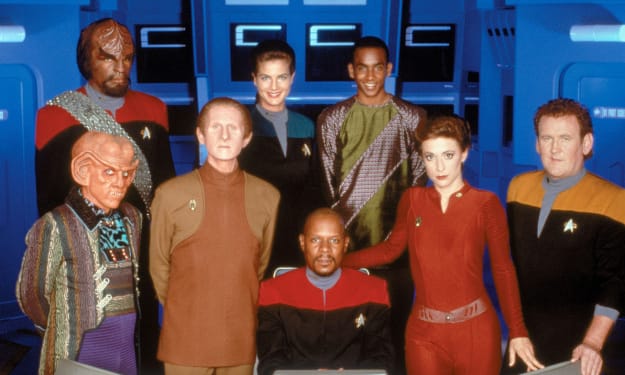
Star Trek: Deep Space Nine's Best & Worst Episodes
One of the most popular television shows ever developed for the Star Trek franchise, Deep Space Nine (DS9), came to an end in June of 1999. Its growing popularity did come as a bit of a surprise, especially to the community of Trek fans. When the show began airing in January 1993, Star Trek: The Next Generation was at its prime, and it had taken long enough for the fans of Kirk, Spock, and McCoy to warm up to that show. Deep Space Nine had quite a few other strikes against it. Not only was it a darker vision of the future, but it was the first Star Trek ongoing series to be developed after the death of Star Trek creator Gene Roddenberry.
By Futurism Staff10 years ago in Futurism
Star Cluster Science
Тhe star clusters must be regions of incredible beauty. Imagine living on a planet inside a star cluster. Your night sky would be densely spangled with bright points of light. Glowing bands of cosmic gas might arch overhead. The spectacle could make Earth's clearest winter skies seem dull.
By Futurism Staff10 years ago in Futurism
E.O. Wilson Interview
The publication of E.O. Wilson's Sociobiology in 1975 was to use a cliché—a landmark event in the history of biology. This enormous volume (697 oversize pages) is a truly remarkable compendium of a vast, widely dispersed literature on the relationship between biology and social behavior throughout the animal kingdom. It ranges from Homo sapiens to the social insects (Wilson is by trade an entomologist; his speciality—he calls them his "totem animal"—is ants). He intended it to be a scientifically respectable, thorough review, so it is full of tables and charts and extensively referenced. On the other hand, it is well written and handsomely illustrated.
By Futurism Staff10 years ago in Futurism
Finding Scorpius Constellation
Scorpius' claim to fame lies in its poisonous sting. The great hunter Orion boasted that he could wipe out all the creatures of the Earth. Gaia, the goddess of the Earth, realized how lonely our planet would be without the birds and beasts, so she sent a giant scorpion to attack the bragging hunter. In the terrible battle that followed, Orion killed the scorpion, but not before he was fatally stung.
By Futurism Staff10 years ago in Futurism
Pioneers of Astronomy
Nicholas Copernicus once said “The massive bulk of the earth does indeed shrink to insignificance in comparison with the size of the heavens." While we may attribute our knowledge of the solar system and astronomy to modern day telescopes, space shuttles, and space probes, it is important to remember that the size of the heavens would not even be discovered without the pioneers of astronomy. From Nicholas Copernicus and Albert Einstein to astronauts and space organizations like NASA, the pioneers of astronomy have laid down an important foundation for which exploration of the stars today is firmly rooted.
By Futurism Staff10 years ago in Futurism
Jacques Vallee Interview
"When I was beginning my career in science," recalls Dr. Jacques Vallee, "the main argument against UFOs was that astronomers never saw them. I found that argument convincing." Then, in 1961, he and other satellite trackers at the Paris Observatory detected something odd overhead. Stranger still was what happened after that: The project director erased the data tape before an orbit for the unidentified object could be computed. "I thought, here we are at a renowned institution, seeing something we can't explain and destroying data for fear of ridicule. That, for me, reopened the entire question."
By Futurism Staff10 years ago in Futurism
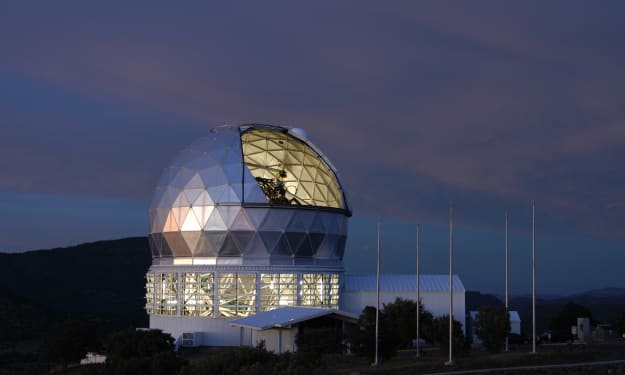
Observatory Guide
There are few pastimes more fascinating, more mysterious, or more peaceful than simply stargazing at a splendid night sky—wondering what it all means. Will we ever travel to any of those other suns? Are there other souls like us on a distant planet, looking up and wondering the same? A special breed of investigator is devoted to finding the answers to some of these questions, by studying everything in the universe from the movement of planets to the nature of such bizarre objects as quasars and black holes, which explode or go beep in the night. That investigator is the astronomer.
By Futurism Staff10 years ago in Futurism
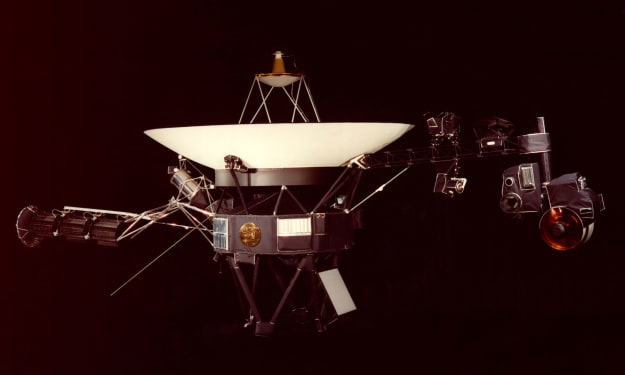
Voyager 2's Expedition
It weighs almost a ton and measures approximately four meters by four meters. Its two television cameras take tens of thousands of pictures of worlds in the outer solar system. A collision with a micrometeoroid could cause it to lose its orientation temporarily, but it wouldn't founder. It is made of millions of parts. If certain components fail, others will take over. We're talking about the fantastic Voyager 2, the semi-intelligent robot that, for nearly 40 years, has explored unknown worlds.
By Futurism Staff10 years ago in Futurism
Gypsy Moth Invasion
The caterpillars were everywhere—in the pool, on the side of the house, in the eaves, in your hair. Where there were large infestations, you could hear them at night. Their droppings, or frass, sounded like a light rain. Perfectly sane people went about protected beneath umbrellas on sunny days.
By Futurism Staff10 years ago in Futurism