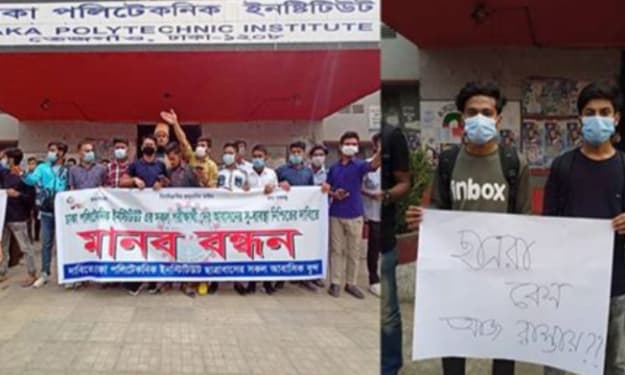
Traffic snarls in Dhaka as polytechnic students block roads to demand degree recognition
On Wednesday, April 17, 2025, thousands of polytechnic student protesters blocked key intersections in Dhaka, Bangladesh, in a fresh wave of demonstrations demanding official recognition and equal status for their diplomas. The demonstration, marked by chants, placards, and sit-ins, disrupted daily life and raised pressing questions about the country's technical education policies.
The Protest
The protest, spearheaded by students from several public and private polytechnic institutes, began early in the morning. Demonstrators blocked major thoroughfares including Shahbagh, Farmgate, and parts of the Bijoy Sarani area, causing severe gridlocks across Dhaka.
"We study for four years, just like university students, but our degrees are treated as inferior," said Rezaul Karim, a third-year student from Dhaka Polytechnic Institute. "We demand our diplomas be recognized as equivalent to undergraduate degrees, so we can compete fairly in job markets and pursue higher education."
The movement has been gaining momentum over the past few weeks as students across the country have been mobilizing through social media, calling attention to what they describe as long-standing discrimination and neglect from policymakers.
Root of the Discontent
The demand for the Bangladesh government to officially recognize engineering diplomas from polytechnic institutes as equivalent to bachelor's degrees is at the heart of the protest. Students argue that despite completing extensive coursework and practical training over four years, they face limited career prospects and are often excluded from applying for government or private sector jobs that require an undergraduate qualification.
Moreover, these students are often denied the opportunity to pursue higher studies in mainstream universities, further limiting their academic and professional growth. The disparity, according to protesters, undermines the government's stated commitment to promoting technical and vocational education to meet the demands of a modern, industrialized economy.
Traffic Nightmare
As the demonstrations intensified throughout the day, Dhaka's already congested roads became virtually impassable. Long queues of vehicles were seen in areas like Mohakhali, Malibagh, and Karwan Bazar, with office-goers, students, and emergency services caught in the chaos. Commuters took to social media to share images and videos of the standstill, with some walking long distances to reach their destinations.
Ride-sharing services were severely impacted, and public transport was sparse in affected zones. "I’ve been stuck in my bus for over two hours just to move a few kilometers," said Nusrat Jahan, a bank employee in Farmgate. "I understand the students’ concerns, but there needs to be a more balanced approach."
Government Response
In response to the protests, representatives from the Ministry of Education and the Technical Education Board held an emergency meeting. Speaking at a press briefing, a ministry official acknowledged the concerns raised by the students and assured that the government is reviewing the policy framework surrounding diploma certification.
The official stated, "We recognize the valuable contribution of polytechnic graduates to our workforce." "A committee will be formed to assess the equivalency demand and other academic integration issues."
Students, however, were skeptical and pledged to continue their movement until concrete measures are taken because there was no clear timeline or commitment. Support and Criticism
While many have expressed sympathy for the students’ plight, others have criticized the method of protest. "Blocking roads and disrupting the lives of millions isn’t the solution," said traffic analyst Mostafa Kamal. "While the demands are valid, such actions put additional pressure on an already burdened city infrastructure."
On the other hand, education experts and rights activists have voiced support for the students, calling the government's delay in addressing these issues "unjustified." Professor Tahmina Rahman of the University of Dhaka stated, "If we are to prioritize skills-based education, we must also ensure that diploma holders are not treated as second-class graduates."
What’s Next?
As night fell, student leaders announced a temporary suspension of the blockade, allowing traffic to resume, but warned that protests would resume in full force if their demands are not met within a week. They also called for solidarity from students in universities and colleges across the country.
The movement underscores a broader challenge for Bangladesh’s education system – balancing academic prestige with practical skill development in a way that ensures equality and opportunity for all graduates.
Unless swift and sincere action is taken, Dhaka may soon see more days of halted traffic and rising tension, as thousands of young people continue to fight not just for recognition, but for a future they believe they deserve.