Invisible Strength. AI-Generated.
A Journey of Strength, Belief, and Change
Invisible Strength
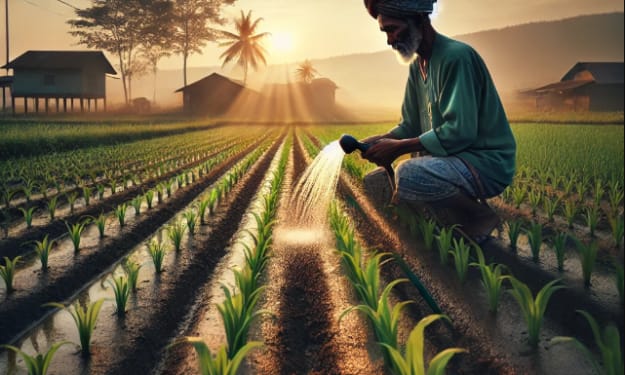
In the village of Sirajganj, a poor farmer named Rabiul had long been struggling.
His crops never thrived, and his family struggled. The land was less fruitful than he had hoped, and the harvest always seemed to bury him deeper in debt. His world was a never-ending flow of problems, one leading into another, to Rabiul.
His heart weighed heavy, but he would not be resigned;
What kept him going in that belief of an inner strength, an unseen power that could make a difference.
One day, as Rabiul was tending his fields, he noticed a figure emerging toward him from across the horizon. It was Ibrahim, an old man, walking on foot. He was familiar with wandering around the lands, he roamed properties at different villages. Father was a gentle, tall man with steel blue eyes, calm, cool and collected, as if he were unfit for a body racked by the harshness of village life. As tends to happen in rural settings, Ibrahim received more than the friendly welcome from Rabiul. It would lead to a life-changing journey when he fed him and gave him a place to sleep for the night.
Dinner conversations: Ibrahim told a story to Rabiul. He spoke of a village that had once suffered terribly from drought and poor harvests, like Rabiul’s village. “But the villagers had learned to transcend their situation. They had pulled their resources together, without waiting for assistance from above them in the hierarchy, without seeking knowledge or lone heroes to come crashing through and save them. By using new techniques but more crucially, by changing their mind-set — they were able to bring their land back to its old richness. And as if by magic, the village started to bloom once more — not with help from the outside world, but because the villagers found the strength within themselves to work together.
Rabiul noted, but the doubt persisted. Could his village truly experience such a change? Was the power of togetherness and inner wisdom victorious over years of infringement? But under that skepticism, Rabiul felt Ibrahim’s presence: “The real power that allows you to do anything is not in the tools you hold or the resources that you have. It resides within you. If you have faith in yourself and stand together with others, nothing can stop you.”
These words resonated with Rabiul deeply. He had focused for so many years on the external forces he fought against drought, poor soil, low yields that he had neglected to look inward. There was something compelling about Ibrahim’s story. Gradually, it occurred to him that he was not fighting for the land his fight had never been about the land but about the way in which he lived his life. Perhaps he needed to address the way he viewed his situation.
The next morning, Rabiul woke up with a plan. So he took stock of resources, ran a cost-benefit analysis and began looking for new ways to do everything better. He reached out to nearby farmers, offering his expertise in exchange for help. They discussed innovative techniques, such as better irrigation methods, crop rotation and organic fertilizers. Rabiul also refrained from throwing soil that he had neglected behind bars.
His wife, Sumaya, was dubious at first, because she had seen Rabiul attempt all sorts of things over the years and fail, at least without much success. But after seeing his resolve, she began to embrace the changes he was making as well. Staggering crops and
utilizing regional resources, Sumaya advised, can help combat pests. Their farm started to implement gradual, thoughtful changes aimed at sustainable, long-term yield.
At first, progress was slow. The land, still exhausted from years of poor management, resisted Rabiul’s efforts. His crops thrived, but not as fast as he would have liked. Yet, he persevered. With every successive job, he became ever more convinced of the process. If Rabiul woke up each day and said, ‘Today I need to get through this,’ you know, there’s only so much to his saga, that this will eventually work.
We began to notice small progress over the weeks. And the dirt started to get better, and the crops started to be taller, healthier. Even the weather seemed to cooperate. The rains fell, right on cue, and the sun shone, when it had to. Satan’s bleak farm was coming alive. Word of his win began to circulate in the village. Inspired by that, other farmers were quick to follow suit on their land.
A fight that had long felt individual became a movement. Manufacturers who were reluctant to pivot reluctantly joined, sharing knowledge and resources. The village began to look inward for solutions instead of waiting for outside rescue. They leaned on each other, cheered each other on and celebrated every small win. All within a short span of time, the entire village’s agricultural productivity improved and their economy began to recover.
Rabiul’s success story motivated the whole community. Not only had he transformed his own farm. He had sparked a movement in Sirajganj. But as painful and hard as it was, for the villagers they learned their true power did not lie with what was outside the village, but with their togetherness, their struggle for change and the faith they had in themselves.
And eventually, after years of toil and trying, Rabiul became prosperous, but to him the farm meant more than material wealth! His influence was not limited to agriculture. So, the villagers started thinking alike in their lives too. They began to be more proactive in solving problems, more supportive of each other and more open to novel ideas. Rabiul had become a leader without asking for the role, without rank or the trappings of violence, simply by teaching the world how to live.
And the years passed, and along them, Sirajganj came into its own. The fields produced, the community thrived and Rabiul’s name became synonymous with hope and perseverance. Soon he realized that the most valuable currency of success was not money or material things but the ability to uplift others and make impact. Its not just a farming path, its a path of re-newing the mind and the paradigms that affect our lives and the lives of those around us.
There was the time Ibrahim told his story. His eternal battle with nature, without that encounter, could keep going forever. But Ibrahim also taught him that the real strength is within — that believing in yourself and standing shoulder to shoulder with others is all that is required to overcome impossible obstacles.
Rabiul’s farm is now flourishing, but more importantly, Sirajganj has become a template for other -- even nearby -- villages. It makes us remember that we all have the power to create change within us. Whether we own the land and the weather and have access to offshore resources, none of that will define our success — only our attitude, our tenacity and our collective labor toward a collective destiny. Rabiul’s journey proves that with the willpower to persevere one way or another, there is no barrier too high.