Charika Janith
Bio
A Soldier of Fortune.
Stories (1)
Filter by community
Does Gravity "Exist" ?
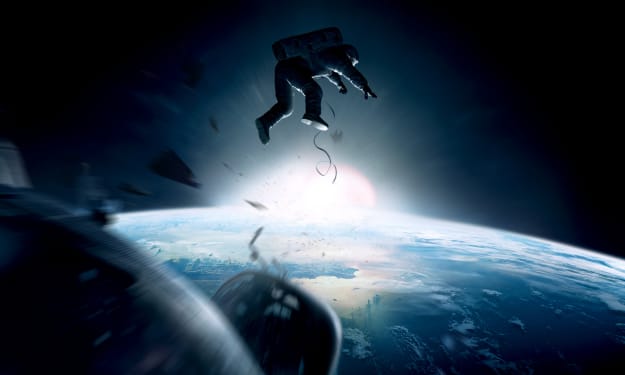
Gravity, as described by the general theory of relativity, is not considered a force. In fact, there are no gravitational fields in this theory, as gravity is perceived as somewhat of an illusion. This concept can be demonstrated by envisioning a scenario in which an individual is launched into outer space. Albert Einstein, the renowned physicist, once expressed that the happiest thought of his life was imagining a man falling off a roof. However, his joy did not stem from a sense of Schadenfreude; rather, it was derived from the realization that during the man's descent, he would not experience his own weight. In this weightless state, any objects dropped by the man would remain stationary relative to him or move in a uniform motion. This scenario closely resembles the conditions experienced in deep space, far away from any significant masses. In such a setting, an individual would not perceive any weight and objects would either remain stationary relative to them or move in a straight line at a constant velocity. As an observer in this inertial state, one would not be accelerating nor be influenced by a gravitational field. Consequently, all the laws of physics would apply within their reference frame, making it impossible to distinguish their initial reference frame from any other. Einstein took a significant leap by asserting that these two scenarios, the falling man and the observer in deep space, are not merely similar but are, in fact, completely equivalent. Physically, they represent the same phenomenon. This implies that the man falling from the roof is not actually within a gravitational field, despite being in close proximity to the Earth. Contrarily, he is an inertial observer, much like the individual in deep space. It is evident that the falling man is indeed within a gravitational field, given his proximity to the Earth and the fact that his speed increases by 9.8 meters per second, every second. This reality becomes painfully apparent when he eventually collides with the ground.Einstein's equivalence principle highlights the importance of the observer's experience in determining whether they are in an inertial frame of reference. Even if two situations appear vastly different, if the observer feels weightless, they are in an inertial frame of reference. For instance, if Rocket Man is coasting at a constant velocity and encounters a planet in the distance, an external observer may notice a slight bend in the rocket's path towards the planet. However, Rocket Man would remain unaware of this change as he feels no force or acceleration. As he approaches the planet, he continues to feel weightless, and his onboard accelerometer would not register any change. Therefore, his frame of reference remains inertial until he crashes into the planet. The curved path of his rocket can be explained by the concept of curved spacetime. Although Rocket Man feels like he is moving in a straight line through spacetime, the presence of massive objects like planets causes spacetime to curve.Hence, the reason why his trajectory seemed curved to a distant observer becomes apparent. This phenomenon is not as uncommon as it may initially appear. For instance, airplanes always strive to take the most direct route between cities, which essentially entails flying in a straight line. However, due to the Earth's curved surface, the shortest path does not appear as a straight line. These shortest paths over curved surfaces are referred to as geodesics. Interestingly, we employ the same term, geodesics, to describe the straight line paths followed by inertial observers through curved spacetime.To further illustrate this concept, consider the following analogy: imagine you and a friend standing 1000 kilometers apart on the equator. Both of you begin walking due North. Over time, you will gradually converge and eventually meet at the North Pole. It is as if there is an invisible force drawing you together, even though neither you nor your friend perceives any force acting upon you. In reality, gravity functions in a similar manner; it does not actually exist as a tangible force. The true reason behind your convergence is that both of you are traversing straight paths, or geodesics, on a curved surface.Likewise, astronauts aboard the space station experience weightlessness. This implies that they too are inertial observers traveling along a geodesic. However, the Earth's gravitational field curves the fabric of spacetime surrounding it, causing their seemingly straight path to manifest as a helix. Only when the temporal dimension is disregarded does it resemble a circular orbit. It is crucial to remember that we are all in constant motion through both space and time, collectively existing within the framework of spacetime.The standard bent sheet analogy for curved spacetime is often used to explain general relativity, but it can be misleading. This analogy can give the impression that objects fall towards the middle of a well due to the gravitational force, when in fact, there is no gravitational force in general relativity. Instead, objects travel on a straight line path through spacetime, which appears curved around massive objects. The curvature of spacetime is determined by the presence of matter, and in turn, spacetime influences the motion of matter. If we consider the scenario of accelerating at 9.8 meters per second squared in deep space, someone outside the rocket would observe all objects remaining stationary while the floor of the rocket accelerates towards them. Inside the rocket, everything would appear to accelerate towards the ground, and a force would be felt pushing up on one's feet, similar to the force experienced on the surface of the Earth. This situation is equivalent to being in a gravitational field, and it is important to note that it is not the same as being in an inertial frame of reference. In summary, the standard bent sheet analogy can be misleading when trying to understand general relativity. Instead, it is important to consider the straight line path of objects through curved spacetime, which is influenced by the presence of matter. The scenario of accelerating in deep space is equivalent to being in a gravitational field, and it is not the same as being in an inertial frame of reference. Acceleration and the absence of a gravitational field may seem contradictory, but let's delve into this concept further. In the realm of Newtonian physics, we typically depict the weight force acting upon you, which is the force of gravity pulling you downwards, along with the normal force exerted by the floor pushing you upwards. These forces are considered equal and opposite, resulting in no net force on you and therefore no acceleration.However, in the framework of general relativity, gravity is not regarded as a force in the traditional sense. Consequently, you do not possess weight in this context. The only forces acting upon you are the normal forces from the floor, propelling you upwards. As a result, you are indeed accelerating upwards.Now, you may argue that you do not perceive any upward movement. However, this perception is relative to the objects surrounding you, such as the flip chart, the floor, and everything else within the room. It is important to note that all these objects are within your frame of reference, which is known to be non-inertial.To truly measure your acceleration, you would require someone in an inertial frame of reference, such as the individual who fell off the roof. From their perspective, they would observe you accelerating upwards at a rate of 9.8 meters per second squared.This observation highlights that acceleration is essentially a deviation from a geodesic, which represents a straight-line path through spacetime. The presence of the floor prevents you from following such a path by exerting an upward force, causing you to accelerate upwards.Now, if you and everyone else around the world, as well as the entire surface of the Earth, are accelerating upwards, one might question whether the Earth should be expanding.It is indeed possible for an object to be accelerating even if its spatial coordinates remain unchanged. For instance, consider a rocket ship moving through deep space. If a light beam is shone across the ship, it will travel in a straight line and hit a point on the opposite wall at the same height as the source. However, if the rocket is accelerating, an external observer will still see the light beam traveling in a straight line, but inside the rocket, the light will take longer to travel across the cabin due to the rocket's increased speed. As a result, the light will hit the opposite wall at a lower point than before. This effect is known as light deflection in an accelerating frame of reference. Although the deflection is typically very small, it demonstrates that light can bend in an accelerating frame of reference. This led Einstein to hypothesize that light would also bend when passing a large mass, such as the sun. The ideal experiment to test this hypothesis would be to observe light passing near the sun, but the sun's brightness makes it difficult to see stars nearby. However, during a total solar eclipse in 1919, Arthur Eddington was able to take pictures of stars near the sun and found that their positions appeared deflected by the precise amount predicted by Einstein's general theory of relativity. This result provided strong evidence for the theory, which has since passed numerous tests.An extensively acknowledged and empirically verified discovery is that electromagnetic radiation is emitted by accelerating charges. To experimentally examine this phenomenon, one could compare the behavior of a stationary charge and a gravitational field with that of a freely falling charge. If the Newtonian perspective of gravity holds true, the stationary charge would not emit electromagnetic radiation, whereas the freely falling charge, being subject to acceleration, would emit radiation. Conversely, according to general relativity, the freely falling charge is perceived as non-accelerating, following a straight path through curved spacetime, while the stationary charge is accelerating and thus expected to emit electromagnetic radiation. However, logistical obstacles have thus far hindered the actual execution of this experiment. Nonetheless, one's belief regarding the outcome of this experiment reflects their fundamental understanding of the nature of gravity. Therefore, the question arises: Do you anticipate a freely falling charge to emit electromagnetic radiation? Furthermore, is gravity merely an illusion?
By Charika Janith2 years ago in FYI