Bijan Mondal
Bio
Stories (55)
Filter by community
The Dance of Creation: A Story of Lord Shiva and Devi Parvati. AI-Generated.
The Dance of Creation: A Story of Lord Shiva and Devi Parvati High in the celestial abode of Mount Kailash, where the heavens touch the earth, Lord Shiva and Devi Parvati lived in divine harmony. Shiva, the ascetic, and Parvati, the embodiment of love and devotion, complemented each other perfectly—the destroyer and the nurturer, the stillness and the movement.
By Bijan Mondal12 months ago in Art
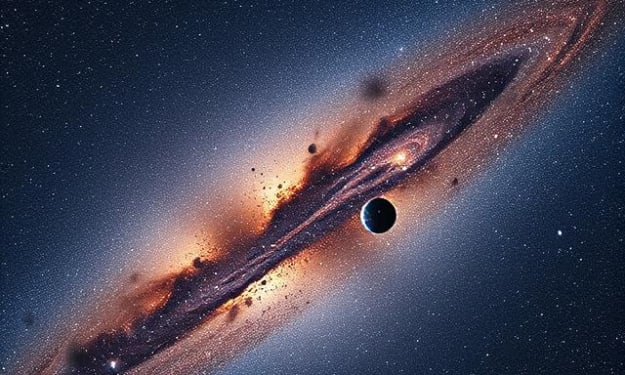
The Andromeda Galaxy
The Andromeda Galaxy: Unknown Facts and Mysteries The Andromeda Galaxy (M31) is the nearest spiral galaxy to the Milky Way and one of the most fascinating objects in the universe. Located approximately 2.537 million light-years away, Andromeda is the largest galaxy in the Local Group, which includes the Milky Way, the Triangulum Galaxy (M33), and about 54 smaller satellite galaxies. Despite its relative proximity, many aspects of Andromeda remain mysterious. This article explores some lesser-known and intriguing facts about our galactic neighbor. 1. Andromeda is Moving Toward the Milky Way One of the most striking facts about Andromeda is that it is on a collision course with the Milky Way. Unlike most galaxies that move away due to the universe's expansion, Andromeda is heading toward us at a speed of 110 km/s (68 miles per second). Scientists predict that in about 4.5 billion years, Andromeda and the Milky Way will merge to form a single giant elliptical galaxy, sometimes called "Milkomeda." Despite this impending collision, individual stars are so far apart that very few direct stellar collisions will occur. Instead, gravitational interactions will rearrange the structure of both galaxies over millions of years. 2. Andromeda is Bigger Than the Milky Way For a long time, scientists believed the Milky Way was the largest galaxy in the Local Group. However, observations now suggest that Andromeda is significantly more massive, containing an estimated one trillion stars, while the Milky Way has around 200–400 billion stars. Andromeda's mass, including dark matter, is estimated to be 1.5 times that of the Milky Way. 3. Andromeda Has a Dual Nucleus The core of Andromeda is unusual—it appears to have two bright centers instead of one. This dual nucleus is likely due to a dense cluster of stars orbiting a supermassive black hole. Some astronomers believe this could be the remnant of a smaller galaxy that was absorbed by Andromeda in the past. 4. It Contains a Supermassive Black Hole Like the Milky Way, Andromeda hosts a supermassive black hole (SMBH) at its center. This black hole is estimated to have a mass of 140 million solar masses, significantly larger than the Milky Way's central black hole, Sagittarius A*, which has a mass of about 4 million solar masses. 5. Andromeda Has Many Satellite Galaxies Just as the Milky Way has satellite galaxies like the Magellanic Clouds, Andromeda has more than 20 known satellite galaxies. Some of the most notable ones include: • M32 – A compact elliptical galaxy that may have been stripped of its outer layers by Andromeda's gravity. • M110 – A dwarf elliptical galaxy rich in dust and gas. • NGC 185 and NGC 147 – Two small dwarf galaxies orbiting Andromeda. These satellite galaxies offer insights into galaxy formation and evolution. 6. Andromeda's Past Galactic Cannibalism Andromeda has a history of "galactic cannibalism", meaning it has absorbed smaller galaxies over billions of years. Evidence from star streams and faint stellar structures suggests that Andromeda has consumed multiple dwarf galaxies. Astronomers have identified giant stellar streams around Andromeda—remnants of galaxies torn apart by its gravity. The most famous is the Giant Stellar Stream, which likely came from a once-independent dwarf galaxy. 7. It is Visible to the Naked Eye Andromeda is the most distant object visible to the naked eye from Earth. Under dark, clear skies, it appears as a faint, elongated patch of light. It spans about 6 times the width of the full moon, but its brightness is low due to the dispersion of its light over a large area. Ancient astronomers were aware of Andromeda long before the invention of telescopes. Persian astronomer Abd al-Rahman al-Sufi documented it in 964 AD in his "Book of Fixed Stars." The first telescopic observations were made in the early 17th century. 8. It is Home to Over 450 Globular Clusters Andromeda hosts an impressive system of globular clusters, dense spherical collections of stars. It has over 450 known globular clusters, far more than the Milky Way’s about 150. Some of these clusters, like Mayall II, are among the most massive known, containing millions of stars. 9. It Once Had a Different Name Before being widely recognized as Andromeda, the galaxy was called the "Great Nebula in Andromeda." Early astronomers, who lacked the technology to resolve individual stars, believed it to be a massive cloud or nebula within our own galaxy. It was only in the 1920s, thanks to Edwin Hubble’s observations, that Andromeda was confirmed to be an entirely separate galaxy beyond the Milky Way. 10. Andromeda’s Strange Ultraviolet Ring NASA’s GALEX (Galaxy Evolution Explorer) detected a bizarre ultraviolet ring structure around Andromeda. This ring is likely a remnant of a past galactic collision, possibly with a smaller galaxy. The presence of such unusual features suggests that Andromeda's history is far more complex than previously thought. 11. Andromeda's Stars Rotate in Opposite Directions Observations show that parts of Andromeda’s disk rotate in opposite directions—a surprising discovery. Normally, galaxies have a uniform rotational motion, but Andromeda’s inner and outer regions move in different directions, hinting at past mergers with other galaxies. 12. It Might Contain Extraterrestrial Life Given Andromeda's sheer size and vast number of stars, scientists speculate that it could host habitable planets and, potentially, extraterrestrial life. Some exoplanet candidates have been detected within Andromeda, but with current technology, it is difficult to confirm their potential for life. 13. Andromeda May Have Once Been a Quasar Quasars are extremely bright, energetic centers of galaxies, powered by supermassive black holes consuming large amounts of material. Some astronomers theorize that Andromeda’s core may have been a quasar in the past, though more evidence is needed to support this idea. 14. It Will Change the Night Sky in the Future As Andromeda moves closer, it will gradually appear larger in the night sky. In a few billion years, it will dominate Earth's night sky, forming a spectacular celestial display before merging with the Milky Way. Andromeda Galaxy remains one of the most intriguing objects in our universe. While we have learned much about its structure, past interactions, and eventual fate, there are still many unanswered questions. As future telescopes and space missions provide more data, Andromeda may reveal even more fascinating secrets about galactic evolution and the cosmos itself.
By Bijan Mondalabout a year ago in Education
Spring Season
Like spring, this airy whisper-the music of the heavens-as the sweetest and the most fragrant. The earth wakes from its frozen sleep and begins to feel the gentle breezes. The noiseless blush of soft color in the sky is blue, and the golden rays light it as well. Cool to each flower that opens, bold and true, pours in color whole-hued in shy but brightness.
By Bijan Mondalabout a year ago in Poets