Ashley Nestler, MSW
Bio
Ashley Nestler is a Bibliotherapist and a survivor of Schizoaffective Disorder, OCD, Quiet Borderline Personality, Fibromyalgia,multiple eating disorders, and C-PTSD. Ashley has dedicated her life to books and advocating for mental health.
Stories (58)
Filter by community
Hone Your Self-Care Skills in Quarantine
Throughout the past week as more and more cities, states, and districts have begun to enforce shelter-in-place orders due to the COVID-19, I have seen something harmful unfold. Many people are out of a job and being forced to stay at home, while numerous influencers across all social media platforms have created videos and articles shaming individuals who are using this time to rest and practice self-care. Some influencers have broadcast how we need to use this time to be productive and “skill up” instead of being “lazy and watching Netflix”.
By Ashley Nestler, MSW6 years ago in Psyche
5 STEPS FOR USING BOOKS AS THERAPY DURING SELF-ISOLATION
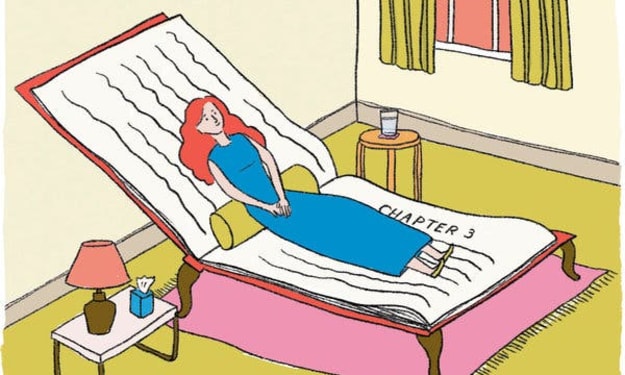
Books have always been a safe haven for me. Ever since I was young, I have found solace in and healing through reading. My healing experience with reading has led me to become a huge advocate for Bibliotherapy (the use of books as therapeutic tools). I am so excited to share this easily accessible form of therapy with you! Now is an excellent time to practice using books as therapy if you are self-isolating, and reading is something that you can share with anyone (including little ones) in your home.
By Ashley Nestler, MSW6 years ago in Longevity
5 Ways to Protect Your Mental Health During the Coronavirus Pandemic
I know that you are probably being bogged down with articles about the Coronavirus pandemic in one way or another, but I wanted to reach out and provide you with some of my personal help if you are struggling with mental illness during this time.
By Ashley Nestler, MSW6 years ago in Longevity
How Criticizing My Emotions in Childhood Created an 'Emotional Storm' Inside Me
When I was growing up, I was labeled as a “shy” and “sensitive” child. I would cry often, and I would be criticized for it, which contributed to my quiet demeanor. Whenever I would express anger, I was told I wasn’t allowed to be mad, or that being angry was wrong. I learned that sadness and anger were “bad” emotions, and whenever I experienced either emotion, I felt ashamed as though something was wrong with me for feeling them. Throughout my life, I learned to internalize my sadness and anger, which has led to chronic self-harm and digestion issues. Soon into adolescence, the inability to express sadness or anger led me to lose the ability to express any emotion properly — even feelings such as happiness. In my life, I have also experienced relationships where my feelings were invalidated and gaslighting was a factor, which only contributed to my internalization of emotions and my distrust of my emotional experience.
By Ashley Nestler, MSW6 years ago in Psyche
THE SUMMER OF JORDI PEREZ (AND THE BEST BURGER IN LOS ANGELES) BY AMY SPALDING
SYNOPSIS: Seventeen, fashion-obsessed, and gay, Abby Ives has always been content playing the sidekick in other people’s lives. While her friends and sister have plunged headfirst into the world of dating and romances, Abby’s been happy to focus on her plus-size style blog and her dreams of taking the fashion industry by storm. When she lands a great internship at her favorite boutique, she’s thrilled to take the first step toward her dream career. Then she falls for her fellow intern, Jordi Perez. Hard. And now she’s competing against the girl she’s kissing to win the coveted paid job at the end of the internship.
By Ashley Nestler, MSW6 years ago in Humans
Borderline Personality Disorder and Me
Borderline Personality Disorder (BPD) is often categorized — in short — as a mental illness where the survivor exhibits explosive anger, impulsive behaviors, and unstable relationships — with romantic partners, as well as friends and family. Due to the destructive nature of these symptoms, BPD has almost become a bad word in the mental health community. As an MSW, I have come across professionals who won’t work with individuals who have been diagnosed with BPD due to the stereotypical “abusive” nature of the disease. However, the symptoms listed above provide an overgeneralized assumption of the disorder based on only three out of nine possible symptoms — and all symptoms are frequently linked to trauma. This overgeneralization of BPD marginalizes survivors of the illness by belittling or oversimplifying their experience — particularly those who don’t fall under the assumed criteria. Furthermore, it makes finding help extremely difficult, let alone receiving an appropriate diagnosis. There are four types of Borderline Personality Disorder that all exhibit differently, and to be diagnosed with BPD, one must exhibit five out of nine possible criteria. The variation of symptoms then puts the survivor on a sliding scale of 256 possible representations of the disorder. Because of this, no one person fits 100% into any one of the four categories of BPD due to the number of possible variations. Survivors often exhibit symptoms that put them in more than one category — and sometimes all four — but the categories help survivors, loved ones, and professionals better understand Borderline Personality Disorder, possible causes, and treatment options.
By Ashley Nestler, MSW6 years ago in Psyche
5 Truths About Trauma You Need to Know
Trauma. How many times have you heard or been told what trauma is, or what counts as trauma and what doesn’t? Everyone has their own perspective of trauma based on what they know, think they know, or what they have experienced; however, trauma affects each person differently. The following are five truths about trauma that I have learned from my personal experience and from my experience in social work.
By Ashley Nestler, MSW6 years ago in Psyche
One Stitch At A Time
Art therapy was established in 1942 by Adrian Hill, who found painting and drawing soothing while healing from tuberculosis (Team, 2016). Since then, art therapy has grown as a profession and has been utilized in the treatment of anxiety, depression, PTSD, cancer, eating disorders, and numerous other conditions. Art therapy is no longer limited to only painting or drawing as various other forms of visual art are utilized in this form of therapy – such as sculpting or collage making. The beauty about art therapy is that it allows individuals to express themselves in a non-verbal format, and the process of creating art has a soothing effect.
By Ashley Nestler, MSW6 years ago in Psyche
The War Inside of My Mind
Borderline personality disorder (BPD) is a frequently overgeneralized condition. Stereotypically, individuals with BPD are seen as impulsive and moody with outbursts of anger; however, while impulsivity and intense emotions are possible symptoms of BPD, they are not applicable to all. There are 256 possible representations of BPD, and stereotyping individuals with the disorder marginalizes those who exhibit these “stereotypical” symptoms. It also further silences those who do not present in a way seen as “typical” of BPD.
By Ashley Nestler, MSW6 years ago in Psyche