Abul kalam azad
Bio
Stories (1)
Filter by community
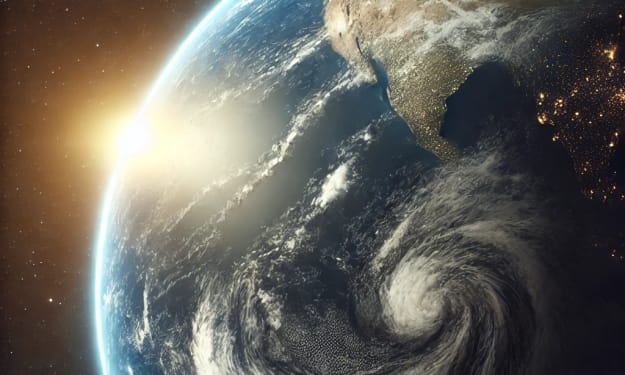
The Earth is 100% round?. AI-Generated.
The Earth is frequently portrayed as a flawless sphere—a smooth, round ball effortlessly gliding through the vastness of space. We get pictures of the Earth that show it perfectly circling from early childhood, and our minds are trained to think of it that way. However, the actual shape of our planet is far more fascinating and intricate. Scientifically, the Earth is better described as an oblate spheroid—not a perfect sphere, but slightly flattened at the poles and bulging around the equator. This subtle bulging is caused by the Earth's rotation on its axis. A centrifugal force that pushes outward most strongly at the equator is produced as the planet spins. The equatorial region expands slightly outward as a result of this force, while the poles are gently pressed inward. The Earth's shape changes as a result, becoming slightly wider from east to west and slightly shorter from north to south. Simply put, our planet is like a ball that has been slightly compressed and is rapidly moving through space. To better understand this difference, let us look at some numbers. The diameter of the Earth at the equator is approximately 12,756 kilometers. In contrast, the distance from the North Pole to the South Pole—the polar diameter—is about 12,714 kilometers. Although a distance of about 42 kilometers may appear insignificant, it is significant on a planet of this size. It affects a wide range of scientific disciplines and technologies. Gravity, for instance, is influenced by this shape variation. Gravity is slightly weaker at the equator than it is at the poles, because the equator is farther from the Earth's center due to the bulge. This means a person would weigh just a little bit less in countries like Kenya, Ecuador, or Indonesia than they would at the North or South Pole. Though we do not notice this difference in daily life, it is critical for precision in scientific calculations. Modern satellite and navigation systems also depend heavily on the true shape of the Earth. The Earth's oblate shape necessitates GPS technology, which we rely on for everything from tracking our location to finding nearby restaurants. Positions would be off by several meters or more if it was based on the assumption that the Earth was a perfect sphere. Even the paths of satellites orbiting Earth are planned using precise models of its real shape. The equatorial bulge also plays a role in shaping our planet’s climate. Regions near the equator, such as Indonesia in Asia, Brazil and Ecuador in South America, and Uganda and Kenya in Africa, all lie along this widest stretch of the Earth. These places often receive more direct sunlight year-round, contributing to warmer climates and unique ecosystems. On the other hand, traveling northward toward Canada, Russia, or Norway—or southward into the frozen expanse of Antarctica—means moving along the Earth's slightly shortened vertical axis. Temperature, daylight patterns, and the kinds of plants and animals that can survive in these polar regions are all affected by the colder temperatures and slanted sunlight. The Earth’s seemingly minor asymmetry adds an elegant complexity to the design of our world. From space, the effects of the bulge and compression can't be seen with the naked eye, but they affect the systems that support life. The Earth's unique shape has a subtle effect on everything from the force of gravity to ocean currents, airplane flight paths, and weather satellites' operation. Although referring to our planet as "round" may appear straightforward, the reality is significantly more complex. Earth is not just a spinning globe—it is a finely tuned, living system whose shape, motion, and internal forces are all connected. It is dynamic, functional, and conducive to life in part because of its slight imbalance between the equator and poles. Nature has created a design that is both beautiful and necessary with its gentle curve and quiet tilt.
By Abul kalam azad10 months ago in Earth