
When the Work Looks Back
A meditation on creation, imperfection, and the quiet moment when art begins to look back

Artists like to believe we are the ones doing the looking.
We stand before blank canvases, empty pages, untouched clay, glowing screens—deciding where meaning should begin, convincing ourselves that intention alone is enough. We call ourselves observers, architects, originators. We talk about vision as if it arrives fully formed, waiting patiently for our hands to catch up.
But anyone who has created long enough knows the truth we rarely say out loud.
The work watches back.
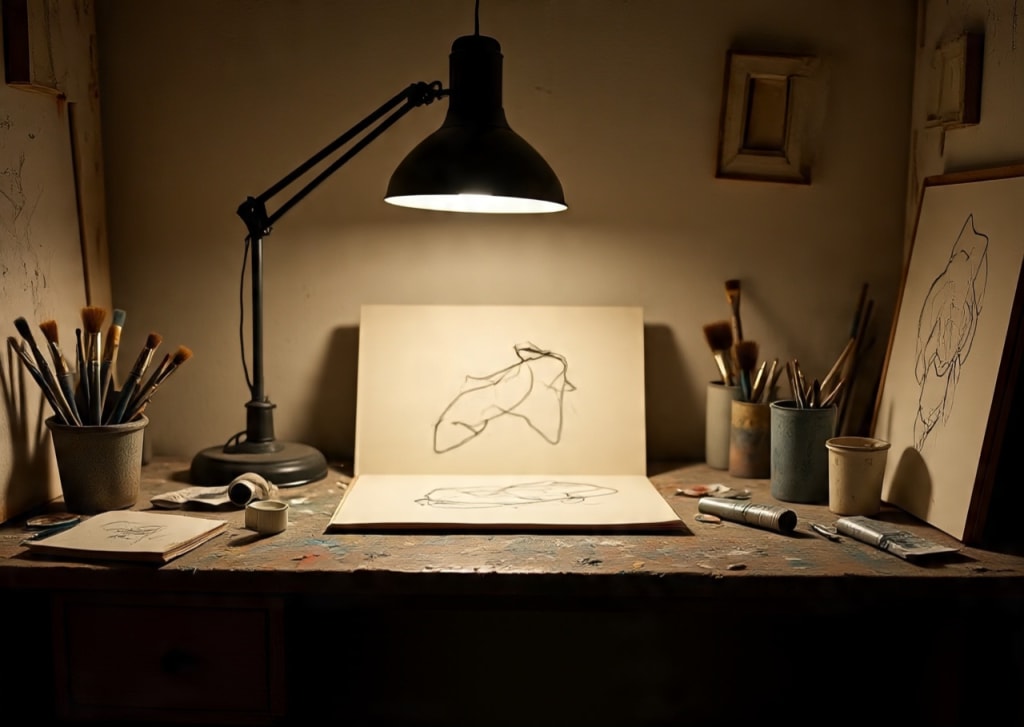
I learned this in a room with unforgiving lighting and a desk rescued from a sidewalk. The kind of space no one dares call a studio until something good has happened there. The walls were bare except for old tape marks, ghosts of ideas long removed. My supplies were a mismatched congregation—frayed brushes, half-dried paint, a sketchbook warped by coffee spills and impatience.
Nothing about the room looked serious.
And yet, I treated it like a chapel.
Each evening, I sat down with the promise that tonight would be different. Tonight I would make something honest. Something worthy. Something that justified the time I kept stealing from sleep and certainty.
Most nights, I failed.
I stared too long. I planned too carefully. I chased refinement like it was proof of legitimacy. I smoothed edges that didn’t need smoothing, corrected instincts before they had time to speak. The work stalled in that familiar, suffocating space between idea and execution—alive enough to haunt me, unfinished enough to accuse me.
The blank space didn’t feel empty.
It felt patient.
One night, after a day spent performing competence for other people, I sat down exhausted. Not inspired. Not hopeful. Just tired of pretending I knew what I was doing.
So I did something reckless.
I stopped trying to be good.
I grabbed the wrong brush without apologizing to myself. I mixed colors without testing them first. I let lines wobble and textures clump. I worked quickly, almost carelessly, as if the piece might disappear if I hesitated too long. There was no time for cleverness. No room for borrowed styles or intellectual justifications.
And somewhere in that unpolished momentum, the room changed.
Not dramatically. Not mystically.
Just enough.
It was the subtle shift you feel when silence thickens. When attention sharpens. When something that was once inert begins to feel aware.
The work watched.
Not with judgment—but with expectation.
Art does that. Once you commit, truly commit, it demands honesty the way a mirror demands your face. You can decorate it for a while—dress it in technique, hide behind references, borrow voices that feel safer than your own—but eventually it asks the question every artist learns to fear:
Is this actually you?
I realized how many pieces I had abandoned not because they were bad, but because they were too revealing. Because they told the truth faster than I was ready to hear it. Because they exposed the parts of me I preferred to keep abstract.
Art doesn’t just express us.
It excavates us.
It pulls up old grief and quiet hope and unresolved longing, all tangled together. It reveals patterns we didn’t consciously choose—recurring shapes, familiar themes, the same emotional weather appearing again and again like a signature we didn’t know we were signing.
The watching is mutual.
As we work, the piece remembers us. Our hesitation. Our impatience. Our courage when it finally arrives. It becomes an archive of who we were brave enough to be in that moment.
That night, I didn’t finish the piece.
But I didn’t abandon it either.
I left it open. Breathing. Unresolved.
For the first time, that felt like success.
In the days that followed, something shifted—not just in my work, but in me. I stopped apologizing before showing my art. Stopped explaining what it was meant to be, as if intention mattered more than presence. I allowed pieces to exist without defense, imperfect and quietly defiant.
I began to understand something essential.
Art does not ask us to be fearless.
It asks us to be present.
To sit with discomfort without immediately fixing it. To keep working while the piece stares back and reflects something we don’t fully recognize yet. To trust that uncertainty is not a flaw in the process, but the process itself.
The blank page is not empty. The canvas is not silent. The studio is not neutral.
They are waiting.
They have always been waiting.
So if you sit down tonight and feel watched—good.
It means you’ve stopped hiding. It means you’re close. It means the work has begun.
Create anyway.
Let your hands move before your doubts. Let the piece see you.
Because the moment it does, you finally see yourself too.
About the Creator
LUNA EDITH
Writer, storyteller, and lifelong learner. I share thoughts on life, creativity, and everything in between. Here to connect, inspire, and grow — one story at a time.
Keep reading
More stories from LUNA EDITH and writers in Art and other communities.
Art of Seeing Without Judging
When I was younger, I thought understanding people meant labeling them. I thought that to truly see someone, you had to decide who they were — the hero, the failure, the loud one, the quiet one. But with time, I learned that judgment is not the same as understanding. In fact, it often gets in the way.
By LUNA EDITH5 months ago in Art
Golden Journey
Once in a small town named Willow Creek, something extraordinary was about to happen. The sun was setting, casting long shadows and a golden glow across the landscape. Among the townspeople was a curious boy named Ethan. A dreamer with bright green eyes and messy brown hair, Ethan was often lost in his thoughts. He wanted to explore worlds beyond his own, driven by the tales of adventure his grandmother used to tell him.
By Hamad Afridi about 19 hours ago in Art
me, me, me
when i read back my poetry it screams “me, me, me” on my screen in bold letters and i can’t shut it up — most days, i cannot make any other words out; i want to throttle a thousand versions of the me gone by, i want to throw myself from a figurative balcony, i want to sink a sword into every pen i’ve held
By angela hepworth4 days ago in Poets


Comments
There are no comments for this story
Be the first to respond and start the conversation.