
The Woman Who Became a Mirror
How Marina Abramović’s Silent Surrender Revealed the Darkness and Light Within Us All
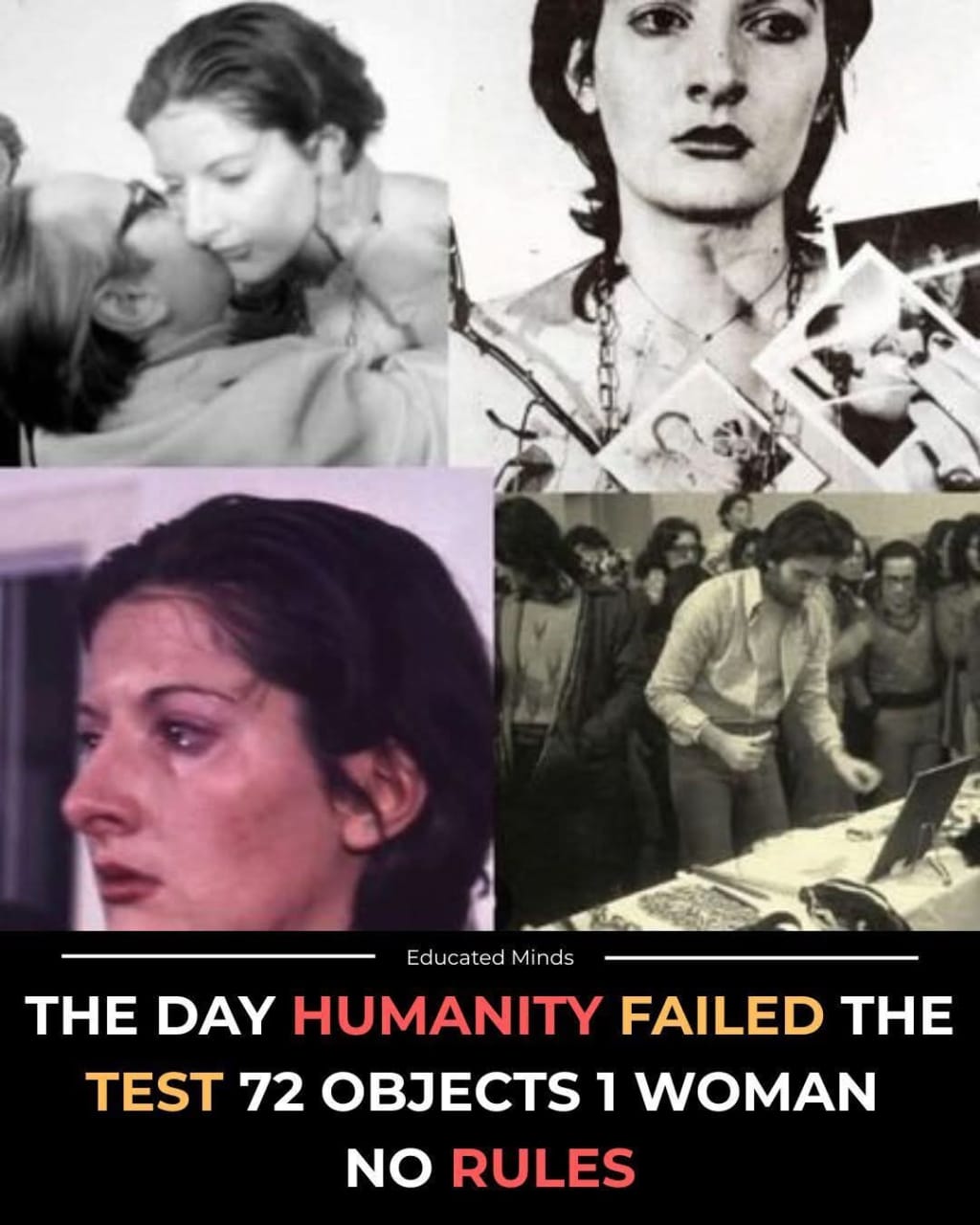
In the history of performance art, few moments have struck the human conscience as sharply as what unfolded in a modest gallery in Naples in 1974. It was an experiment that involved no words, no movement, and no stage—only a woman, a table of seventy-two objects, and the unpredictable landscape of the human soul. To this day, Marina Abramović’s Rhythm 0 remains one of the most disturbing, enlightening, and unforgettable explorations of human behavior ever witnessed.
Marina Abramović, a young performance artist at the time, walked into the Studio Morra gallery with a simple—but terrifying—idea: she would stand motionless for six hours, offering herself as an object to the public. On a table beside her lay seventy-two items ranging from the harmless to the horrific: a rose, a feather, a piece of bread, a comb, perfume, honey, a whip, scissors, a scalpel, a chain, nails, a knife—and a loaded gun.
The instructions were brutal in their simplicity: “Use any of these objects on me as you wish. I will not move. I will not resist.”
And so she became what she later described as “a mirror for the audience—whatever they wanted to project.”
The Opening Hours: Kindness in its Purest Form
The first hour passed slowly, almost tenderly. Visitors approached her with caution, unsure how far they were permitted to go. Some whispered apologies as they placed a flower in her hand. One woman brushed Marina’s hair with soft, motherly care. Someone kissed her cheek, almost shyly.
These gestures seemed to affirm something hopeful: perhaps when given the choice, humans would choose compassion. Perhaps empathy did not need rules, eyes watching, or fear of judgment. For a moment, humanity looked beautiful.
But beauty in the human heart is often thin and delicate—easily shaken when boundaries blur.
Curiosity Turns to Permission
As the hours ticked on, something subtle began to shift. The crowd grew larger. More confident. More daring. The silent, unblinking woman standing before them no longer seemed entirely human. She did not flinch. She did not speak. She did not claim pain or protest.
Slowly, curiosity became a kind of freedom—and freedom without accountability often becomes danger.
Someone cut her dress with the scissors.
Another cut her skin with the scalpel, watching her bleed.
One person dipped the rose’s thorns into her skin, carving slow patterns of red.
A man poured honey on her head, not gently but mockingly. Someone else picked up the metal chain and wrapped it around her arms. Laughter began to seep into the room—a laughter that did not sound joyful, but rather hungry.
What was emerging was not simply cruelty, but a psychological phenomenon later deeply studied: deindividuation—the state in which people lose their normal restraints when they feel unidentifiable, unjudgeable, invisible.
And Abramović had given them exactly that: total permission, total anonymity of guilt.
When the Line Finally Broke
The darkness reached its peak when a man picked up the loaded gun.
He placed it in her hand. Then he lifted her arm, pointing the gun at her own chest. The room shifted instantly. A few audience members intervened, pushing the man away. But the damage had been done—not to her body, but to the collective conscience.
In the silence of that gallery, humanity had shown how quickly kindness evaporates and how easily cruelty steps forward when consequences step back.
Six Hours of Human Truth
For six hours Marina Abramović remained still. She absorbed every gesture—the gentle, the curious, the humiliating, the violent. She gave herself as a canvas onto which strangers could paint their deepest impulses.
But when the six hours ended, Marina finally moved.
She lifted her head.
She turned her eyes to the crowd.
She walked toward them—not with anger, not with fear, but simply as a human being reclaiming her humanity.
And then something extraordinary happened.
The crowd froze.
People stumbled backward.
They could not meet her gaze.
The same hands that had slapped her, cut her, mocked her, or threatened her now shook with regret.
In those few moments, guilt flooded the room like cold water. When faced with a silent, motionless figure, people had forgotten she was human. But when she moved—when life returned to her eyes—they remembered.
And they could not bear what they had revealed about themselves.
Art or Warning?
Debate erupted immediately around Rhythm 0: Was it art, or was it a psychological trap? Was it bravery or a dangerous experiment? Marina herself called it a “life-changing experience,” one that forever transformed her understanding of people.
Psychologists, however, saw something else: a chilling demonstration of how environmental factors—not inherent evil—can unleash cruelty.
When responsibility is removed, empathy fades.
When accountability disappears, aggression awakens.
When a crowd forms, individuality weakens.
But the experiment also revealed something more balanced, more complex: not everyone succumbed to darkness. Some protected her, defended her, or stayed gentle even as the crowd shifted. Their quiet resistance became proof that goodness does not vanish entirely—it simply becomes harder.
A Mirror for All of Us
Rhythm 0 remains one of the most referenced examples in psychology textbooks on crowd behavior, mob mentality, and deindividuation. But beyond the academic world, it stands as a mirror held up to humanity.
It asks questions that still make us uncomfortable:
What would you do if there were no consequences?
How much of your kindness depends on being watched?
Would you stand with compassion—or fall with the crowd?
Perhaps none of us can say for sure. But the purpose of Abramović’s performance was not to accuse—it was to reveal. To make us aware of the thin line between restraint and impulse, and the responsibility each person carries simply by being human.
If You Had Been in That Room…
Each reader must answer this question privately.
Would you have placed a flower in her hand?
Would you have wiped honey from her face?
Would you have protected her?
Or would you have followed the crowd, letting the illusion of anonymity loosen your empathy?
None of us know with certainty.
But perhaps the very act of asking ourselves makes us a little more aware, a little more responsible, a little more human.
About the Creator
Keep reading
More stories from Ikram Ullah and writers in Art and other communities.
The Weight of the Heart: Interpreting the Profound Emotions in Cri Sood’s Artwork
Introduction: Cri Sood’s visual art often communicates deep emotional narratives, drawing viewers into reflections on the human psyche. In this specific work, we are met with a deeply stirring scene: a solitary figure—likely a young girl—poised perilously on a cliff’s edge, bound by a rope to an enormous, heart-shaped stone. Rendered in subdued hues of gray and blue, the artwork radiates solitude and sorrow, encouraging introspection on the burdens we silently endure and the emotional ties that restrain us. This article delves into the layers of meaning within this powerful image, examining its metaphorical significance, stylistic execution, and potential emotional impact for readers on platforms such as Vocal Media.
By Ikram Ullah10 months ago in Art
Kitchen Help by Amy Lyn Bihrle
Introduction I follow The Reiki Cat Lady on Facebook as they share some wonderful feline artwork and this lovely funny one caught my eye to inspire a story. They remind me of my friends Cherri and Amanda's and my daughter Juliet's cats that know where all the treats are hidden, in the kitchen.
By Mike Singleton 💜 Mikeydred about an hour ago in Art

Comments
There are no comments for this story
Be the first to respond and start the conversation.