
The Rise of AI and Its Impact on Creativity
When Robots Dream: How AI is Redefining Creativity
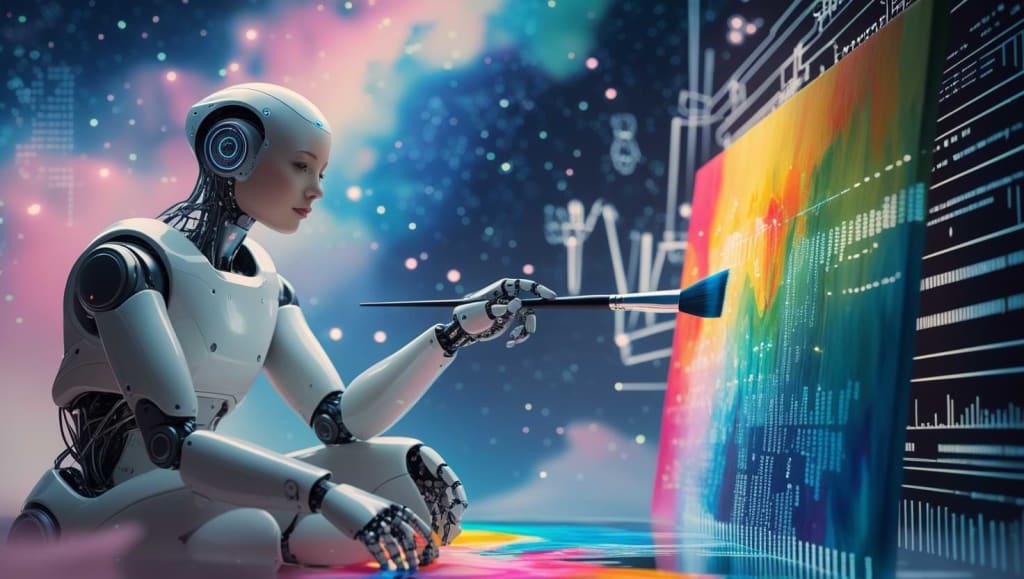
What does it mean to be creative in a world where machines can paint, write, and compose music? Not long ago, artificial intelligence (AI) was a sci-fi dream, but today, it’s a reality reshaping how we create. In just a few years, tools like ChatGPT, MidJourney, and DALL-E have evolved from quirky experiments to powerful platforms, churning out poetry, photorealistic art, and more in mere seconds. As AI blurs the line between human and machine-made works, a big question looms: Is AI a spark for inspiration, or is it poised to replace human creativity altogether?
The AI Revolution in Art and Writing
Picture this: a painting wins a prestigious art competition, only for people to discover it was crafted by AI. That’s exactly what happened in 2022 when Jason Allen’s Théâtre D’opéra Spatial, created using MidJourney, took first place in the digital art category at the Colorado State Fair. The artwork stunned judges and sparked heated debates—was it truly “art” if a human didn’t draw it? Meanwhile, in writing, AI is making waves too. Take Zack Thoutt’s short story The Last Human, co-authored with GPT-3, which blends human storytelling with machine-generated prose. These aren’t just gimmicks; they’re proof that AI is stepping into creative spaces once reserved for humans.
For creators, AI is a game-changer. Writers stuck on a plot twist can turn to ChatGPT for ideas, while artists can whip up a book cover with MidJourney in minutes. These tools don’t just save time—they open doors to new possibilities, letting creators experiment and innovate like never before. But as exciting as this revolution is, it comes with some tricky questions.
The Ethical Dilemma
AI’s rise isn’t all smooth sailing—it’s stirring up ethical storms. For starters, who owns an AI-generated masterpiece? The programmer who built the tool? The person who typed the prompt? Or the AI itself? It’s a legal gray area. The U.S. Copyright Office, for instance, has refused to grant copyright to fully AI-made works, leaving creators and lawyers scratching their heads.
Then there’s the job question. If AI can churn out articles, logos, or songs, what happens to the writers, designers, and musicians? Sure, some tasks might get automated, but AI is also birthing new gigs—like AI prompt engineers or creative directors who shape machine outputs. Still, the worry lingers: could AI turn art into a mass-produced product, stripping away its value?
And what about the human touch? Can a machine ever grasp the messy, beautiful depth of human emotion—say, the ache of loss or the thrill of discovery? AI might mimic these feelings based on data, but it hasn’t lived them. Human creators bring personal experience and cultural context to their work—qualities AI can’t replicate. So, we’re left wondering: Can AI’s polished imitations ever match the raw soul of human art?
Counterarguments: Originality and Homogenization
Not everyone’s sold on AI’s creative potential. Critics argue it lacks originality, claiming it just remixes what’s already out there instead of inventing something new. Others fret that if everyone uses the same AI tools, art and writing might start to feel cookie-cutter, losing their diversity. These are fair points, but they miss a key truth: AI isn’t the creator—it’s the tool. Humans decide what to make with it. Just as two chefs using the same ingredients cook different dishes, two artists using MidJourney can craft wildly unique works. It’s our vision and choices that keep creativity fresh.
AI as a Collaborative Tool
Rather than a rival, many creators see AI as a partner. Writers use it to bust through creative blocks—ChatGPT might suggest a plot twist or polish a clunky sentence. Artists treat it like a digital muse, generating ideas to riff on. Beyond art and writing, architects lean on AI to whip up design options fast, freeing them to focus on beauty and purpose.
In music, artists like Holly Herndon are teaming up with AI to invent whole new sounds, merging human passion with machine precision. The magic happens in the balance: AI cranks out the raw material, but humans shape it with emotion, meaning, and context. As one designer put it, “AI’s the pencil—I’m still the one drawing the picture.”
The Future of Creativity
So, where’s this all heading? In a decade, we might see live AI-human collaborations—like a painter and an AI co-creating a mural in real time during a performance. New jobs could pop up, too: think creative curators who blend human and machine art, or specialists who fine-tune AI outputs. AI might even level the playing field, letting anyone with a vision create, no formal skills required. The future’s wide open—if we’re bold enough to explore it.
Conclusion
AI is shaking up creativity, no doubt about it. But it’s not here to steal the show—it’s here to hand us a bigger stage. By teaming up with AI, we can push our imagination further than ever. What makes us human—our emotions, our stories, our unique perspectives—still drives the process. AI might supply the words or brushstrokes, but we’re the ones breathing life into them.
What’s your take? Is AI a creative ally or a threat? Better yet, why not test it out yourself? Try a tool like ChatGPT or MidJourney this week—write a poem, design a scene, whatever sparks your curiosity. Then drop by the comments and tell us what you made. Let’s see where this AI adventure takes us!
About the Creator
Keds
Passionate about sustainable living and eco-friendly choices. Sharing tips and insights to help you live greener and make a positive impact on our planet. 🌍🌿 #SustainableLiving #EcoFriendly #GreenTips
MUSIC
Why Music Is Way More Important Than Most People Think Honestly, music is one of those things we all use every single day, but we don’t really stop to think about how deep it actually goes. Like yeah, we play songs in the car, in the shower, while studying, or just when we’re bored. But music is doing way more than just filling up silence. It’s shaping how we feel, how we remember things, and even how we see the world, which is kinda crazy when you think about it.
By Beshoy Zayer4 days ago in Art


Comments
There are no comments for this story
Be the first to respond and start the conversation.