
The Colors of Yesterday
Inside the Last Standing Art Store of Willow Lane
Chapter 1: A Stroke of Legacy
Eloise had inherited the store from her father, Thomas Harding, a quiet man who believed every soul was born with colors inside them, waiting to spill onto paper, canvas, or clay. He opened the shop in 1965 with nothing but a small loan and a larger dream: to make art supplies affordable for all, and to create a haven for local artists to gather, inspire, and create.
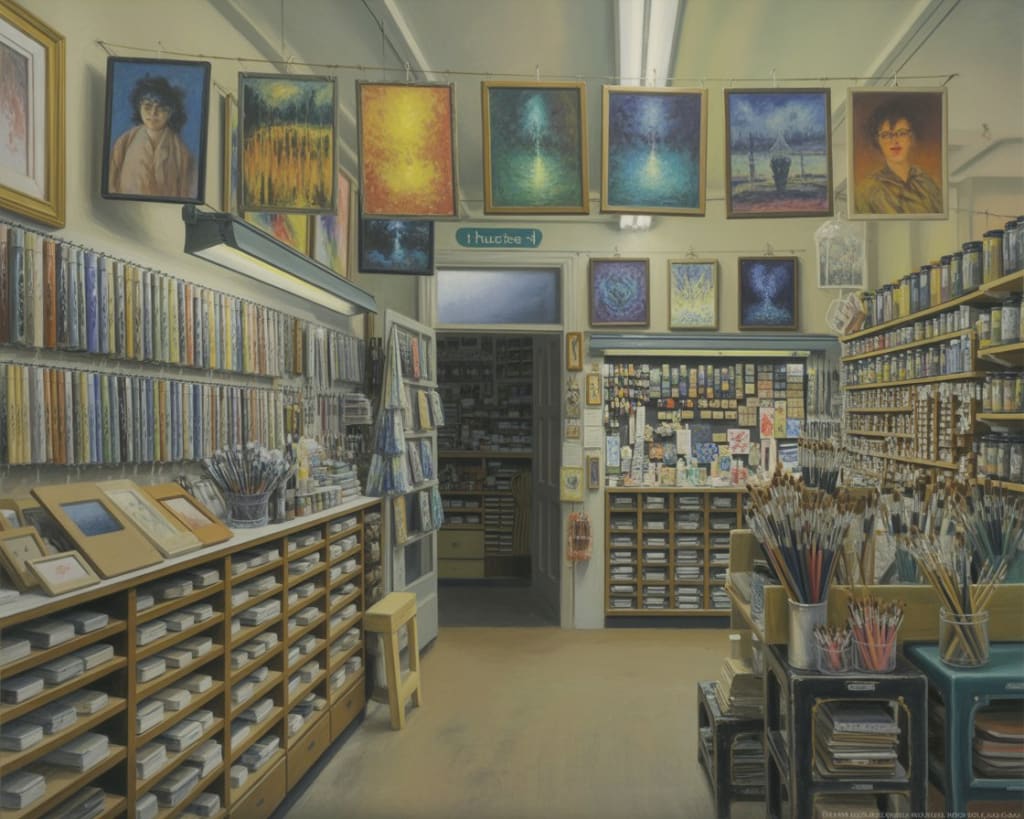
The walls were lined with hand-labeled wooden drawers filled with charcoal sticks, pastels, ink bottles, and brushes of every size. The ceiling had dozens of paintings hung with wire: works of unknown artists who once painted in the shop’s upstairs studio, long before the city’s skyline swallowed the old art quarter.
Eloise, once a dreamy-eyed girl with smudges of cobalt blue on her cheeks, had watched the shop become the heartbeat of the neighborhood. People didn’t just come to buy—they came to find something: a spark, a beginning, or even a friend.
But times had changed.
Chapter 2: Fading Colors
Willow Lane had grown quiet. The bookstore had closed last year. The jazz café next door was now a cryptocurrency co-working hub with LED lights and glass partitions. Eloise’s art store was an island in a sea of sterile modernity.
Foot traffic had thinned. Young artists now bought supplies online. Workshops that once filled the second floor with laughter and the rustle of sketchbooks were now silent. She’d refused to digitize or run online ads. “This place breathes through people, not pixels,” she often said.
Her nephew Liam didn’t agree.
Chapter 3: The Brush of Conflict
Liam, 28, graphic designer by trade and digital-native by birth, had offered countless times to help.
"Aunt Ellie, a website could triple your customers."
"I don’t want clicks. I want footsteps on my floor."
"You’re running out of time."
The words stung, not because they weren’t true—but because they were.
She knew. Every night, Eloise locked the register drawer, not knowing if tomorrow’s sales would even cover the electricity. But letting go? It felt like scraping a palette clean of a masterpiece that was never finished.
Chapter 4: The Portrait Boy
It was on one of those quiet mornings, in late October, that he arrived.
A boy, no older than ten, with oversized glasses and a denim jacket too big for his frame, walked in with a folded piece of notebook paper in his hand. He didn’t speak. Just walked to the counter and placed the paper gently in front of Eloise.
It was a portrait—a pencil sketch of his mother, remarkably lifelike and filled with emotion. The eyes, in particular, looked like they held a hundred stories.
"You drew this?" Eloise asked.
He nodded.
"She passed away last winter," he said finally. "Drawing helps."
His name was Arman. A quiet boy who sketched in the margins of his schoolbooks. He came from the apartment building across the street and lived with his grandmother.
"Do you have colored pencils?" he asked. “Real ones? Not the school kind.”
She gave him a set—free of charge. Every Friday after school, Arman returned. He brought drawings. Landscapes. People. Dreams. He asked questions about blending, shadowing, and how to draw hands that didn’t look like mittens.
Eloise found herself alive again—teaching, laughing, remembering.
Chapter 5: The Canvas Awakens
Word of Arman’s talent spread through whispers. One afternoon, Liam stopped by and saw a watercolor of Arman’s taped behind the counter—a soft sunset over Willow Lane, full of warmth and life.
"Who painted this?" Liam asked.
"A boy with too much soul and not enough paper."
That night, Liam stayed late. He took photos of the store, the shelves, the brushes, and even Eloise sitting on her stool by the window, painting a violet sky. He launched a free website, just a single page, titled The Palette’s Heart – More Than a Store. A Story.
He uploaded Arman’s work. Then added a simple message: Support our last local art shop. Buy a set, sponsor a child, or just stop in and feel something.
Chapter 6: The Gallery Night
By Christmas, the shop had changed.
Footsteps returned—curious teenagers, nostalgic painters, and tourists drawn by social media. An arts nonprofit contacted Eloise to start after-school workshops. Liam organized a monthly “Young Artist Exhibit.” Arman’s portraits drew crowds, and people started calling him “the mini Van Gogh.”
On the first Friday of the new year, they hosted their first official gallery night. Soft jazz played from a record player. Paintings from kids and elders alike hung proudly. Arman’s newest piece—"The Woman at the Window," a portrait of Eloise—brought tears to more than one visitor.
That night, Eloise stood on a small wooden box and raised a glass of cranberry cider.
“This store was never about brushes or paint,” she said. “It’s about giving the world back its color. Thank you for helping me remember that.”
Chapter 7: Full Circle
Months passed. The store remained small, imperfect, and beautifully human. Eloise kept her father’s hand-written signs. Liam managed the digital side. Arman, now the face of their youth art program, taught two kids every weekend.
And upstairs, the old studio buzzed with laughter once more. Light bounced off the windows, carrying the promise of something bigger than profit—a shared breath between past and future.
One afternoon, Arman found Eloise sketching by the window.
“Miss Eloise,” he said, “When I grow up, I want a store like this.”
She smiled.
“No, dear boy. When you grow up… this store will already be yours.”
About the Creator
Keep reading
More stories from zulqarnain and writers in Art and other communities.
"Where Poppies Grow"
Chapter 1: The Call to Arms In the summer of 1914, Edward Martin stood on the wooden platform of his small village station in Somerset, England. The sun was bright, the air thick with the scent of blooming roses from the garden behind his family home. His mother held his hand tightly, trying to keep her composure as he prepared to board the train.
By zulqarnain7 months ago in Fiction
How Tattoo Parlours in Cape Town Help Clients Feel Comfortable and Informed
Walking into a tattoo parlour in cape town for the first time can feel strange. You are trusting someone with your skin, your story, and a design you might wear for life. It is normal to feel excited and scared at the same time.
By Tools of Trade Studios6 days ago in Art
Arnold Clark Photography… The Pinnacle in High School Senior Portraits
Arnold Clark Photography sits on 24th Street in Omaha Nebraska, its front windows glowing softly long after most shops have gone dark. From the outside, it looks timeless with clean lines and framed portraits that hint at decades of stories. Inside, it is anything but stuck in the past.
By ArnoldClark Photographyabout 16 hours ago in Art



Comments
There are no comments for this story
Be the first to respond and start the conversation.