
The city of living Art
Where Imagination Breathes and Stone Comes Alive
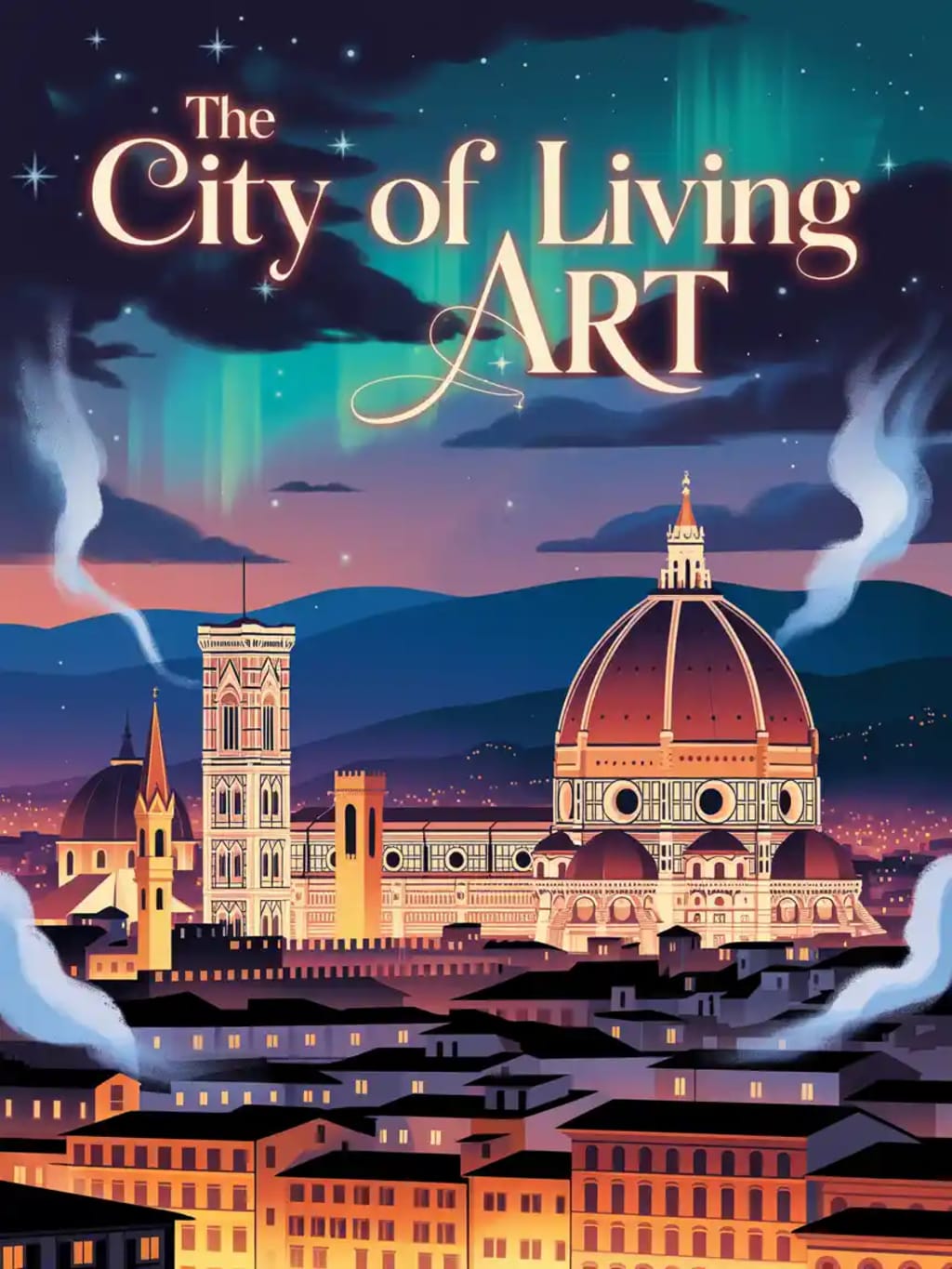
Hidden beyond the misty hills of Verona, there lies a place few dare to believe exists — Aurelion, the City of Living Art. It was said that every sculpture there could move, every painting could whisper, and every melody drifting through the air had a soul of its own. Travelers who found their way into Aurelion never forgot it; some stayed forever, enchanted by the life that pulsed through its marble veins.
Liana was one such traveler. An artist from Milan, she had grown tired of galleries where beauty hung still and lifeless on walls. She longed for something alive, something that would look back at her as she painted it. When she heard whispers of Aurelion from a wandering musician, she packed her brushes, left her studio, and followed the fading notes of his violin deep into the fog.
The road was long and winding. As she crossed a bridge of white stone, the mist parted to reveal towers that shimmered with colors too vivid to be real. The streets were paved with tiles that rippled like liquid glass. Statues lined the boulevards — but when Liana blinked, they moved. A dancer spun, a knight bowed, and a bronze horse snorted softly as if alive.
“Welcome to Aurelion,” said a soft voice beside her.
It belonged to a man carved entirely of marble. His face was smooth, his eyes glowed faintly blue. He extended a hand. “I am Callen, curator of the Living Gallery. You must be new.”
Liana hesitated but shook his hand — it was warm. “How is this possible?” she whispered.
“In Aurelion,” Callen smiled, “art and soul are one. The Founders discovered the Breath of Asha, a wind that gives life to creation. Every artist who enters here is offered a choice: to give life to their art — or lose their own in the process.”
The city was breathtaking. In the Grand Plaza, enormous frescoes changed with the light. Paintings spoke in soft tones, telling the stories of their making. Sculptures debated philosophy. Music floated from invisible instruments. The air itself seemed to hum with creativity.
Liana spent days exploring, sketching feverishly. Yet something strange began to happen. The figures in her sketches began to move — stretching, yawning, and smiling faintly when she wasn’t looking. One evening, her newest painting — a girl with fiery red hair — blinked at her from the canvas.
“You gave me life,” the girl said softly, her voice trembling like watercolor. “What is my name?”
Liana stepped back, trembling. “You… you can speak?”
“Everything here can,” the girl smiled. “You dreamed me into being. You must name me.”
“Aria,” Liana said after a long pause. “Your name is Aria.”
From that night, Aria became her constant companion. They walked the streets together, met living portraits and talking statues, and even danced under the starlit fountains that sang with every drop. Yet Liana began to notice shadows at the edge of the city — paintings with torn corners that whispered of forgotten names, statues cracked and fading into dust.
She asked Callen about them.
He sighed. “Every creation here depends on its maker’s heart. When the artist’s passion fades, their art dies. That is the price of the Breath of Asha.”
Liana grew silent. She realized then that the city’s beauty came at a terrible cost — the artists themselves were vanishing. Some had poured too much of their souls into their creations, leaving only their art behind. Callen, she noticed, never left the gallery for long. His marble skin had begun to chip.
“Were you once human?” she asked him.
He smiled sadly. “Yes. I was Aurelion’s first sculptor. I gave myself to my art to keep it alive. Now I am both artist and creation.”
Liana felt a chill. She looked at Aria, laughing in the sunlight, and knew she could not let that fate be hers. Yet she couldn’t bear to lose Aria either.
That night, the sky turned crimson. The Breath of Asha swept through the city in a roaring wind. Paintings screamed as their frames splintered, and sculptures cracked like breaking hearts. The living art was dying. Callen appeared at Liana’s side.
“The Breath is fading!” he shouted. “The city will crumble unless a new artist gives life again!”
Liana’s hands shook. “If I do, I’ll become like you!”
“Yes,” Callen said. “But Aurelion will live. Aria will live.”
She looked at Aria — her creation, her friend, her reflection. Aria’s eyes were filled with tears. “Don’t do it,” she said softly. “You gave me life once. That’s enough.”
But Liana couldn’t watch the city die. She took her brushes and stood before the fountain at the heart of Aurelion. As the storm raged, she painted — not on canvas, but on the air itself. Colors burst around her, spiraling into light. Her breath mingled with the wind, and one by one, the broken artworks began to heal. The city glowed, alive again.
When the dawn came, Aurelion stood renewed. The statues danced, the murals sang. But Liana was gone.
In her place stood a statue — not cold or still, but gently breathing. Her marble eyes glowed with color, and her lips curved in a faint smile.
Aria visited her every day, whispering stories of the living city that still thrived. And whenever the wind passed through the streets, it carried a voice that said softly:
“Art lives only when it is loved.”
About the Creator
How to Find reliable sculpture supplier?
When sourcing fiberglass sculptures, buyers often discover that the term “supplier” can refer to different types of businesses. Understanding these categories helps clarify expectations regarding production capacity, quality control, and project management.
By Shenzhen Ruiheng Craftsabout 23 hours ago in Art
I was in a Toxic Relationship, with my Workplace
“You got that?” My ex yelled. His hands were balled into fists at his side. At six foot three, he towered over me. A normal person would have been afraid, but I looked up a video of George Lopez repeatedly saying, “I got this,” and showed it to him. I had grown used to this treatment, so much so that I didn’t blink when he ripped the phone from my hand and threw it across the room.
By Jade M.a day ago in Confessions




Comments
There are no comments for this story
Be the first to respond and start the conversation.