
The Blind Artist Who Paints With Sound"
"How Losing His Sight Unleashed a World of Color Through Vibration"
Introduction: A Symphony of Senses
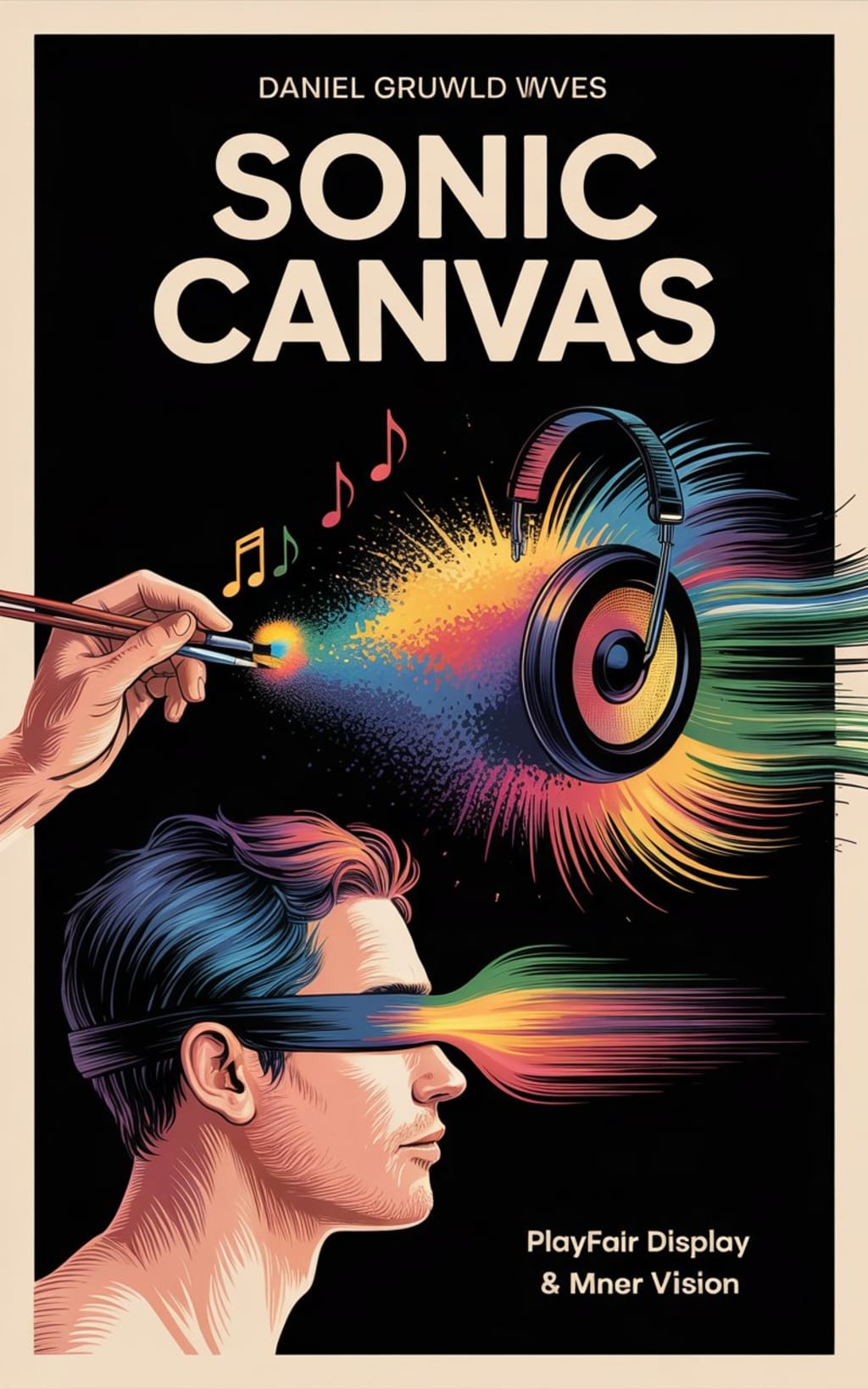
In a dimly lit studio in Barcelona, a canvas comes alive. Swirls of sapphire bleed into bursts of crimson, while geometric patterns pulse like a heartbeat. The artist, Daniel Huang, steps back, tilts his head, and smiles. He hasn’t seen his work in over a decade—not with his eyes, at least. Daniel, blind since his early 20s, creates art by translating sound into color. His story isn’t just about resilience; it’s a radical reimagining of how we define creativity itself.
Chapter 1: The Illustrator Who Lost His Light
Long before synesthesia became his muse, Daniel was a visual artist. Born to Taiwanese immigrants in San Francisco, he spent his childhood sketching streetcars and fog-drenched hills. At 22, he was studying fine arts in Paris when a rainy-night taxi crash left him with irreversible optic nerve damage.
"I woke up in a silent, endless dark," he recalls. "I couldn’t draw. Couldn’t navigate my apartment. I felt like a ghost."
For months, Daniel isolated himself, until his younger sister, a jazz vocalist, intervened. She dragged him to her rehearsals, insisting music would "give him back a language."
Chapter 2: The Synesthetic Spark
During a rehearsal of Debussy’s Clair de Lune, Daniel’s darkness erupted into light.
"The piano keys weren’t just notes—they were textures. The high C-sharp felt like sunlight on my skin; the bassline was a velvet rope I could grip," he explains. Neurologists later diagnosed him with acquired synesthesia, a rare condition where the brain cross-wires senses after trauma.
But Daniel didn’t just sense colors—he needed to channel them. Armed with Braille-labeled acrylics and a $50 thrift-store speaker, he began experimenting.
Chapter 3: Crafting a Sonic Palette
Daniel’s early attempts were chaotic. He’d press paintbrushes against vibrating speakers, letting Mozart guide his strokes. But without sight, he’d accidentally mix colors into mud.
"I ruined 30 canvases before realizing I needed a system," he laughs.
His breakthrough came by categorizing sounds:
Pitch = Hue (e.g., flute = icy blue; tuba = maroon)
Volume = Saturation (whispers = pastels; screams = neon)
Rhythm = Texture (staccato = jagged lines; legato = smooth gradients)
Collaborating with a sound engineer, he developed a "sonic easel": gloves with vibrating nodes that pulse in sync with music, guiding his hand placement.
Chapter 4: The Critics’ Dilemma
When Daniel debuted his work at a small Seattle gallery in 2018, the art world balked.
"Is this a gimmick?" wrote one reviewer. "Can we judge art made by someone who can’t see it?"
But audiences were captivated. His piece "Bach’s Fugue in Fire"—a storm of oranges and blacks mirroring the composer’s complex harmonies—sold for $12,000.
"His work isn’t about blindness," argues curator Amara Singh. "It’s a dialogue between sound and space that anyone can feel."
Chapter 5: The Science of Seeing Sound
Daniel’s process fascinates neuroscientists. Dr. Elena Ruiz (MIT) explains:
"His visual cortex, deprived of input, repurposed itself to ‘see’ sound. When he listens to music, his brain activates the same regions as a sighted person viewing art."
This phenomenon, neuroplasticity, suggests our senses are more fluid than fixed. Daniel’s art literally maps this flexibility: MRI scans show his brain "lights up" identically whether he’s painting or listening to a concerto.
Chapter 6: Beyond the Canvas
Today, Daniel’s mission transcends galleries. He hosts "Sound & Sight" workshops for disabled youth, teaching them to harness their unique perceptions.
"A deaf girl once ‘painted’ the vibrations of her mother’s voice through a balloon," he shares. "That piece hung in MoMA’s outreach exhibit last year."
He’s also collaborating with AI developers to create an app that converts users’ voice messages into abstract art—a project he calls "Postcards for the Soul."
Chapter 7: The Irony of Vision
Daniel’s most controversial work? A pitch-black canvas titled "Look Closer."
"Viewers think it’s empty until they touch it," he grins. Embedded sensors trigger audio descriptions of the textures: ridges for violins, smooth patches for silence.
"It forces people to question: Do you need eyes to see, or just curiosity?"
Conclusion: The Unseen Artist’s Legacy
Daniel Huang’s story defies clichés. He’s not an "inspiration porn" headline—he’s a pioneer reshaping art’s boundaries. In his studio, where Chopin blooms into cerulean waves and hip-hop beats explode in graffiti-like splatters, he proves creativity isn’t confined by biology.
"Limitations are just directions to try harder," he says, wiping paint from his hands. "My darkness isn’t empty—it’s full of music."
About the Creator
Keep reading
More stories from Syed Huzaifa and writers in Art and other communities.
The Last Influencer
*The Last Influencer in a World of Perfect Clones* --- ### **Prologue: The Glow** In 2037, beauty became obsolete. The nano-filter **Glow**—a subcutaneous implant that edited your appearance in real-time—made sure of it. With a thought, users could smooth skin, sculpt bodies, or even mimic celebrity features. Glow wasn’t just popular; it was *mandatory*. Brands fired "unfiltered" employees. Schools expelled kids whose parents couldn’t afford upgrades. Perfection wasn’t a choice—it was survival.
By Syed Huzaifa10 months ago in Styled


Comments (1)
I love painting with sound! Awesome