

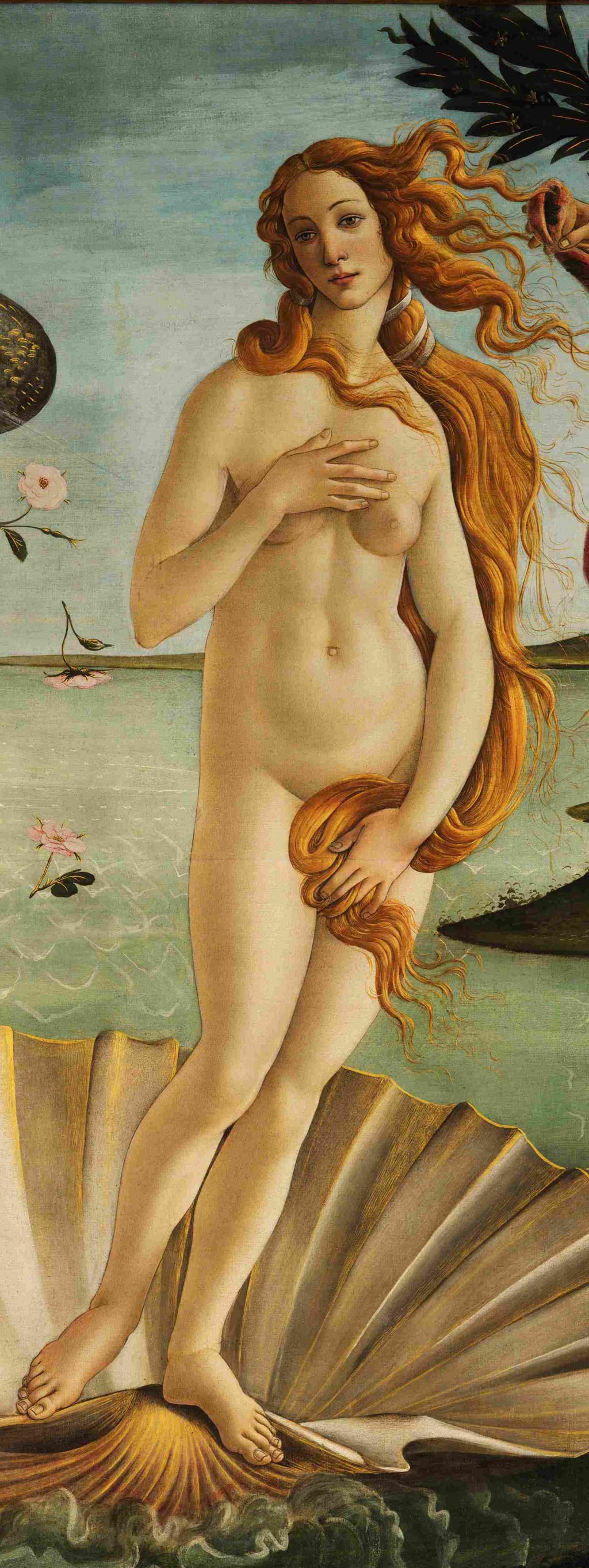
Sandro Botticelli's The Birth of Venus is a masterpiece that captivates not only visually but also with its profound philosophical and symbolic meanings. The painting depicts the birth of Venus, the goddess of love and beauty, emerging from the sea on a shell, her naked body radiating grace and beauty that transcends mere physicality. As a poet, I see Venus not just as an object of beauty, but as a symbol of idealism and perfection that goes beyond the physical world. In the center of this harmonious composition, Venus stands serenely atop a giant shell, seemingly suggesting that true beauty arises not from desire or lust but from deep inner peace. Her flawless beauty, though mesmerizing, speaks more of the birth of pure love—something far deeper than mere outward appearance.
Within every element of this painting, I sense a strong symbolism that invites contemplation on the balance between humanity and nature. Zephyrus, the gentle west wind, blows softly toward Venus, reminding us of nature’s role in ushering new life, while Flora, the goddess of flowers, scatters petals that symbolize birth and fertility. The sea behind Venus is not only the birthplace of the goddess but also symbolizes uncertainty and change in life, which can either lead us toward enlightenment or erase our footprints from existence. The sea, with all its depth, becomes a metaphor for life's journey—full of mystery, yet rich with possibility.
However, despite The Birth of Venus being stunning and inspiring, there are certain aspects that can be seen as weaknesses when viewed through the lens of modern thinking. For example, the idealization of Venus's flawless body may suggest that beauty is confined to an ideal physical form, a view that does not fully reflect the diversity of human beauty. In a world increasingly aware of the importance of inclusivity, the portrayal of Venus as perfect and highly proportional may reinforce a narrow standard of beauty, even though it was likely intended to represent divine perfection in Botticelli's time. Moreover, while Venus is surrounded by an idyllic natural world, one might argue that the symbolism in her surroundings, particularly the elements of nature, seems too perfect and lacks the complexity or tension that could further enrich the overall message of the painting.
Nonetheless, The Birth of Venus still encourages us to perceive beauty not just on the surface but in deeper dimensions, such as inner peace and balance of the soul. Venus, portrayed not merely as a goddess of beauty but as the embodiment of the birth of love and a more exalted life, offers a lesson on how we should view the world. Much like poetry, every detail in this painting holds meaning waiting to be uncovered, and in every brushstroke, Botticelli seems to convey the message that true beauty lies not in outward appearances but in a deeper understanding and appreciation of life itself. The Birth of Venus is more than just a painting; it is a visual poem that speaks directly to our hearts and minds about what it means to be human...about love, beauty, and harmony in the universe.
About the Creator
Gelwaz Prakesit
Writing for me is a way to share stories that can touch the heart. Since I was little, I have always had a great curiosity about the world, and books have been my main door to explore various places and experiences.
Keep reading
More stories from Gelwaz Prakesit and writers in Art and other communities.
About Painting - 'Dante And Beatrice'
Dante & Beatrice by Dante Gabriel Rossetti is not merely a portrayal of two historical figures from Dante Alighieri’s life; it is a visual exploration of idealized love, spiritual transcendence, and the eternal bond between poet and muse. The painting encapsulates a moment of connection between Dante, the great literary figure, and Beatrice, the woman who, in both Dante’s real life and his Divine Comedy, represents an embodiment of divine love and enlightenment.
By Gelwaz Prakesit10 months ago in Art
A Matter of Coincidence
Tuesday, 3 September 2024 Ayesha Fareed Ahmed, Mirpur Khas Sheeda was a simple and innocent man. One day, he was going to his wife’s village to bring her back. On the way, he saw some donkeys grazing on grass at a certain place. Eventually, he reached his in-laws’ house. His wife’s brother asked him to sit in the guest room.
By Sudais Zakwan7 days ago in Art




Comments
There are no comments for this story
Be the first to respond and start the conversation.