
Sufism
A Gentle Introduction to the Transformative Teachings of Sufism
I. The Night I First Heard the Whirl
I still remember the night I stumbled upon Sufism.
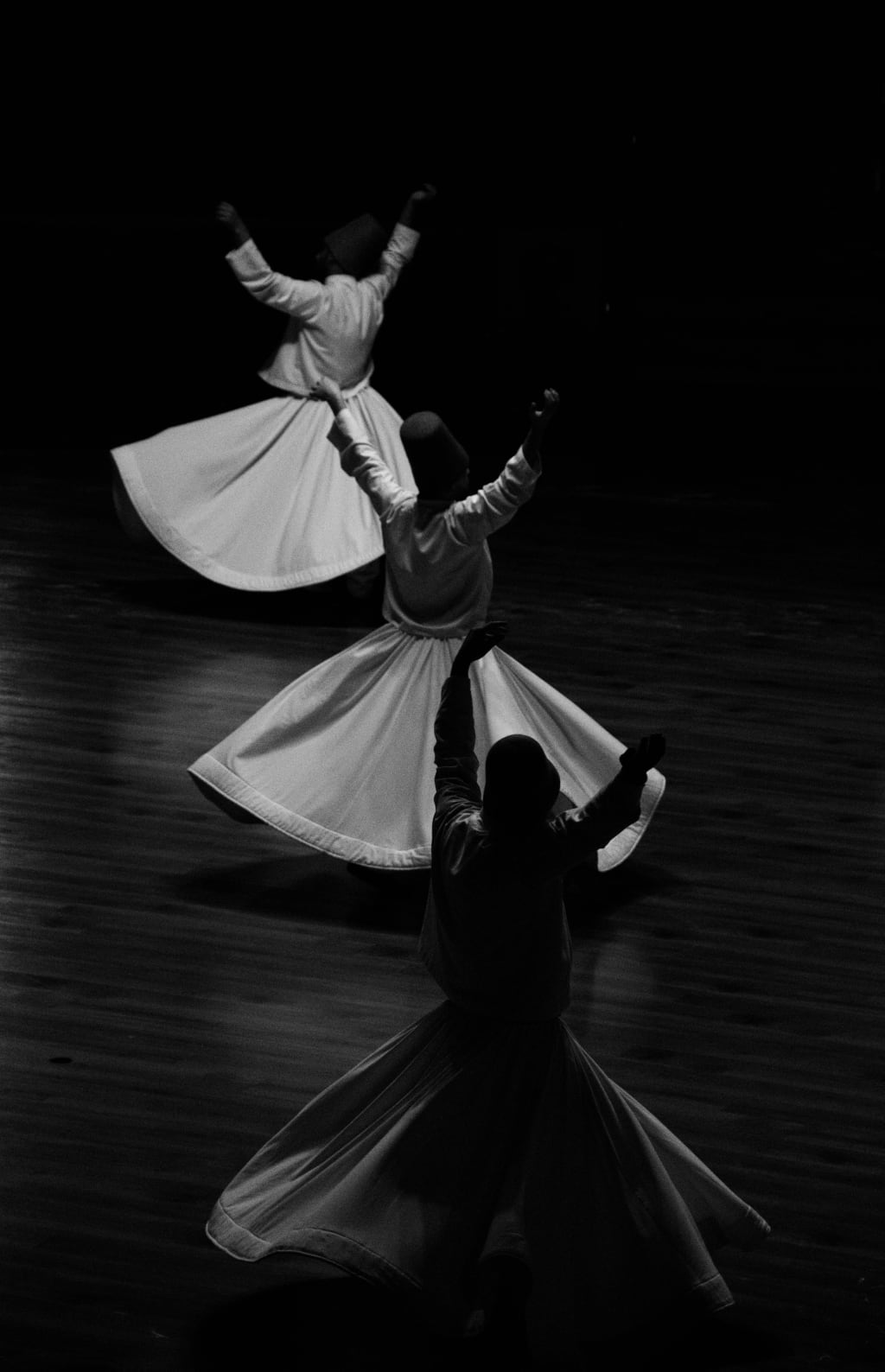
It wasn’t in a dusty book or a formal religious lecture. It was through sound—rhythmic drumming, chanting, and a voice that seemed to cry and sing at once. I was walking through the old streets of Lahore during a Thursday evening, near a shrine I hadn’t intended to visit. The energy in the air was thick. The scent of rose water mingled with incense smoke. And there they were: whirling dervishes in white robes spinning slowly, gracefully, as if pulled by a force unseen.
I stood there frozen, not because I understood what was happening—but because something inside me did.
That was the beginning of my journey into the world of Sufism.
---
II. What Is Sufism, Really?
Let’s start with the basics. Sufism is often described as the mystical path of Islam. If Islam were a tree, Sufism would be the fragrance of its flowers—the unseen, often unnoticed essence that reaches the soul before the eyes.
While many religious traditions emphasize ritual, Sufism leans into inner experience—not to reject outer practices, but to deepen them. It’s not just about how you pray, but why your heart longs to pray. It asks not just whether you fasted, but whether your soul was humbled in the process.
Sufis seek something beyond intellectual belief or external obedience: they want direct, personal union with the Divine. This pursuit is often described as a journey inward—a movement from the noise of the ego to the silence where God whispers.
---
III. The Ego Must Die Before You Truly Live
One of the central concepts in Sufism is fana, which literally means "annihilation."
But it’s not as dark as it sounds. Fana doesn’t mean physical death—it means the death of the ego, the false self, the layers of pride, fear, and selfishness that separate us from others, and ultimately, from God.
Imagine trying to look into a mirror covered in dust. You can’t see your reflection clearly until you wipe it clean. Fana is that process of wiping the mirror of the heart—so we may see the truth within, and the face of the Beloved.
This “death before death” is actually the doorway to real life. A life rooted not in temporary pleasure, but in eternal meaning. As the 13th-century Sufi poet Rumi wrote:
> “Die before you die, so you shall live forever.”
---
IV. The Role of the Guide
But this is no solo journey. In Sufism, a seeker often travels under the care of a sheikh or murshid—a spiritual teacher who has walked the path and knows its valleys and cliffs.
Why? Because the spiritual ego is subtle. It hides in good intentions, masquerades as piety, and whispers pride even as we kneel. A guide helps us detect those shadows and walk steadily toward the light.
This relationship is built on humility, trust, and deep love. It’s not about worshiping the teacher, but recognizing that we need someone to hold the lantern while we find our way.
---
V. Dhikr: The Music of Remembrance
One of the most beautiful practices in Sufism is dhikr, meaning “remembrance” of God.
In a world constantly pulling our attention outward—likes, notifications, to-do lists—dhikr pulls us back inward. It can be silent or vocal, whispered or sung. Repeating the names of God is not about quantity, but quality. It’s about remembering who you are, and whose you are.
Sometimes dhikr takes the form of sama—gatherings with music, poetry, and dance. The whirling dervishes of the Mevlevi order in Turkey are the most famous example. As they spin in their long white robes, one hand pointed to the sky and the other to the earth, they become living metaphors of a soul in harmony: receiving divine light and spreading it to the world.
---
VI. Sufi Poets: The Lovers Who Couldn't Stay Silent
Sufism and poetry go hand in hand. Because how else do you explain the inexpressible?
When love for the Divine overwhelms the heart, words tumble out in fire and tears. Sufi poets like Rumi, Hafez, and Ibn Arabi didn’t just write verses—they wrote love letters to God.
Rumi says:
> “The minute I heard my first love story,
I started looking for you,
not knowing how blind that was.
Lovers don’t finally meet somewhere.
They’re in each other all along.”
These words aren't just about romance. They’re about the soul’s longing for its true home—for a reunion with the Source.
---
VII. Misunderstood and Misrepresented
Despite its deep roots in Islam, Sufism has not always been welcomed.
Throughout history, some within orthodox circles have viewed Sufi practices—especially dance, music, and poetry—as innovations or even heresies. And yet, many of the greatest Islamic scholars, including Al-Ghazali, deeply respected and practiced Sufism as a way to revive the spirit of Islam.
Sufism isn't a separate religion or sect. It's a dimension—a way of seeing, of being, of loving deeply.
---
VIII. Why Sufism Still Matters Today
We live in noisy times. The speed of life is dizzying. Anxiety is rampant. Our souls are hungry—but we often feed them with distractions instead of depth.
Sufism offers a timeless medicine: presence. It teaches us to slow down, breathe, remember. It invites us to look not just outward for answers, but inward—for meaning.
It reminds us that love is not weakness. That silence is not empty. That the heart, when polished, can become a mirror of the Divine.
---
IX. Final Whirl
I don’t claim to be a Sufi. I’m still stumbling, still learning. But I’ve seen enough to know that Sufism isn’t about perfection. It’s about sincerity.
It’s about turning toward the Beloved—even if you’re covered in dust, even if your steps are uneven.
Because in the end, Sufism is not a path for the flawless.
It’s a path for the seeker—the lover who can’t help but keep walking.
Even if they must whirl to do it.
About the Creator
Keep reading
More stories from Shah Fayaz and writers in Art and other communities.
How I earn $100 in a day
There was a time when earning $100 in a single day felt like a fantasy to me. Not a goal — a fantasy. I remember staring at my phone late at night, doing small mental calculations: If I earn $5 today and $10 tomorrow, maybe by the end of the month… Even those numbers weren’t guaranteed. Some days, nothing came in at all. And that silence — the absence of notifications, emails, or messages — was louder than failure. People online love to talk about success like it’s loud and shiny. For me, it was quiet. Heavy. Full of doubt. The day I earned $100 didn’t begin with excitement. It began like every other day: tired eyes, a slow morning, and a question I kept asking myself — Is this even worth it? What kept me going wasn’t motivation. It was necessity. I didn’t suddenly become smarter or more talented. I didn’t discover a secret website or a hidden trick. I simply stopped waiting for the “perfect” moment and started using what I already had. I offered small digital work. Simple things. Work that wouldn’t impress anyone on social media — but work that people genuinely needed. And I did it sincerely. That day, the first payment came in early. It wasn’t big. Just enough to remind me that someone trusted me with their money. That feeling mattered more than the amount. Later, while I was offline, something unexpected happened. A digital product I had created earlier — something I almost didn’t upload because I thought it wasn’t good enough — sold. Then it sold again. I stared at the screen for a few seconds, unsure whether to smile or stay calm. By evening, another small task came my way. Then one more. None of these moments felt dramatic. No fireworks. No victory music. Just quiet confirmations that effort, even imperfect effort, still counts. When I finally added everything together late at night, my heart paused. It crossed $100. I didn’t jump. I didn’t celebrate. I just sat there — still — because for the first time, the number felt real. What hit me hardest wasn’t the money. It was the realization that I had been underestimating myself for a long time. I believed earning like this was reserved for “others” — more confident people, more skilled people, luckier people. That belief was wrong. Earning $100 in a day didn’t change my life instantly. But it changed something inside me. It replaced doubt with proof. And proof is powerful. Now I understand something important: money doesn’t always come from doing big things. Sometimes it comes from doing small things consistently and with sincerity. Some days I still don’t reach $100. Some days are quiet again. But the fear is gone. Because once you know something is possible, it stops being a dream and starts being a process. I no longer wait for motivation. I work, even when I feel unsure. I trust that effort never disappears — it just takes time to show itself. If you’re reading this while feeling stuck, tired, or invisible, I want you to know something honestly: You’re not behind. You’re just early in your story. And one ordinary day — without warning — things can start to add up.
By Shah Fayaz about 8 hours ago in Motivation
Ida Shaghoian and the Quiet Architecture of Feeling
In a contemporary art world often driven by immediacy and spectacle, Ida Shaghoian offers a markedly different experience. Her paintings unfold slowly, rewarding attention rather than demanding it. They are not depictions of places one can locate on a map, but emotional environments shaped by memory, sensation, and atmosphere. Through abstraction and restraint, her work creates spaces where viewers are invited to pause, reflect, and reconnect with their own inner landscapes.
By Ida Shaghoian5 days ago in Art
A Modern African Tarot
The thirteenth card in A Modern African Tarot invites a radical shift—not in motion, but in perception. Where XI JUSTICE confronts truth and accountability, XII HANGED MAN asks us to release control, embrace stillness, and see the world from a new angle. This card reimagines the traditional Hanged Man archetype through African patience, spiritual surrender, and the wisdom of waiting.
By Vongani Bandi6 days ago in Art


Comments
There are no comments for this story
Be the first to respond and start the conversation.