
Modigliani's lost opportunity
A friendship with Dr. Paul Alexandre cut short by the war

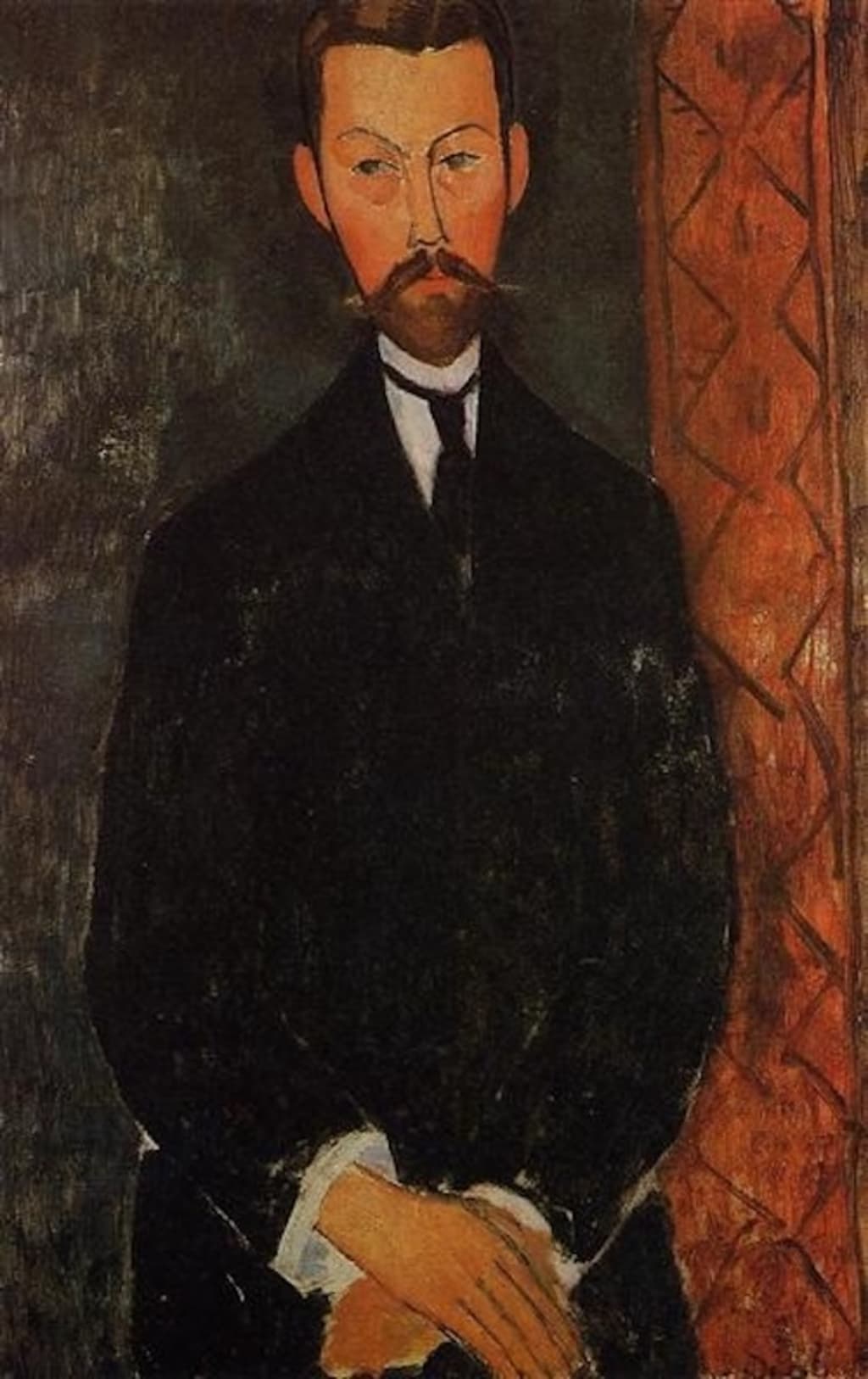
Growing up in the coastal town of Livorno, Italy, Amedeo Modigliani had suffered from Tuberculosis, Typhoid, and Scarlet fever, all of which almost killed him while still a youth. Each time he was ill, his mother Eugenie Garsin, nurtured him back to health, at the same time nurturing his talent for painting. She took the teenage Modigliani to Italy’s greatest museums so he could study and copy classic works from well-known Renaissance, Florentine and Neapolitan painters, continuing to "home-school" him in literature and philosophy. During these trips and thereafter, symptoms of tuberculosis continued to plague the young man while he restlessly engaged in spiritualism and philosophical discussions, always drawing vigorously. Sadly, virtually no works exist from those very early years.
When he first arrived in Paris, the charismatic and handsome twenty-two -year-old rented a shed built of tile and wood on the corner of the Rue Lepic, adjacent to a dilapidated building at 13 Rue Ravignan called The Bateau-Lavoir. Between 1906 and the start of The Great War, the area was a haven for soon-to-be famous artists, including Picasso. They gathered in Montmartre's cafés and dance halls for meals, drinks, and intellectual banter, especially in its more rambunctious quarter on the top of a hill called La Butte, which also housed writers like Francis Carco and Douglas Goldring. The neighborhood was outside city limits and free of city taxes. Its open wastelands and small vineyards, some of which still exist, were filled with inexpensive eateries and cabarets such as the Moulin Rouge, Le Chat Noir, and Le Lapin Agile, made famous a few decades earlier by Henri de Toulouse-Lautrec.
Modigliani was a veritable street artist of his times. He sketched constantly, but like others, he also drank absinthe. With an alcohol content as high as ninety percent, this sweet, tasting emerald-green liquor known as la fée verte (the green fairy), was popular since the 1870s. Absinthe’s bitter, licorice-like taste and reported effects of euphoria without drunkenness were caused by mixing wormwood, a plant used for medicinal purposes since 3000 B.C., with alcohol. The young Italian bourgeois painter soon became a rebellious bohemian who could be seen staggering drunkenly from place to place with Montmartre native and fellow artist, Maurice Utrillo. He bartered sketches for a glass of wine or a meal. He gave drawings to friends and acquaintances who did not keep them, traded paintings for rent, and had a tendency, unless restrained, to remove his clothes when drunk.
It is unclear whether Modigliani’s increasing consumption of booze, drugs, and women was the result of his curious nature, a need to investigate sources for artistic inspiration, or to ward off his inner demons. Perhaps it was the stress of poverty, or disappointment with his life that led him into a downward spiral; perhaps he felt alone, a stranger disenfranchised, or depressed. One day, the painter Henri Doucet brought Modigliani to 7, Rue du Delta, a house rented by Dr. Paul Alexandre, a 26-year-old well-to-do dermatologist who was also an art enthusiast. The house soon became a meeting place for amateur theatrical performances, painting, and conversation. During the next six years, the good doctor did much to support Modigliani’s work, amassing more than 400 drawings, 25 fabulous paintings and several stone sculptures.
What might Modigliani's life have been like had his friendship with Dr. Alexandre matured, had Alexandre's younger brother Jean, also a big fan of the young artist, not died of tuberculosis, or if Alexandre had been able to stay in touch with the artist despite the chaos and turmoil of the First World War. Paul Alexander served in the French army during the entire conflict, and the last time he saw Modigliani was in 1914. Modigliani died presumably from tuberculous meningitis in 1920, at the young age of thirty-five. Dr. Alexandre passed away in 1968, still in possession of hundreds of drawings, only a few of which have been placed on auction.
About the Creator
Henri Colt
Henri Colt is a physician-writer and mountainer who adores beauty in all its forms. He is the author of many short stories and a recently published biography of the Jewish-Italian painter, Amedeo Modigliani, Becoming Modigliani.
Keep reading
More stories from writers in Art and other communities.
2026 Commercial Space Design:How Fbierglass Sculpture Drives Traffic
Today, offline commercial spaces are facing continuous pressure. With e-commerce offering convenient and fast services, physical stores must showcase unique features to attract customers. In this context, fiberglass sculptures are no longer merely decorative items; they have become visual focal points in shopping malls, brand stores, pop-up shops, and mixed-use commercial projects, playing a crucial role in increasing foot traffic.
By Shenzhen Ruiheng Crafts7 days ago in Art
Why Strategic Branding Is Essential for Long-Term Business Growth
In today’s fast-paced digital environment, businesses face constant pressure to stand out. Consumers are exposed to endless choices every day, making attention harder to earn and trust harder to keep. While quality products and services are important, they are no longer the only factors that determine success. Strategic branding plays a key role in helping businesses grow steadily and remain relevant over time.
By Ayush Bagwari7 days ago in Art
📢 Raise Your Voice Thread: 01/22/2026
Our “Raise Your Voice Threads” are hosted most alternating Thursdays at 12PM ET to offer creators more avenues to uncover exceptional stories on Vocal. As we are continuously searching for fresh creators and inspiring stories, this thread provides an opportunity to exchange and discuss the stories that have moved and motivated us on Vocal.
By Raise Your Voice by Vocalabout 13 hours ago in Resources




Comments (1)
So informative. Colt paints a brief vibrant summary of one artist’s life. Thanks for writing!