
Marion Patrick: Dog's Head
Looking up at art four


Marion Patrick is an artist you probably never heard of. Unless you have visited the Bethlem Museum of the Mind in Beckenham, a London suburb bordering Kent to the south east of England, you are unlikely to have seen her work. Patrick was a one-time resident at the Bethlem Royal Hospital, set in expansive leafy grounds just outside of the town.
The Bethlem Royal Hospital was founded in 1247 as the Priory of the New Order of our Lady of Bethlehem in the City of London. The nickname of the hospital gave us the word 'Bedlam' meaning uproar and confusion. Today, Bethlem is a modern psychiatric hospital.
Patrick was an artist whose paintings were mostly about subjects that reflected a state of mental and emotional distress. Dog's Head is one such work and can perhaps be best understood when considered in the context of the artist's other works.
At first look, the subject is a straightforward depiction of a dog's head, a beagle, its big sad eyes looking at the viewer, perhaps appealing for some attention. In a way, it could be seen in the same light any other cute doggie picture. But look again and you may see something haunting and disturbing about about how the subject is depicted in this painting.
Consider the limited color palette. A grey-white coat and dull grey-yellow head and ears on a plain flat grey background. This no regular, cheery pet portrait. If we compare it to a photograph of a real beagle it may be easier to see the exaggerated effect this execution has.
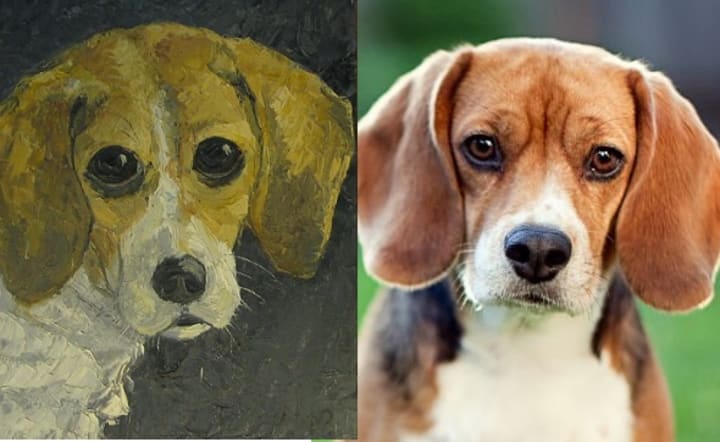
In both images, the dogs are looking directly at the viewer, as if sharing a moment with us. Both dogs appear to have big, sad eyes and endearing floppy ears, characteristic of the beagle dog breed. Any belief that a dog may have a sad expression is perhaps imaginary and anthropomorphic. There is a tendency to imbue a pet with our own emotions or those we see in others. The big appealing eyes and floppy ears suggest the dog is in need of some love, which is perhaps closer to what a pet dog may actually be feeling. A need for attention, to be noticed, to be fussed or fed. We might view this as a survival strategy that has served domesticated dog breeds well over many thousands of years.
Dog's Head is part of the collection of Marion Patrick's painting held by Bethlem Museum of the Mind. More of the artist's work can be seen by looking at the museum's archive here
In the case of Patrick's painting, however, the sadness is not imaginary, it is very real. It is not the sadness of the subject of the painting, however, so much as the reflection of the mood of the artist. Unlike the photograph, the 'mood' of the painted dog depicts the mood, and more particularly the state of mental health, of the artist. To get a better understanding of Marion Patrick's mood and state of mind, and how this affected her art, it may be helpful to look at some of her other work. Two works in particular, stand out for me.
The first is a painting of three girls, known as 'The Cross.'

Again, this is a painting executed from a sparse palette. Each of the three girls depicted are barefoot and wearing the simplest of dresses and hairstyles. Why are they barefoot? Perhaps this is a reflection of their poverty, either economic or emotional. Although grouped together there is no interaction either with each other or with the viewer. The center child may be looking in our direction, perhaps with curiosity, but there appears to be no invitation to engage. The girl to her right, in the left-hand foreground corner of the frame, is looking down, her head tilted low, hands hidden behind her back. The shape or her mouth and the position of her head could not have given a stronger impression of acute sadness. The downturned mouth is repeated in the third child, standing at a distance from the other two, further behind. This girl has one hand in her pocket, the other closed as if holding something or making a fist-like shape. The thumb is bent with the knuckle raised. The meaning of this gesture is unclear.
The center child has a slightly different expression which might be curiosity or might be recognition of the viewer. There could even be the beginning of a smile. Unlike her companions, this girl's ears are showing. Does this indicate she is listening to something or someone? Has someone just spoken to her, called her name? Perhaps someone, seeing her sad expression, is saying "Cheer up!" Perhaps the enigmatic expression is an attempt at a smile. The fingers of her left hand are touching, perhaps gripping those of her right. Is this a nervous or anxious gesture? Anyone who has ever felt low or depressed and been told to cheer up will know that this does not help.
In the distant background of the picture stands a cross which must surely indicate some religious reference, or simply a church. Why is the group so distant and looking away from the cross? Without knowing more of the background and life of this artist, beyond her having been a resident patient at Bethlem Royal Hospital in Beckenham, it is difficult to say. When I have some time I will visit the museum and ask if there is any information about the artist in their archive that I could access.
The second painting I think worth viewing alongside Dog's Head is this:
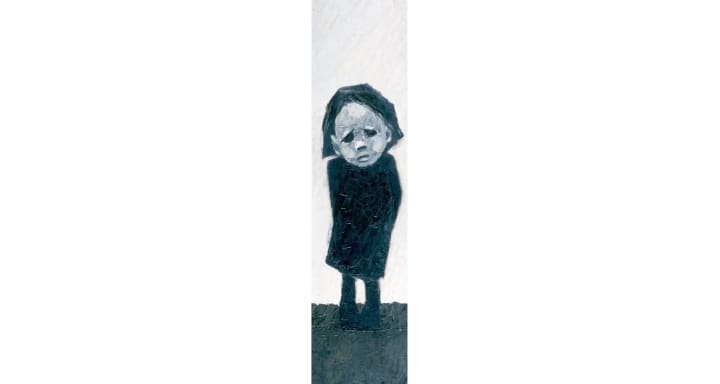
A Solitary Child is a painting I have seen several times and I have a postcard copy of this work displayed in my workspace. It is a stark image of a girl standing with her hands hidden, her head to one side, a face with hardly any detail and wearing the bleakest expression imaginable. The pose, the angle of the head, the blank, angular eyes and the downturned streak indicating a mouth, all speak of the deepest depression or fear imaginable.
The artist appears to have used a palette knife with short deliberate strokes making an almost mosaic pattern for the foreground image. Blue and black appear to be the only colors used for the subject or foreground, with a gray wash background. The effect is devastating and heart-breaking. When my young daughter saw the postcard she said the face was really scary. I can see what she meant but, to me, the face is either fearful or appealing, or just uninterpretable.
Perhaps the child in this image longs for a connection, some sympathy, some love. Perhaps she longs to speak to us, to embrace the person looking at her, but is afraid to do so. At the same time she may fear she elicits a greater fear within the person who is looking at her, we the viewer.
Given the uncompromising use of blues and blacks to render this image, I wondered whether the artist was trying to emulate Picasso's blue period painting. When I looked at online copies of some of these works, I found nothing as stark, spare or depressing in their impact as any of Marion Patrick's work.
Consider 'Old Guitarist', for instance. The blue color scheme and flat, two-dimensional rendering, as well as the position of the head and expression
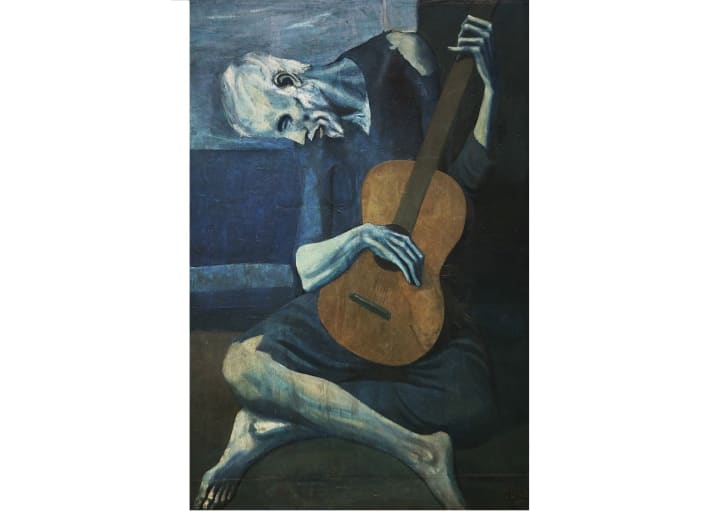
of the man's face, indicate a melancholy mood that typifies this period of the artist's life and work (1901-1904 - Wikipedia). To me, however, Patrick's work is far bleaker, flatter and much more melancholy. More importantly, Marion Patrick's paintings suggest characters that are far more tragic, not least because they are children.
With limited information about Marion's Partick's life, it is difficult to understand exactly what she way trying to say with these pictures. Was she asking for our sympathy for the children in the second two painting? Was she asking us to understand their plight, the depth of their sadness, anxieties or fears?
Returning to Dog's Head, I find it difficult to be more sympathetic to the plight of a sad-looking dog than I would be to the dreadful tragedy that I see in the children paintings. Not least because if you make a fuss of a sad-looking dog (which probably is not really sad in any case) you will soon have it bounding around, looking lively and playful. You could hardly expect the same from the four children depicted in the other paintings.
Was Patrick simply responding to what she saw as a sad expression on the beagle's face with 'Dog's Head', or did she intend to put a deeper meaning into this work? Whether she merely intended to paint a simple portrait of a dog or had a deeper motive, I can only conclude that the artist painted a considerable part of herself into this work. Looking at this head of a dog asking us to give it some fuss, some love, I can only think of the artist, Marion Patrick, pleading with the outside world for some understanding, some engagement and some love from us. I only wish we could give it.
O ~ 0 ~ o ~
Thanks for reading
If you liked this, you might also like:
Ray
O ~ 0 ~ o ~
About the Creator
Raymond G. Taylor
Author living in Kent, England. Writer of short stories and poems in a wide range of genres, forms and styles. A non-fiction writer for 40+ years. Subjects include art, history, science, business, law, and the human condition.
Keep reading
More stories from Raymond G. Taylor and writers in Art and other communities.
Art for our sake: six
A little break since edition five. Sorry 'bout that but been doing some art appreciation at Tate Modern, Tate Britain, and the Mall Gallery among others. Always so much to see in London and never enough time to see it all. At Tate Modern I met some lovely people too, from the UK, Europe and around the world, many from various US states. One family were visiting London from Washington D.C., reminding me of a wonderful but brief visit to the National Gallery Of Art some 30 years ago. There I also had a chance to take a look around the National Museum of Women in the Arts, then still in its early days. The featured image is of a portrait by the American impressionist Lilla Cabot Perry. A picture that is forever etched in my memory as I bought a poster copy which kept me company on the wall of my home business office for a number of years.
By Raymond G. Taylor2 years ago in Art
Sahara Desert of Merzouga: The Complete Travel Blog Guide
Sahara Desert of Merzouga is one of the top places, you should not miss when visiting Morocco. It's place where golden dunes stretch endlessly, camels walk across the horizon, and nights sparkle with a sky full of stars. Located near the Algerian border, Merzouga is the gateway to the spectacular Erg Chebbi dunes, the most lovely sand dunes in Morocco. Merzouga desert is highly recommended among travelers due to its lovely high, clean and golden dunes offering visitors the chance to enjoy their vacation. Morocco Tours Company
By Othmane Anaamabout 19 hours ago in Art


Comments (3)
Interesting. I wonder if the group of three girls is a reference to the Crucifixion although there is only on cross. Also the isolated child might be a self portrait. I’ve never seen her work before, very interesting.
I am a dog person and liked the Dog's Head painting. I have a mutt that is half beagle.
Wonderful! Fantastic work!