
Maria Bregman: Literary and art critic (London)
How Maria Bregman is Shaping the Future of Arts and Literature


In the hallowed halls of cultural criticism, history lionizes specific archetypes: the formalist kingmaker like Clement Greenberg, who built the temple of Modernism; the philosophical disruptor like Arthur Danto, who declared art’s history “over”; and the populist provocateur like Jerry Saltz, who brought art world debates to the digital town square. But as culture accelerates at the speed of technology, a new model of critic is emerging—one who is not merely an observer, but an architect, a connector, and a catalyst. Maria Bregman stands as a definitive example of this new paradigm.
A UK Global Talent holder, Bregman is a polymath in the truest sense. With a background that fuses chemistry, law, and journalism with award-winning literary and curatorial work, she dismantles the traditional silos that separate the critic from the creator and the innovator. Her influence isn’t derived from a single column in a legacy publication, but from a dynamic, integrated ecosystem of her own making. She is not just reviewing the cultural landscape; she is actively building its future infrastructure.
The Innovator’s Gaze: Finding a Language for a New Age
While critics of the 20th century grappled with the meaning of a canvas or a sculpture, Bregman’s work addresses a more urgent question: What does it mean to be creative in the age of artificial intelligence? In this, she echoes the philosophical depth of Arthur Danto, but instead of looking back at the end of art history, she looks forward to its next evolutionary leap. Her novels, which explore AI ethics and cultural identity, are not just fiction; they are acts of speculative criticism, using narrative to dissect the anxieties and possibilities of our time.
This forward-thinking perspective is most tangible in her role as CPO of Al Disraeli, an AI-content startup. Here, Bregman moves beyond theory and into practice, pioneering tools that empower creators. She isn't just writing about the intersection of technology and art; she is building the very intersection itself. This makes her critique uniquely informed and pragmatic. She understands the algorithm not as an abstract threat, but as a medium with its own rules, biases, and potential for beauty—a perspective few critics possess.
The Curator as Critic: Championing Talent and Building New Canons
If Hans Ulrich Obrist’s influence lies in his role as a "curator-critic" and networker, Bregman operates on a similar, yet distinct, plane. Her curatorial practice—spanning solo exhibitions for renowned figures like Zurab Tsereteli to international festivals under the auspices of UNESCO—is an extension of her critical eye. For Bregman, to curate is to make a critical argument in three-dimensional space, championing artists and ideas she deems vital.
This mission to discover and amplify new voices is most powerfully realized through her role as Editor-in-Chief of Creativitys.UK. With a readership of over 100,000, the digital magazine functions as a modern-day salon, but with a global reach and an explicit mission to elevate "underrepresented voices." In an era where figures like Katy Hessel use new media to correct the historical record by spotlighting forgotten women artists, Bregman uses her platform to challenge the established canon in real-time. By providing a stage for emerging talent, she directly influences the market and the discourse, shaping whose work gets seen, discussed, and ultimately, valued. Her jury positions for prestigious awards like the Vasily Kandinsky Art Prize further solidify this role as a key talent-spotter and gate-opener.
The Multidisciplinary Edge: A Synthesis of Rigor and Vision
What truly sets Bregman apart is the synthesis of her diverse expertise. She approaches art with the analytical rigor of a chemist, the structural understanding of a lawyer, and the narrative flair of a journalist and novelist. This allows her to deconstruct complex cultural phenomena with a clarity that eludes many of her peers. When she writes for publications like ELLE or Esquire, she brings a depth that connects a fashion trend to a technological shift or a new artwork to a global social movement.
Her founding of the International MBA in Creative Leadership is perhaps the most complete expression of her vision. It institutionalizes her belief that the future of the creative industries depends on leaders who can navigate data, technology, and social impact with equal fluency. She is not just educating critics or artists; she is training a new generation of cultural leaders equipped for the complexities of the 21st century.
In Maria Bregman, we see the evolution of the critic from a commentator on the sidelines to a central node in the cultural network. She is a writer, but also a builder. She is an analyst, but also an advocate. By seamlessly integrating her roles as a storyteller, tech innovator, curator, and educator, she offers a powerful answer to the question of what criticism can and should be today: a force for creating a more equitable, innovative, and interconnected world.
About the Creator
World Culture
Guiding you through our world's rich heritage. We explore history, art, literature, music, dance, theather, photography, mythology, and timeless traditions. A chronicle of the stories that connect humanity across the globe.
Keep reading
More stories from writers in Art and other communities.
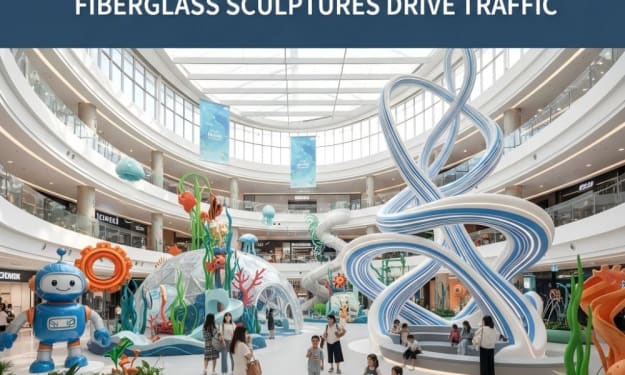
2026 Commercial Space Design:How Fbierglass Sculpture Drives Traffic
Today, offline commercial spaces are facing continuous pressure. With e-commerce offering convenient and fast services, physical stores must showcase unique features to attract customers. In this context, fiberglass sculptures are no longer merely decorative items; they have become visual focal points in shopping malls, brand stores, pop-up shops, and mixed-use commercial projects, playing a crucial role in increasing foot traffic.
By Shenzhen Ruiheng Crafts6 days ago in Art
Why Strategic Branding Is Essential for Long-Term Business Growth
In today’s fast-paced digital environment, businesses face constant pressure to stand out. Consumers are exposed to endless choices every day, making attention harder to earn and trust harder to keep. While quality products and services are important, they are no longer the only factors that determine success. Strategic branding plays a key role in helping businesses grow steadily and remain relevant over time.
By Ayush Bagwari6 days ago in Art



Comments